Kindle Edition
Amazon
Rupert Colley
Category:
Historical Fiction
Pages: 105
Copyright: Dec 7, 2013
Price: $1.25 (eBook)
Fear on the streets. Death on every corner. But the real enemy is the brother at his side.
Fear on the streets. Death on every corner. But the real enemy is the brother at his side.
For fans of Sebastian Faulks, William Boyd and Helen Dunmore, comes a short historical novella on a large canvas from the founder of History In An Hour.
"My Brother the Enemy" is a story of jealousy, sibling rivalry and betrayal against a backdrop of Soviet oppression, violence and a desperate bid for freedom.
Hungarian twins, Lukacs and Janos, and their parents have survived the war and the Nazis.
But in 1949, aged 13, they find themselves victim of Hungary’s Soviet masters and exiled into a forgotten village. Ostracised and persecuted for being Jewish, the twins fall prey to the whims of their violent father. Janos’s love for his brother is slowly eroded as Lukacs proves himself to be ruthless and manipulative. When Monika comes into their young lives, their mutual jealousies heighten and threaten to tear them apart.
1956 – Hungary is in the grip of revolution, rebelling against Soviet oppression. As the Soviet tanks roll in to crush the uprising, Lukacs and Janos find themselves in Budapest at the epicentre of events. Amid the violence and death that descends over the city, the twins’ seething bitterness and their shared love for Monika finally explodes with devastating consequences.
“A good, fast, page-turning read and I cared about the characters and wanted to know what happened to them.”
“Fraternal jealousies and rivalries are searingly drawn.”
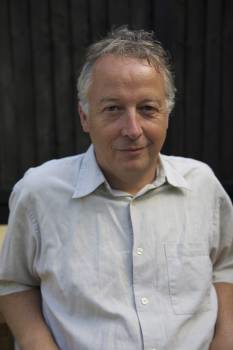
Rupert Colley is the founder, editor and writer of the highly successful "History In An Hour" series of ebooks and audio, published by HarperCollins.
"My Brother the Enemy" is his first novel.
Excerpt
On their hike to school, Lukacs talked further of denouncing their father, of ‘ridding the family of its cancer.’ Janos thought of his mother and her loyalty to her husband, and tried to work out whether her loyalty was misguided or heroic. But he said nothing.
He turned round to see Monika following them only yards behind. Each day, she seemed to be closing in on them. He wanted to invite her to walk alongside them but, as always, allowed himself to be swayed by his prediction of Lukacs’s reaction.
As soon as they arrived at school, the twins realised that something unusual was happening – the teachers seemed agitated, the atmosphere tense. But when they asked round, none of the children knew why and the teachers weren’t saying.
They had to wait until mid-morning before they found out. The first lesson had been Russian language with Miss Zador, a dreadful old widow who lectured with such a shrill voice, Janos always came away from her lessons with a headache. It was rumoured her husband had committed suicide. Having to listen to a voice like that every day, Janos didn’t blame him. The children hated learning Russian but it was obligatory for every Hungarian schoolchild.
Mr Mikes took the second lesson, pulling nervously on his tie. His hair was so carefully parted, it made Janos think of a straight road running through a forest. The children settled down quickly hoping that Mr Mikes would enlighten them as to why everything seemed out of the ordinary. They weren’t disappointed – what he said was both satisfying and intriguing at the same time. Mr Nikos, the headmaster, said Mr Mikes, needed to speak to every child in the school – individually. When their name was called, they should report directly to his office, and when finished, come back to class. They were not permitted to speak to anyone about their conversation with the Head, and the severest of punishments would be meted out to those who were caught gossiping. Almost as soon as he’d finished, Miss Orban, sometime teacher, sometime Headmaster’s secretary, knocked on the classroom door and entered without waiting for a reply. ‘Tomi Molnar,’ she said, without acknowledging the teacher.
Tomi looked at Mr Mikes, waiting for permission to leave – an unusual show of obedience, thought Janos. ‘Well go on, then, boy. Off you go.’
Tomi rose from his desk and grinned at the rest of the class, but Janos could see the uncertainty under the bluster. He saw it because he was feeling it too. What on earth could Mr Nikos want with all of them? And to see each of them, one at a time, was unprecedented.
Pulling again on his tie, Mr Mikes launched into his lesson – the expansion of the Roman Empire. He spoke in a low, rambling voice, his nerves on display, rendering it almost impossible to listen or take in what he was saying.
‘Julius Caesar first landed in Britain in fifty-five BC…’
After only a few minutes, Tomi returned; swinging open the classroom door, his shoulders swaggering with arrogance, because he’d been through it and come back unscathed – whatever ‘it’ was. His eyes gleamed with satisfaction of knowing that he was in on the secret and no one else in the class so far, possibly including Mr Mikes, knew what it was.
‘It’s Janos’s turn,’ he said, without addressing Mr Mikes.
‘OK, Janos – off you go.’
Janos went to tidy his books and papers.
‘Go on then, boy, don’t dilly-dally.’
*
The Headmaster began. ‘A situation has arisen, young Kovacs, that needs the utmost integrity and honesty. I expect you to be frank with me and not to hide away any facts that may be of assistance. I expect you, also, to put aside any feelings of personal loyalty and to remember the country is, and must always remain, your first priority. Any other loyalties are irrelevant. Do you understand?’
‘Yes, sir.’
‘It has come to my attention, Lukacs, that a serious allegation has been made against one of the teachers in the school.’
Janos squirmed, reluctant to interrupt. He coughed, lightly, ‘Comrade Headmaster – ’
‘Yes, yes, what is it?’
‘I’m Janos, not Lukacs.’
The Head glanced down at his notes and then peered at Janos, as if trying to spot the difference between the twins. ‘Yes, of course – Janos.’ He cleared his throat. ‘The teacher concerned is Miss Markus. The allegation against her is that of anti-Soviet agitation.’ The Head paused for effect and Janos accordingly absorbed the revelation, his face reddening. ‘Miss Markus is, without doubt, a popular teacher but I must reiterate that her crime is as such that any misguided loyalty must be put to one side.’ Janos noticed the subtle switch from allegation to presumed guilt. ‘Our political system and our survival as a nation state under the glorious communist system is still very much in its infancy. Like a flower, we need to nurture and protect it against the slightest digression from the rightful path. So, Janos, with this in mind, I have to ask you, what evidence can you provide me of Miss Markus’s political deviation?’
We’re safe now with our so-called liberators. His heart had skipped at her use of the phrase, uttered so casually, as if these dangerous words were but random, innocent words. Who had heard her say them? Lukacs, Monika and himself. Could someone else have overheard? Had she repeated them, or something similar, elsewhere? Was she in the habit of saying such dangerous things?
‘Well?’
Janos liked her, always had done; she had a heart, a personality, she stuck out from the other teachers for her individuality; and now she was being made to pay for it, for her lack of conformity. He didn’t care what Mr Nikos had said, she’d saved him from an anti-Semite beating and for that he’d always appreciate her. But what if Lukacs or Monika told Mr Nikos the truth? Then the Head would know of Janos’s concealment. The humiliation of taking the blame and the beating following his brother’s prank at the play still rankled.
‘For pity’s sake, boy, do you think I have all day? You know something; what is it?’
‘No, Comrade Headmaster, I don’t; I was just trying to remember.’
The Head leant forward, as if trying to see into his eyes. ‘Are you absolutely sure? I warn you, Kovacs, you cannot afford to lie.’
‘I know, Comrade Headmaster, but it’s true.’
‘So, you have never heard Miss Markus utter or pronounce anything that could be construed as anti-Soviet?’
‘No, Comrade Headmaster.’
‘OK.’ Satisfied, the Head leant back in his chair and picked-up a sheet of paper from a pile on his desk. ‘Sign this and then you may go back to class.’ He pushed the paper across the desk, and pointed at a fountain pen.
Janos read the short typewritten document:
I, the undersigned, petition that Miss Markus should be tried and punished with the strongest possible sentence for anti-Soviet agitation. No leniency should be afforded to the above named.
Long live Hungary and our brothers in the Soviet Union.
Long live Comrade Stalin and his ablest pupil, Comrade Rákosi,
Signed …………………………………………………
Janos’s hand shook as he scanned the words. Her fate was already as good as sealed. He looked up and was confronted by the Head’s face leering down at him. ‘Well, aren’t you going to sign it?’
He couldn’t possibly sign it, and equally he knew he couldn’t possibly not sign it. His hand reached out for the fountain pen.
|