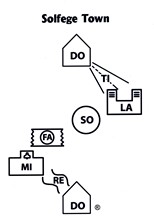
Teach your students how to write music by telling stories with notes. This remarkable book treats each Solfege note as a location in a town and greatly reduces the difficulty of teaching Solfege.
Want to review or comment on this book?
Need a FREE Reader Membership?
Reviews for "Solfege Town"
Reviewed by Hue Huynh
8/24/2015
In the Introduction to Solfege Town, Adam Cole writes: "There are many ways to teach music, but the best way is to engage the imagination."
In this innovative book, Adam Cole takes us on a tour of an imaginary place called Solfege Town where music teachers are encouraged to instruct students to create musical stories using Solfege, a system of symbols representing tones in the seven note scale. Solfege Town is a sequence of music activities that help students understand how the notes of the scale relate to one another. Adam Cole is a non-linear thinker, and his thought process is apparent this book. He goes beyond the Solfege syllables (Do-Re-Mi-Fa-So-La-Ti) and assigns a physical "place" for each note. The places assigned for the notes are: SO = bus station; MI = school; LA = hotel; DO = home; RE = path; TI = highway; FA = ticket counter. He draws a picture for each place and takes the student on a musical journey that is concrete and visual.
Each chapter introduces a note. He begins the first chapter with the dominant SO rather than the tonic DO because it is "the most useful of all the signs". As the dominant getting ready to move to the tonic, it suggests possibilities and has an edge over the dominant DO. "A song made up of only the tonic would be very flat and lifeless. On the other hand, a song composed with just the dominant suggests more to come." Music is dynamic and wants to move. By suggesting that the first note, SO, is a bus station, students learn that SO is a note that can take them to any other note easily. The dominant is special in that it can resolve its movement in any direction with equal effectiveness. By starting with a bus-station in town, the teacher plants the idea that the notes are different kinds of places to go and not simply houses on a street. Each note has a function, like people in a family or a business.
Every chapter contains songs and games that reinforce the note in discussion. Adam Cole is great at explaining activities with precision. The first appendix contains songs Adam Cole wrote for Solfege Town. The second appendix contains traditional songs featuring same concepts taught in the book. These songs are very simple and easy as well as interesting and intriguing.
The purpose of Solfege Town is to transform abstract musical notions into more visible visual tools. Students are taught music composition by traveling on a bus from place to place around town. They tell stories this way. The teacher writes down the musical notes represented by each place, which sequentially form a melody. The students "see" each note before they hear it. It would not come to a surprise if many melodies come out sounding like pentatonic scales. I have never seen music pedagogy approached in this manner -- visually representing Solfege. It is a fun way to learn about musical notes. This new approach to Solfege is unique and mind blowing. And it works!