Amazon
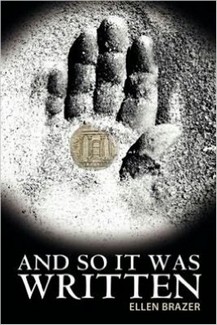
And So It Was Written
Amazon
Smashwords
Category:
Historical Fiction
Publisher: TCJ Publishing
ISBN-10: 0615671837
Type: Fiction
Pages: 323
Copyright: 2012
ISBN-13: 9780615671833
Price: $9.99 (eBook)
A fabulous saga into Biblical history. If you liked the Dove Keepers you will love And So It Was Written.
Ellen Brazer is a bestselling author of Jewish historical fiction. And So It Was Written premiered as a bestseller on Amazon under Jewish Literature.
Summary: And So It Was Written
The year is 132 CE, and the proclaimed Jewish Messiah, Bar Kokhba, has defeated the Roman army and rules Judea. As the Romans prepare to reclaim Israel, the book follows two sets of brothers–one Roman and one Jewish–whose friendships, hatreds, and lives intertwine.
For characters you will dream about, And So It Was Written is the ultimate treat. You will smell the spices in the markets and see the blood on the battlefields, rage with the injustice of brother against brother. From triumph to defeat, this is a saga of courage, conquest, familial loyalty, honor and love–showing man at his best and his worst.
Here is what people are saying:
“… A born storyteller, Ellen Brazer transported my university students to another place and time. Her talk was both mesmerizing and inspiring. Over the course of the past decade, I have invited many well-known authors to share their words but none have elicited such interesting discussion nor have made such a strong impact. Ellen has a gift for bringing the past to life, weaving an authenticity of setting with rich multi-faceted characters. We are swept into another era and become part of what was.-- Dr. Anita Meinbach, Clinical Associate Professor, University of Miami, School of Education and Human Development
“…Ellen is an award winning author of historical novels. She writes of the early centuries of this era, the transitional centuries that witnessed the emergence of rabbinic Judaism. She communicates as clearly as she writes, leaving her audiences entranced and curious enough to learn more.” -- Rabbi Mitchell Chefitz, author of The Seventh Telling and The Curse of Blessings
“ … I could almost see the characters of your book, hiding in the crevices of the rocks in the desert of Judea and Ein Gedi. The book you wrote is really a gift to the people of Israel, so there is no doubt you are some of the messiah breeze. May God bless your hands as you continue to write books and bring a smile and emotional longing, on our way to a world of peace and love.”
-- Rabbi Ariel Joshua Louis, Torah scribe, Tel Aviv, Israel
Excerpt
The Jewish Enclave of En Gedi
In the Year 128 CE
A two-day walk from the holy city of Jerusalem, on the western shore of the Dead Sea, stood the lush oasis of En Gedi. Fed by a jeweled waterfall, the grass was green as emeralds; the palm and date trees flourished and the vineyards were lush. Amid miles and miles of naked, treeless mountains of rock, where herds of ibex grazed. This was the Judean Desert–unchanged since the time of Joshua.
As the clouds shifted and the sun blazed, Livel and his brother Masabala patrolled the perimeter of the olive groves searching for any sign of approaching Roman soldiers.
At sixteen, Livel was narrow in the hips and shoulders. A newly sprouting beard sat upon an angular face, his chin a little too sharp, his brow a bit too wide. He had large, expressive coal-colored eyes and an imposing nose that curved at the end. His appearance teetered on the edge of homeliness–until he smiled, an act that transformed his face.
In contrast, fifteen-year-old Masabala was handsome, with thick ebony hair, sable eyes, long legs, and a sleek hard body. Even though he was younger by a year, he was already two inches taller than Livel.
Masabala weaved towards Livel with a sharpened stick in his hand, graceful as a panther, slashing the air like a sword. “Take that, you Roman swine!” he hissed, arm extended feigning an attack. He lunged, driving hard and stopping just short, as he gently poked Livel’s chest with the tip of his weapon. Faking a sneer, he hissed, “Had you been the enemy, you would be dead!”
Livel shook his head and laughed. “With a stick?”
“A stick today, tomorrow a mighty sword. Let’s go. There’s a cave I want to explore.” Masabala yanked Livel by the arm.
Livel dug in his heels. “We shouldn’t leave the grove.”
“You afraid?” Masabala jeered.
“Not afraid, just cautious. As you should be.” Livel knew his remarks would go unheeded. Once Masabala had set his mind to something, he was relentless, and it was fruitless to try to dissuade him. Memories flashed of the times Masabala had put them in harm’s way–climbing dangerous cliffs where one misstep would have meant death, hanging precariously from tree limbs as they built a forbidden tree house, their bodies scarred from scratches and falls.
Livel would never admit that he loved the danger, or that he silently rejoiced in his brother’s bravado. He did not have Masabala’s great physical strength, but he did have the courage and aptitude of a warrior, and he often fantasized what it would be like to act as impulsively as Masabala. But impulsivity went against Livel’s nature. He protested for the sake of protesting, telling himself that he was going along to keep Masabala out of trouble. In truth, he wanted to go. “We have to be back before dark.”
Masabala shot his brother a smile. “We will be.” He knew that Livel was more adventurous than he would ever admit, but there were great expectations surrounding his brother, and for that reason alone Masabala was willing to take the blame for all their bloodied knees and bruises.
They ran side by side towards a ridge of low cliffs. Masabala was swift as a gazelle, his stride long and elegant. Livel kept up by sheer determination.
Without warning, Masabala slid in the sand. Livel came to a stop beside him.
“No matter what our parents say, my destiny is to become a great warrior!” Masabala proclaimed, raising a clenched fist in the air. As a Kohen, his family was directly descended from Aaron, the older brother of Moses. Being a part of that lineage came with certain obligations and becoming a soldier was not one of them.
“I’m sure the entire Roman garrison will one day know your name and they will tremble in your presence.” Livel faked a bow and then playfully punched Masabala’s arm.
“And one day all of Judea will know your name as well,” Masabala said, respect tingeing his words. “Father says even now the rabbis in Jerusalem speak of you in whispers.”
As the first-born son of a respected rabbi, Livel’s fate was sealed at birth–he would follow in his father’s footsteps. What set him apart from others was his unique gift. Information stayed in his head, stored in compartments, available verbatim as needed. With perfect recall he could recite all six hundred and thirteen commandments–the ethics, laws and spiritual practices of the Jewish people. He spoke Hebrew, Aramaic, and he had learned to speak Latin and Greek from the traders who frequented En Gedi. By this time next year he would be studying under the tutelage of the great rabbis in Jerusalem.
Masabala ran backwards. “Come on, great scholar, I’ll race you!”
The boys sprinted toward the ridge that led to the cave they were going to explore. When they were halfway between En Gedi and the cave, they heard the thundering of horses’ hooves and the unmistakable clanging of armor. Horrified, the boys froze. Sound carried far in the desert, bouncing off the sheer walls, making it impossible to gauge how far away the soldiers were.
The Romans controlled Judea and were unmerciful adversaries. They would overrun villages at will and there were stories of young boys being beaten and forced to become sex slaves for the men.
|