
Kindle Edition
Download from Apple iTunes (eBook)
Download from Smashwords (eBook)
Amazon
KOBO
Category:
Home & Garden
Publisher: White Rose Content
ISBN-10: 0969954001
Type: Non-Fiction
Pages: 200
Copyright: Oct 15, 2013
ISBN-13: 9780969954064
Price: $2.99 (eBook)
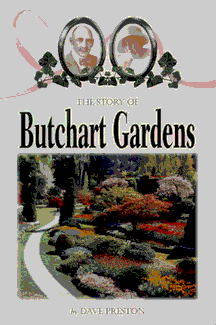
How did Jenny Butchart turn an ugly, disused limestone quarry into the world’s most famous private garden? Over 100 years later Butchart Gardens still attracts almost a million visitors from around the globe, to enjoy a world created by an unrivalled green-thumb visionary.
Filled with myth, legend, and love, it’s a cheerfully told story, as colourful and unique as the gardens themselves.
Late one mid-December afternoon in 1950, an elderly woman looked out of the window of her home in Victoria, British Columbia, and softly whispered to her nurse: "I've never seen a more beautiful sunset."… a moment later, she died.
The woman was Jennie Butchart, and during her eighty-two years on this earth she helped make a small corner of it so beautiful that almost a million people a year travel to see it. Taking over her husband’s disused limestone quarry, she oversaw the design and development of the world’s most famous private garden. The legacy she left rivals the splendor of any sunset and Butchart Gardens continues to amaze visitors from around the world... it's a remarkable legacy, left by a remarkable woman. And one which her family continues to cherish.
The stuff of legend is what makes a good story, and the stuff grows here as quickly as a well-tended flower bed. Legends cannot be proved or disproved, merely recounted and enjoyed. Mystery and speculation only serve to make them more durable. Butchart Gardens is certainly a legend.
The story of Butchart Gardens is an amazing one, but cheerfully and simply told here.
“Well researched and concise… reader friendly material of historical value.” – B.C. Historical Federation
“An amazing story about an amazing garden… a must-read for visitors and locals.” – CKNW Radio
“What a remarkable story and what a pair the Butcharts were!” – CBC Radio
Excerpt
Creating the Sunken Garden
A couple of years before Europe would erupt in "the war to end all wars," Jennie looked out over the first quarry at the end of her garden and saw a sight that filled her with despair. All the useful limestone had been removed by 1908, and the ravaged quarry was now an ugly, gaping hole, covering three and a half acres. Excavation work had moved east to another part of the property, leaving this rough quarry floor strewn with broken machinery, discarded tools and assorted, rusting debris. A towering island of rock stood silently in the centre, being of too poor a grade to be useful to the cement plant, and behind it gaped a huge crater where the limestone seam had run much deeper. A small stream trickled its way across this site, forming deep pools and muddy puddles. Scattered across it all were hundreds of jagged rocks that had escaped the crusher, or been ignored by the quarrymen.
As devastating as the scene was, this "silent, ghastly tomb" gave Jennie inspiration, and a vision: "Like a flame, the limestone pit burst into imaginary bloom. A flame for which I shall ever thank God." A friend threw down a challenge by saying: "Even you would be unable to get anything to grow in there."
In 1910, Jennie tried to screen the cement works from view by planting a few Persian plum trees, and a row of Lombardy poplar that have survived to this day. The cement boom was beginning to slow, and many of the four hundred or so workers were frequently short of work. Jennie asked Bob if a few of them could be seconded to her project, and soon many Chinese labourers, directed by William Westby, were hauling rocks and laying the foundations of flower beds and rock gardens. Small retaining walls were built and thousands of tons of rich black topsoil, brought in by horse and cart from the neighbouring farmland, was piled behind them to form small beds.
The work was arduous and dirty. Mud plagued the wagon wheels and teams of horses strained to get their loads across the uneven quarry floor. Planks were laid down across the muddy patches and Westby struggled to lay drainage pipes along the rugged terrain, leading water away to a pond at the deepest end of the quarry, to the south. It was fenced off for safety and later became the site of the Ross Fountain.
A crater left in the middle of the quarry was lined and filled with water to form a tranquil lake, reaching depths of fifty feet in places. Bob, a keen fisherman, had an idea to stock the lake with trout, and the first few were caught in buckets from nearby Durrance Lake. Later, he took to aquaculture more seriously and ordered some young fish from the local hatcheries. He particularly liked rainbow trout and eventually trained these fish to come to the sound of his hands clapping, to be rewarded with food. It is said that Jennie's quest to lay a carpet of flowers and grass around the quarry lake was spurred on by the mud brought into her home on Bob's feet after a quarry fishing trip.
Bob had fished, quite successfully, since his younger days in Ontario. In 1908, during a 17-day cruise with friends aboard the power yacht, Calcite, he earned this account from shipmate John McCormick: "For the benefit of those who do not know him, I will say that Mr. Butchart in everyday life is a very quiet, dignified gentleman, devoted to the successful management of a very large business, and is the last man one would choose as an enthusiastic fisherman. But I am here to say that when he got his first strike there was not a word of criticism to offer for the way in which he conducted himself. He played that salmon for fifteen minutes, giving it all the chance a true sportsman could be expected to give; at the same time he handled his gear like an expert, bringing the fish to gaff without a sign of the usual awkwardness of the once-a-year fisherman."
Although he now fished in his own backyard, Bob was quite protective of his stocks. He came home one day to find visitors fishing for his trout in the Sunken Garden. He was furious and chased them out, and reportedly closed that part of the estate to the public for several days.
Jennie's new horticultural venture took off, and the sharp tones of the quarry were soon being feathered by spirea, ferns, and "baby's breath." (Baby's breath was particularly apt, as its other name, gypsophila, means gypsum-loving-an ideal plant for a limestone quarry). Ivy and virginia creeper were planted into cracks in the walls, and the story goes that Jennie spent some time being dangled down the fifty-foot cliffs in a basketwork bos'n's chair, while she tucked tiny pieces of ivy into crevices. Using a technique still employed by landscapers today, a watery mixture of soil and seed was splashed onto rocky surfaces and slopes, giving a tenuous grip for flowers of many colours. Plants such as thrift and stonecrop soon took hold of their lofty perches, and Jennie planted a pair of Asian bolleana white poplars which would shoot up to reach well above the quarry's rim, where they still tremble in the breeze today..
Help from the cement works' labour force was still forthcoming, as they were seconded to help plant a garden that would fast become a legend. Climbing roses were trained along bailing wire fastened over rocks and boulders, as they still are today. Around the lake and stream that fed it, masses of Japanese irises were planted, and lilypads soon covered the water's surface.
After about two years' had work, the new garden was ready to be unveiled to the public, and people were amazed. Already the harsh lines of the quarry walls were disappearing beneath lush new growth. A fallen tree formed a rustic archway over the northern entrance and steps were cut into the steep bank at that end of the garden. Stepping stones down to the quarry floor were almost covered, and held in place, by saxifrages, starry-faced sedums, linums and portulacas. Soft green lawns surrounded flower beds and rockeries teemed with colour. A tiny flagstone bridge took visitors over the stream that fed the lake, already ringed by healthy young trees. Boulders that once littered the quarry floor now formed small islands in a verdant sea, shading low-light plants and conserving moisture on one side, while providing a warm home to sun-loving plants on the other.
The first tea room (there were several around the estate eventually) was perched high on the southeast rim of the quarry, offering a wonderful view of the new garden and Tod Inlet. In 1921 the Sunken Garden was finished, and people could hardly believe the transformation.
For the first few years, visitors simply roamed around the lawns but as the flower beds grew in size, foot traffic was increasingly forced through narrowing areas, and the grass began to wear down. As visitors increased so did the problem and, much to Jennie's chagrin, flagstone pathways were eventually laid. Years later these were replaced by permanent cement and cobblestone footpaths, which in turn had to be widened to their present size.
The two trees which flank the pathway are arbor vitae (also known as Western red cedars) and although they're not the most unusual trees on the estate, they've become a feature which makes the Sunken Garden instantly recognizable the world over. They are not pruned but grow naturally in a tight, conical shape. Bob planted the first pair here in 1920, but over the years, as they increased in height, casting too much shadow and obscuring the view from the lookout, they have been replaced several times.
|