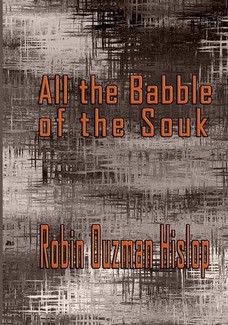
All the babble of the Souk
all the life of the planet &
so little part of it, that I breathe
Excerpt
Ian Irvine (Hobson) - The metaphor of the 'marketplace' or 'bazaar' - symbolic in this collection of public spaces generally (both physical and cultural/mediatised) - launches this remarkable collection of poems by a poet, editor and creative thinker of international significance. The 'souk' is a place of trade, chance meetings, overheard conversations and communal eating. This collection also links it to our post-post modern state of life in the face of cultural globalisation. However, rather than theorise key aspects of our world we are invited to explore them instead as states of being - with joyous and anxious dimensions. As the poet/narrator mingles, observes, samples and digests (in poem after poem) a colourful array of stimuli - sensorial, relational and intellectual - we gradually feel our perception of life and the species crisis/moment deepen and expand. The melancholy grandeur of the human predicament slowly comes into focus - largely through the poet's gift of empathy. A wonderful selection of poems updating for the new millennia themes mulled over by the likes of Baudelaire (in Paris Spleen), Apollinaire (in Zone), George Oppen (in Of Being Numerous) and many other great 19th and 20th century poets.
Professional Reviews All the Babble of the Souk Marie Marshall Editor
The eternal curse of a poetry editor is that she can seldom read for pleasure alone. For example, when I come across a phrase in Robin Ouzman Hislop’s new collection of poems – this phrase, ‘a beehive of allies’ – I find myself wondering whether he meant ‘alleys’, instead of just reading on and enjoying the ride. Because Robin’s poetry is often just that, a ride. The same poem that brought me up short in editor mode, contains lines like in little stanzas like
The hag in her rags begs her bag
holding all shadows to account.
each a new thought after a pause for breath, or so it seems, each with an image that sparkles, almost with effrontery. That’s how I like my poetry – image, sound, and bare-faced cheek.
As the images pile up, or maybe I unearth more as I drill down, discovering depth in the poetry, the typographical puzzles pile up too, and I begin to wonder if they are deliberate cantrips on the poet’s part. I hope they are. I hope they are, because I want to trust the poet’s intentions. I know he’s not your average Internet Joe, but a man with a mean, keen pen. He knows how to play, how to make free, how to brew poetry:
Riding along in our dream machine
our virtual reality all but a scream
no exit
blood on the wind screen, faithful Fido’s gone
the machine’s a mess, - every where’s a gas.
A trickle through a diaphanous sheen
a thin crust peels, roll the dice
a question of ethics, the cost of life.
Y’know, somewhere along the line, Ezra Pound and John Cooper Clarke rolled dice for this man’s soul, and I can’t say who won. Maybe he walked away laughing while the bones still tumbled, soul intact. I hope so. He has the measure of our suburbs, seeing how
gleamed cleaned cars
the phallus of a Sunday afternoon
let us (you’re here too, and I have morphed into ‘we’) catch our reflection in that polished surface, wondering how to measure the depth of the shine. Meanwhile
Danger, Deep Water, Keep Out
As if we could. There are caesuras in this collection, but they almost seem accidental, as though titles, page breaks, and stars merely interrupted a flow of thought momentarily. The collection has the feel of a single work, as though the poet sat down, started at the beginning, wrote the middle, and stopped at the end. See? The golden arches of a fast-food outlet, the taunts of a cuckoo, big Sunday words like ‘bifurcation’, ‘pheromone’, and ‘olfactory’, all rub shoulders, and rub along. We ride. It’s the same ride all the time, but the scenery outside the window shifts, and fellow passengers come and go. Occasionally we get off, but only to stretch our legs
As we celebrate
life lies dead on the table
we eat it.
and then the ride starts again. But a short offering like that reminds me that on the return journey I must insist on long enough to read each poem on its own…
and I’m by myself again, closing the book at its final page. Second impressions:
The poet is aware of the shape of his work on the page, of its concreteness. The poet knows when to be serious and when not to, and he knows when to muddy the water of each with the other. When he says ‘Watch my stick’, you hear ‘This means you!’ The poet can make a dream return from the rubble of artifice. I know poetry when I see it.
Norman Ball, writer, author of Between River and Rock: How I Resolved Television in Six Easy Payments
Before I get to the book itself, I’d like to offer up a confession. Robin and I have, over the years, engaged in some fascinating discussions on such far-flung topics as Big Bang contrarianism, the mystery of consciousness, theories of memes, multiverses, Popper falsifiability and vitalism, just to name a few; in short, the usual water cooler chatter. Or maybe not. Robin’s a whole lot smarter than me. Nonetheless it’s a lot of fun trying to keep up. If you’ll forgive a mixed metaphor, we’re odd ducks of a feather.
For one thing, Hislop is not averse to the occasional Latinate or ism getting tossed into a stanza. Of course poetical exploration of High Concept puts one at odds with the prevailing penchant for concrete image and tactile adhesives. There are many in poetry today who insist that, if you can’t say something nice about a spatula, a garden hose or a lamppost, you have no business trafficking in periphrasis. Everything must be grounded in the real, they say—as if such a thing as the real really existed. If I may say, oh prevailing sentiment in poetry, get real.
So, perhaps All the Babble of the Souk is not for everyone. But then, what of any value ever is? Poetry marches under a Big Spatula and we all can’t be flipping fried eggs and hash. Besides, in the hands of a deftly abstract mind, abstraction is not exactly a kick in the head. Nor will it break the yokes and spoil your breakfast. What is a speculative poetic excursion, after all, but high imagination and eccentricity commiserating via language? Let the arbiters of bric a brac catalog the quotidian like good flea marketeers. Such people are born to rummage about in the attic and log their heirlooms on eBay. Hislop doesn’t trammel their kiosks. He has Big Thoughts to mull.
Fresh off a personally intense eye-mind exploration, I found myself greatly predisposed to ‘Maps’, a four-piece series of poetic aphorisms that offers some dazzling insights into how we demarcate our space, time and existence, and especially how these elements are conveyed, if not even defined, by our senses:
Time links the auditory, the visual cortices on the retina which maps a fission between the unseen form of sound, the unheard sound of seeing
This notion of time having a real job to do immediately put me in mind of John Archibald Wheeler: "Time is what prevents everything from happening at once." Hislop may be onto something even more subtle: Does time keep chaos at bay, allowing time for our disparate senses to marry their qualia into a coherent universe? Perhaps those with synesthesia are more evolved creators of worlds, their gaps between sound and vision less discontinuous.
‘Maps’ delivered me to a speculation I wouldn’t have reached otherwise. And I find that’s a critical function of Hislop’s poetry. It gathers, then points away. More important than the resolved landing place is how it offers a hospitable ‘symposium’, couching philosophical fields of inquiry within poetic metaphor from which the reader’s own speculative arcs can then rise and take tangential flight; speculations feeding speculations. What does resolution ever resolve anyway? Conclusions are overrated. The concrete of the concretists doesn’t exist in a world:
Imposed as
an impression
seeking an ineffable concrete
in an abstraction
which defies location. —from ‘Red Butterflies’
Tumbling down rabbit holes beats rabbit stew any old day, especially when the universe has us fixed for the tasty, sentient rabbit anyway. In this sense I would call Hislop’s poetry inviting, intelligent, and non-binding.
In ‘From Here to Silence, three’, he sets up a free will versus determinism tug-of-war stalked by Nietzschean recurrence and Leonard Susskind’s holographic 2D picture-show. You got a problem with that, Rod McKuen?
Say we are not sui generis
(the cause of yourself)
we are homeostatic holographs
dimensions in spectral parallel membranes
our near eternal process to err
along such a line we pass time in, time out
but could we not cheat the butterfly effect?
The stanza ends on the plaintive hope, reminiscent of Kafka that our cycle of error could end if freewill achieved grace but for an instant. Let us hope that moment arrives as I’m so tired of breaking my shoelace the day before Thanksgiving forever.
Am I losing the yucksters in all the heavy universe lifting? Not so fast. Hislop can be funny too. ‘At a Slant’ has a droll quality that still draws a snicker if for no other reason than that we’re stuck, all together (‘but it’s the same for all of us!’):
The con of life
the weirdness of its melodramatic sham
how good we are at yesterday, tomorrow
always better than before
like, being had – in the process by it.
The juxtaposed tenses of being had cement the interminable predicament we share. No exit. But at least we perfect our yesterdays until such time as we resume them anew, becoming rank amateurs all over again; amateurs though with a difference, with a modicum of acquired wisdom and an almost imperceptibly elevated rank.
Okay, so it’s bleak, black humor. But there are shafts of light. One day, though maybe yet a half-eternity away, some butterfly will escape the dark matter of our descending shoe. (Butterflies pervade Hislop’s poetry.) We’ll be released to the next pristine universe armed with a butterfly-brain’s worth of hard-earned prescience. So yes, each successive Big Bang is not an unadulterated singularity. Some kernel of hard-earned wisdom gets borne through. Each new universe is a tooth on a slowly revolving gear that turns towards…perfection? In short, something barely better. Since Hislop asks, that’s what—I think, I hope—may be next:
Pack, the near infinite
(in—the moment before you munch)
take a bit of the biscuit
before the Big Crunch
it’s an eternal packet
& having all, what’s next? —from ‘Lucky Hat Day’
All the Babble of the Souk will have you pondering your predicament in a whole new imaginative light. Reflect well my friend, as mindless impulsivity and materialist inanity are precisely what dangle this eternity over the present-day abyss. Therein may lie our paper-thin chance for freedom: by insect increment, one pardoned butterfly per eon at a time.
Richard Vallance, writer, author of Canadian Spirit Voices
If “All the Babble of the Souk” is anything but memorable — as it surely is — it is so because of its sweeping portrayal of the tumultuous market that is humankind. The “babble” of this bazaar is that of all the markets in the world — irrespective of nation, language, culture or race or for that matter, at the symbolic level, of any manifestation of our nature, be it “good” or “evil”, which are not opposing psychological or spiritual states as all too many naďvely imagine, but rather their subtle blending in our psyche. There is no suggestion of the presence or absence of God or a “god”. It is irrelevant. There is just humanity.
The poems, mostly quasi free form, some of them highly reminiscent of haiku, range from very short to a few pages long. Except for one poem and one only, Scale Free, in which we come face to face with some of the most beautiful imagery in the entire collection, and I quote:
A cuckoo taunts
high in the mountain
where are you?
there is not a single question to be found in the rest of the book. All the rest of the poems consist only of statements, some of them brief, others rather too long for my taste and some even downright convoluted. When this approach to poetry composition is carried to its extreme, it can and sometimes does result in the overly prosaic. That is the only real quarrel I have with this collection. Fortunately, there are only only a handful of poems which are painfully prone to the prosaic. Among these are Mannequins, the whole series Maps 1,2,3,4, The Prisoners, Non Linear and in particular Rust (which reads more like a scientific tract than a poem), none of which have any real appeal to me.
The rest of the poems run from agreeable at the very least to the truly amazing. Among those poems agreeable to the mind and/or the ear I count: Passage, At the Party, Here Comes the Moon, Multiverse, The Pine at the Summit and Wind upon a River. Others like these will more or less please the reader. But as everyone knows, we all have our own preferences for the kinds of poetry we like. The poems which appeal more to one person appeal less to another. The aforementioned choices are merely my own.
Next come poems which display remarkable talent, such as: After Dylan on the Ninth Wave (which I for one particularly like), Africa North (haiku-like), A Witch for Halloween (in which we find some of the most striking chthonic imagery in the book), Core (commendable for its brevity, economy of verse & imagery), Entanglements (haiku-like), Sequence 1 & 2 (haiku-like) and Story of a Rose.
I have a marked preference for the poet’s haiku-like poems. Haiku have always strongly appealed to me. In fact, I myself, along with Robin Ouzman Hislop and so many other truly talented haijin, have composed a considerable number of poems of this nature, many of which were published in the print quarterly, Canadian Zen Haiku (2004-2010), which is now out of print. Brevity is the soul of wit, and indeed of the memorable. It is Robin Ouzman Hislop’ s more compact poems which please me the most. There are exceptions, poems which are not haiku-like or are somewhat lengthier. There are some truly memorable lines in these poems. For instance, we have:
from Africa North:
A winnowing canvass tosses corn
and
... as fireflies in the blazing day.
and finally
In the gloaming a solitary reaper reaps its shadow.
(Reminiscences of Wordsworth’ s, The Solitary Reaper, one of the most astonishingly beautiful poems in English.)
from After Dylan on the Ninth Wave, there are a considerable number of memorable lines, which you can explore for yourself. The poem is not quite up to Dylan Thomas... a very tough act to follow!
and from Core:
reaching my eye’s peninsula
...
sudden scene, solitary strand
All of the poems in this class pleased me a great deal.
Now we come to the downright brilliant poems, of which there are naturally only a few. I might as well cite them all. They are Scale Free (a series of haiku-like lines & almost pure haiku), A Split Second Later’s Late, Laminations in Lacquer, Lucky Hat Day and Red Butterflies, all of which had a powerful psychological and spiritual impact on me. Here are just a few of the lines from these truly remarkable poems which really struck me, and I mean really —
from A Split Second Later’s Late:
... a serpent’s spit according to legend.
from Laminations in Lacquer, the gripping lines:
Fireworks like a diaphanous lithograph
print an emblazoned sky
on the craggy mountains of the night
where comets play at kites
& glistening the eerie beak hisses.
and from Red Butterflies, where we find some of the most highly inspired, truly imaginative lines:
but as a collage on shifting sands...
...
A sword brazed in a fire
that does not distinguish
between the battle
& the field.
I believe we can safely say that the poet has achieved a level of poetic style and content which can hardly disappoint. Some of the poems in in “All the Babble of the Souk” remind me of T.S. Eliot's “The Wasteland”. Perhaps the most striking feature of this volume is the poet’s portrayal of humanity, which deprives us of any escape from the darker, more insidious depths of our human condition. The most striking imagery in the entire collection forces itself on the least flattering trait of of our nature, our tendency towards — I might as well say it flat out — bestiality, which leaps to the fore in the poet’s all too frequent comparison between homo sapiens and apes (King Simian, seeking simian), gorillas, baboons and other fierce beasts of that ilk, all the way to neanderthals, Australopithecus and the odious nocturnal lupine, the proverbial werewolf. Lines such as: the hairless ape, go ape, going bananas... all mercilessly zero in on our ape-like nature bedeviling our so-called civilized veneer.
There is also frequent reference to eating meat, and being eaten (we grow the meat we eat, those she didn’t eat alive, children simply to feed her, how they like human flesh, to be consumed by hell), all the way through to witchcraft and Zombie imagery. The dreadful presence of these creatures of the night inexorably lurks just beneath the thin veneer our blasé urbanity.
To cut to the quick, the most memorable qualities of Robin Ouzman Hislop’s poetic gifts are his penchant for economy of lines and the puissant imagery of the chthonic. Where these features dominate any poem, they impel it towards the nonpareil! Such poems soar. When it works, it works supremely well. As for the rest, there is much to please the reader.