Amazon
Astrid Hendren.com
Category:
Action/Thriller
ISBN-10: 0997286008
Pages: 115
ISBN-13: 9780997286007
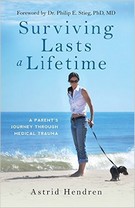
The true story of a young mother who survives a near death experience against all odds. It chronicles the survival, recovery, and the difficult task of moving on, and integrating a new normal.
Surviving Lasts a Lifetime: A Parent’s Journey through Medical Trauma details the journey of a young mother who survives a near death experience against all odds. It chronicles the survival, recovery, and the difficult task of moving on, and integrating a new normal. Astrid wrote letters as a “guide to life” for her children in case she would not live to teach them to her own children, as the trauma brought into sharp focus life’s great questions about love, family, and purpose.
This book is a source and inspiration for other survivors, parents, caregivers, medical professionals, and mental health professionals dealing with such a devastating chapter to give them strength facing their own challenges. It is intended as a reminder that people are surviving all around us, and that surviving lasts a lifetime, and does not necessarily fit neatly into society’s stringent guidelines and expectations for coping with any given trauma.
Excerpt
At one o’clock an attractive doctor walked into the room. His name-tag read: “Dr. Philip Stieg, Associate Chief of Neurosurgery.” Slender and tall, he had friendly blue eyes, blond hair, and an engaging and reassuring smile. His confident demeanor put me at ease. His bedside manner was direct and honest. This style worked well for me; I’d never liked to sugarcoat things. In hindsight, I am sure that, by the time patients get to Dr. Stieg, he knows he can only save those who have the attitude to face the dire statistics that come with the diagnoses and risks associated with his work.
Dr. Stieg looked serious as he stood by my bed and said: “I’m not going to lie to you, this will be a very tough surgery. I’ll need every top person on this team and they’ll need to be well rested.” He went on to tell me that he’d found what he’d feared: I indeed had an AVM—a malformation of blood vessels—at the tip of my brainstem. My ruptured aneurysm was inside that AVM, two inches deep into my brain.
He told me that since the malformation was located at the tip of the brain stem, it would be extremely difficult and risky to access. I learned that the majority of people with this particular kind of aneurysm die immediately when it ruptures. Most of those who survive have subsequent bleeds soon after—and this kills them. Dr. Stieg made it clear that if I did not have surgery, I would be one of those people. Meanwhile, he explained those survivors who underwent surgery, and survived it, have a high risk of disability because of the complicated location, and possible death from vascular spasms in the weeks after the surgery. I got the message loud and clear: my chances for survival were slim, and my chances of fully functioning if I did survive were even slimmer.
Dr. Stieg told me that he would open my skull on the back, left side of my head. He planned to remove a piece of bone from behind my ear and move all the layers of nerves and brain tissue until he could get to the aneurysm. He took a slight breath, looked directly at me, and turned very serious, “Worst case scenario,” he said, “I won’t be able to get to it, in which case I will sew you back up and you will go home and most likely have only a few weeks to live.” He paused for a minute to let me take in those words.
I think he was encouraged that I hadn’t broken down in tears so far. I waited for his next words, which I hoped would be the good news. He gently put his arm on the bed railing and touched my hand. He continued in a soft voice. “Best case scenario: I get to the malformation, and to the aneurysm, and I’m able to clip it. I sew you back up and you could possibly go home on Friday.”
I took a deep breath. “Well, I hear you’re the best in town,” I said. “Why don’t you do your job and I’ll do mine.”
|