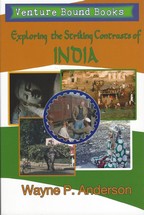
This is a personal report of a six week, five thousand mile travel through the major sights of India riding with a group of English in a bogie (special train car.)
INDIA'S MAJOR WONDERS SEEN UP CLOSE AND PERSONAL
FIND OUT WHAT IT IS LIKE TO TRAVEL INDIAN ON THE CHEAP
Readers eager to learn more about life in India will find interesting Wayne Anderson's latest book, "Exploring the Striking Contrasts of India." He has written a day-by-day account of the six weeks he spent with 25 brave souls as they traveled and lived in train car called a Bogie with one toilet and simple cooking utensils over 5000 miles of India. Twenty short chapters move readers from village to village, describing the sounds, scents, and social setting of each. He visited sites such as funeral pyres, learned the reason for the special regard of cows, stopped at the Burning Ghats of Benares, and entered the Ajanta and Ellora caves.
Besides reporting on many of India's major wonders, he met and conversed with more Indians than most travelers who are taking a standard tour that often shields them from the realities he encountered. Anderson often writes in his journal while things are happening and gives a the reader a feeling of being immersed in the adventure.
One reviewer, Dorothy Watson captures the tone of the book: "Anderson helps travelers avoid culture shock: 'Keep your sense of curiosity and wonder active.' He does just that as we meander along the banks of the sacred Ganges; to Buddhist, Hindu, and Muslim sites; all the way to the breathtaking Taj Mahal. Not only do we encounter shop-keepers, religious men, lepers, beggars, and temple dancers, but we also come to know and enjoy his fellow travelers. Enjoy this captivating journey."
An example from the book: "If Indians got rid of the sacred cows here there would be an energy crisis. It seems the main fuel for many of the small stands along the street. Manure can be in many different forms, you could use it straight, but that seems to lack style, but putting on the side of a wall to dry gives it a nice flat round shape. This is still a bit unwieldy. Idaho potato size is easier to use, and I've seen it sold in stalls. There are also square brick, small ball shape and one shape popular to the north that looks like half of a thick plate. I imagine each of the shapes has its own particular use, but I have yet to have figured that out."
Excerpt
India’s holy city of death
Some years back, I took a six-week, 6,000-mile train tour of India with only a pack on my back. My goal was to see the sights and smell the aromas of the country unprotected by tour guides. Although I don’t recommend this as a way for an aging adult to see India, it did provide some experiences a regular tourist would not have had.
Among the memorable places I visited was the ancient city of Varanasi, also called Bernaras. One of the world’s oldest cities, it is the holiest city for Hindus and is on the holiest river in the world, the Ganges. Many Hindus consider Varanasi a good place to die. Hindus believe in reincarnation, the continuous recycling of life and death. For one’s soul to become properly purified requires many lifetimes.
Those who disregarded Hindu teachings in a previous existence are punished by being reincarnated into a lower caste or even as an animal. The possibility that they might have what was once a human soul is one of the reasons cows in particular are sacred. People who faithfully followed Hindu teachings in a previous existence are rewarded with reincarnation into a higher caste. Hindus believe that through innumerable upward reincarnations, the soul eventually will be completely purified, freed from further rebirth into this sorrowful world.
What a person will be reborn as is questionable, and as a result, Hindus do not always look forward to the next life. It might be bad now, but it could be even worse next time. Varanasi offers a special way to avoid this, for to die naturally in Varanasi is to achieve "moksha." If the right rituals are performed, the reincarnation cycle will end.
Because of this belief, many people come here near the end of their lives to die. In the Hindu faith, Varanasi is the home of Siva, creator and destroyer. It is Siva who whispers a sacred mantra into the ears of the dying, granting them freedom from reincarnation.
Besides those who come to die, the city is full of religious pilgrims who come to worship at the many shrines and travelers who come to observe. The town is full of temples, religious men, beggars, cows and shops selling richly brocaded silks and fine brassware.
The first day in town, a group from our train took bicycle rickshaws down to the ghats at 5 a.m. so we could see the sun rise and watch the early-morning pilgrims take their ritualistic dip into the Ganges to wash away their guilt and sins.
The Ghats are wide stone steps that descend to the river, providing a bathing platform for worshippers and a place for bodies to be burned. As the sun was rising, we took a boat trip on the river to better see the Hindus doing their morning rituals and ablutions.
I did not get a religious or spiritual feeling for what I was seeing; what I was aware of was the mud, cows, stacks of wood for the pyres, hawkers of wares and beggars. The Ganges seemed dirty; I saw unsavory things floating in it and felt it must be a carrier of disease.
I commented to our boatman that this seemed terribly unsanitary, especially because people were bathing in the river. Weren’t they running a risk of getting sick? He gave me a look that indicated I was a person of limited understanding and insisted that, as a holy river, the Ganges destroys all bacteria upon contact and dissolves bones in three days.
After watching the morning rituals, we went down to the area where we expected funeral pyres to be burning, but only one body was being cremated. I made plans to come back the next day to see if any bodies were being prepared. Because of the religious significance of the event, it was made clear that no picture-taking would be allowed.
The next day, many people in the train car were loath to go down to the center of the city again because they didn’t like Benares. The narrow streets and sheer mass of humanity overwhelmed them. Two young men from Norway said they would make the trip with me, so we went back to the burning Ghats.
The Ghats run about five kilometers along the riverfront, and at the place where we arrived, there were four bodies on pyres and three being prepared. We saw a brightly clothed body being carried down the streets accompanied by drummers and pipers. The body is ritually placed in the Ganges along the shore. After proper prayers, it is placed on a wood pyre, and the fire is started.
As I watched, a man poked the bodies that had been burning for a while with a stick and at one point smashed them with something like a baseball bat to break them up so they would burn more completely.
It takes three hours for a body to be consumed, after which the ashes and anything left over are thrown into the Ganges. It is said that the person’s soul is thus freed from the cycle of reincarnation.
The term caste is not an Indian word. According to the Oxford English Dictionary, it is derived from the Portuguese caste, meaning "race, lineage, breed" and, originally, "‘pure or unmixed (stock or breed)".[36] There is no exact translation in Indian languages, but varna and jāti are the two most proximate terms.[37]
At the heart of the eight compelling nonfiction stories and five-article appendix which make up Dreams of the Immortal City Savannah is this interesting question: What would your life mean if you were living someone else's dream of what it should be?
Expands beyond the safety of pages bound by predictability to explore and often confirm exciting creative possibilities. A shimmering collage of memoir, creative nonfiction, literary journalism, and dizzying flights into poetic observation, this is t