Amazon
Category:
Science
Publisher: W.W. Norton
ISBN-10: 0393347818
Type: Non-Fiction
Pages: 266
Copyright: 2014
ISBN-13: 9780393347814
Price: $8.96 (eBook)
This book describes some of the early development of computers.
Excerpt
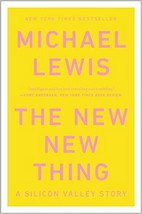
The New New Thing: A Silicon Valley Story
Michael Lewis
© 2014
ISBN-10: 0393347818
ISBN-13: 978-0393347814
W.W. Norton and Company
266 pages, $8.96
Want to take a journey through Silicon Valley and meet talented developers of computers and software? “The New New Thing” will introduce you to men who not only developed the personal home computer as we know it but turned upside down the financial world that, until then, dominated American business. Jim Clark, for example, burst into the business world with bold, new, never-before-tried business strategies to finance his discoveries.
On the surface, this book seems to about computers and The Internet. Under the surface in the business world, however, is where the new new thing happened. Heretofore, wealthy people, who controlled large sums of money, decided whether a new venture was worth financing or not worth financing. The author shows how engineers and software specialists did something new. They bypassed the men controlling the money and went directly to small investors, selling high-risk ventures that, surprisingly, paid off big.
Jim Clark, a genius who grew up poor and was expelled from high school for his unruly temperament, later earned a PhD in computer science. His brilliance led him to develop a very successful computer chip in 1979 that revolutionized computer graphics and virtual reality games. He moved to Silicon Valley in 1995 and created Netscape, a browser that triggered The Internet boom. He launched Netscape directly to the small investor. Netscape became such a huge success that, by 1999, Clark was worth billions of dollars.
Clark’s pet hobby was to control his sailboat “Hyperon” by remote control entirely through The Internet. Though we know today that remote control is possible, nobody ever tried it through The Internet before Jim Clark. His learning curve, as he wrestled through unexpected glitches, makes an interesting side story to the book’s main thrust.
Clark’s Netscape was one-upped by Bill Gates’ Microsoft Explorer. Clark feared someone might come up with a rival browser and challenge Netscape’s pre-eminence as the world’s first window to The Internet. Bill Gates, founder of Microsoft, was already the world’s richest man because of his huge success in providing personal computers. Microsoft developed their own browser and bundled it in with their PC’s, thereby presenting a real challenge to Netscape. Clark complained about Microsoft’s unfair business practices and its monopoly power and eventually succeeded in having Microsoft sued by the U.S. government.
Clark also embarked on a much more ambitious project than Netscape: his comprehensive Healthscape project. Americans, at that time (1996), were spending one and one-half trillion dollars a year on healthcare. Clark viewed one-third of the cost as waste expended on paperwork. He envisioned computerizing health care to eliminate the paper work. He started with a diamond-shaped diagram showing “Consumers,” “Providers,” “Doctors,” and “Payers” at each of the four corners. In the center of this “magic diamond” would be an Internet program to tie it all together: “Healthscape.”
He sold the ideal directly to small investors and once again did the new new thing, accumulating plenty of investment to implement the programming. His magic diamond grew into “The Chart of Many Bubbles,” eleven component parts: “Consumers,” “Health Plans,” “Employers,” “labs,” “Hospitals,” etc. that all communicated through the central bubble: “Healtheon,” the heart of Clark’s more ambitious Internet health care system. Healtheon became very promising and earned a lot of money, but, in the end, some big potential customers pulled out.
Michael Lewis’ “The New New Thing” is an interesting book that introduces the reader to the developers of The Internet industry, goes into some details on how these men developed it, especially the daring, innovative new way they financed their ventures, and some of the all-too-human hobbies they pursued. This is a very good book. You will enjoy it.
|