The history of the cat goes back much further than the Egyptians, as the reader will find out when reading “Looking at the Cat, An Eye on Evolution”.
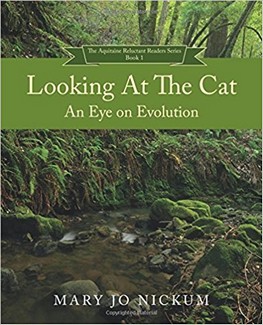
The history of the cat goes back much further than the Egyptians, as the reader will find out when reading “Looking at the Cat, An Eye on Evolution”. The book is an overview of Darwin’s Theory of evolution as it relates to the cat. The student not only is exposed to the concepts of evolution but, at the same time, is shown examples of how evolution has progressed and the time-frame during which these changes took place. The book contains 44 pictures, photos and graphs along with 10 sidebars.
The book is written for students age 12-16 to satisfy Common Core and high school biology curriculum requirements. It is well documented with a source and illustrations credit lists. A list of further readings, with activities is included to amplify further the message that reading is fun.
Excerpt
The history of the cat goes back much further than the Egyptians, as the reader will find out when reading “Looking at the Cat, An Eye on Evolution”. The book is an overview of Darwin’s Theory of evolution as it relates to the cat. The student not only is exposed to the concepts of evolution but, at the same time, is shown examples of how evolution has progressed and the timeframe during which these changes took place. The book contains 44 pictures, photos and graphs along with 10 sidebars.
The book is written for students age 12-16 to satisfy Common Core and high school biology curriculum requirements. It is well documented with a source and illustrations credit lists. A list of further readings, with activities is included to amplify further the message that reading is fun.
Our human genome is full of viruses similar to HIV-1. These have played an important role in human evolution and still play an important role in human embryology and day-to-day chemistry. Just how important are they to our evolution past and future?
Our human genome is full of viruses similar to HIV-1. These have played an important role in human evolution and still play an important role in human embryology and day-to-day chemistry. Just how important are they to our evolution past and future?