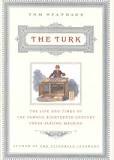
The Turk baffled brilliant minds, beat almost everybody at chess, and yet, he obviously was a machine. Constructed in 1768, this mechanical man, dressed in oriental clothing with a turban on his head, was dubbed "the Turk" by his awestruck opponents. He sat at a desk, one hand on the desk, the other hovering above a chess board, ready to take on any opponent. "The Turk" was built by Wolfgang von Kempelen in 1769. A counselor to Maria Theresa of Austria, von Kempelen was unimpressed with a French conjuror performing feats of wonder. Von Kempelen told the Empress he could do better. Maria Theresa encouraged him and relieved him of his duties so he would have time. Six months later, von Kempelen showed his machine. He never grasped how intriguing his machine was and what lasting interest it would have.
When von Kempelen first displayed the Turk in Maria Theresa's court, he opened all the doors and side panels so the audience could see the internal springs, gears, and magnets that made the chess player work. Then he asked the audience for someone willing to take on the Turk. When someone came up, von Kempelen wound the Turk's mechanism. The audience could hear gears turning. During the game, the Turk said nothing, but the audience could hear the gears turning every time the Turk made a move. Few could beat the Turk. As his fame grew, von Kempelen took the Turk on tour. The Turk played many famous opponents, including Maria Theresa, Catherine the Great of Russia, Benjamin Franklin, and others.
For about fifteen years, von Kempelen amazed audiences, then he set the Turk aside in 1785. Von Kempelen died in 1804. In 1806, his heirs sold the Turk to Johann N. Maelzel. Maelzel displayed the Turk in Europe and the United States. Famous people on both continents tried their skill against the Turk. Edgar Allen Poe played the Turk in 1836 and was one of the many who tried to guess how the Turk worked. In Philadelphia, the Turk played Charles Carroll, then 89. Carroll was the last living signer of the Declaration of Independence. Maelzel died in 1838. Shortly after, John Mitchell bought the Turk. His son took it apart to find out how it worked. The Turk played a few more opponents, then Mitchell donated it to a museum. In 1854, a fire destroyed the Turk. In 1971, John Gaughan built a replica of the Turk, and the Turk had a new lease on life.
Standage's book describes a fascinating machine and brilliant showmen who made the machine famous on both sides of the Atlantic. Standage then reveals in detail how the Turk worked. He ends his book discussing chess playing computers. Gaughan's rebuilt Turk played and beat an IBM 704 in 1958. IBM then developed a more sophisticated chess playing computer and challenged world chess champion Gary Kasparov in the 1990's. "Big Blue" lost the first game, but won the rematch. Standage's description of how complicated the computer programming had to be makes one realize what an amazing feat of ingenuity von Kempelen possessed in 1768.
Standage's book makes intriguing reading. It will keep you guessing how the Turk could not only play chess, but win so many games. At the end, Standage describes, in detail, how the Turk worked. Once you pick up The Turk, you will not want to put it down.