Kindle Edition
Amazon
JohnEriksen.net
Category:
History
Publisher: John Eriksen
Type: Non-Fiction
Pages: 277
Copyright: 2008-2017
Price: $2.99 (eBook)
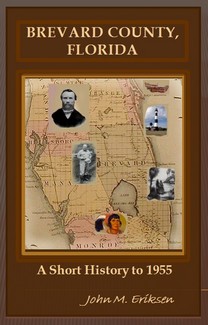
A historic review of Florida's east coast from primitive man to the first rocket launches. 320 numbered endnotes draw from 1000 sources in the Endnotes.
This is an awesome 237-page history of Brevard County, home of NASA's Kennedy Space Center and launch complex for the Space Shuttle.
Would you like to go back in time when life was more in tune with the natural surroundings? Within these pages you'll be transported to a pristine land filled with opportunity and those who sought a new life in a far-away place called Indian River Country.
These pages capture the original beauty and abundance of raw nature so starkly contrasted by today's development, and how that raw beauty was developed for a growing population.
Thoroughly documented with 320 end notes which cover 1000 sources. This is an "instant download" eBook in Kindle format, but also displays on tablets and smartphones.
Excerpt
Excerpt from
Brevard County, Florida : A Short History to 1955 by John M. Eriksen
https://amazon.com/author/john-eriksen
5 - EAST CENTRAL FLORIDA IN THE 27TH STATE(1845——1860) PART ONE
Florida became a state on March 3, 1845. That same year, Samuel Augustus Mitchell completed a Florida map that depicted Orange and St. Lucie as the only two counties on the state's east central coast. The two county area stretched from today's Flagler Beach to Hillsboro Inlet. The counties were divided by a line from Cape Canaveral, through Sharpes along present day Canaveral Groves Boulevard to the center of the state.
Early St. Lucie extended from Cape Canaveral and included all of Lake Okeechobee according to the Territorial Act of February 1845. That Act established the County's site at the home of John C. Cleland on the Indian River.1 This was near Ankona, the center of the Armed Occupation Colony just west of the Indian River Inlet.
The Orange County site was Mellonville (now Sanford), serving settlers along the St. Johns River. Just above Mellonville, on the north side of Lake Monroe, was Enterprise. In 1845 this was the home of John C. Houston.
Originally from a small community called Arlington near Jacksonville, Houston was an election inspector for Orange County and later became prominent in Brevard County history. While still in eastern Orange County, Houston was appointed by Governor James Broome as one of three new county commissioners in 1854 when the area of Orange County east of the St. Johns became Volusia County.2
Between 1845 to 1860, this great three county area was still a land without wholly specific bounds or political definition. This was due to the sparse population and a lack of observable markers (excepting the Atlantic, St. Johns, and a few blazed boundaries). Local politics were kept in a state of disarray as General Assemblymen rearranged county boundaries at will. Some were renamed to honor heroes or politicians. Larger ones were subdivided and new names were created for the remnants.
In 1844, the northern boundary of St. Lucie County was set twelve miles below Fort Ann (near the old Haulover Canal). In February of 1845, the Territorial Council enacted a brief amendment that moved the northern bound an additional six miles to the south. This affected the future Burnham homestead opposite the Canaveral lighthouse.
Due to the many changes between 1845 and 1855, Burnham's homestead at the Cape was once a part of the counties of Mosquito, Leigh Read, St. Lucie, Orange, Volusia, and Brevard.
The boundary and name changes served to confuse mapmakers, causing many discrepancies in the well known maps of the period.3 Even though Mitchell was fairly accurate with his 1845 county map of Florida, the confused cartographer published an 1847 atlas that incorrectly displayed the entire east central Florida area as the old Mosquito County.
No Gold In Florida
The nation experienced rapid growth throughout the 1840s. From 1841 through 1848 two Presidents, Tyler and Polk led the country. While the skittish Indian River Colony was ready to retreat, these two men endorsed the popular expansionist movement in the western territories. First, Texas was annexed, leading to the Mexican War, which brought even more land under the Government's control. Then, in early 1848, there were reports that gold had been discovered in California, causing over 80,000 claimants to assail the area by 1849. Statehood was declared in 1850. The era of western expansion became known and described by the phrase, Manifest Destiny.4 There was, however, no such rush to the Florida wilderness. The 1850 census of St. Lucie County listed only 139 people. This number included slaves and the thirty soldiers assigned to Fort Capron.5
The vast majority of Florida's meager population growth occurred in northern counties. One of the new arrivals was a lawyer from Alabama, Judge Theodore Washington Brevard. Judge Brevard was one of the few to see a future in the new state when he settled in Tallahassee in 1847. He became the State Comptroller, working for twelve years at this post. His efficiency and dedication were acknowledged by the General Assembly when, on January 6, 1855, they changed the county name of St. Lucie to Brevard County.
The Brevards
The name of Brevard has a long and distinguished history in America. The family became established in this country after Jean Brevard, a young Huguenot orphan, fled religious persecution in France during 1685. Young Brevard was one of many thousands that evacuated France when Louis the XIV revoked the 1598 Edict of Nantes and demanded that Protestants renounce their beliefs. Jean Brevard found refuge and passage to America with an Irish family and settled in the colony of Maryland. The youth later married into a prominent family and soon created a large household, including a son, John, in 1716.
John Brevard, raised as a wages of sin Calvinist, moved to western North Carolina in the 1740s. He fathered twelve children, eight of which were sons who fought in the Revolutionary War. His son, Alexander, born in 1755, became an officer in the Continental Army and father of ten children, including Judge Theodore Washington Brevard, Brevard County's namesake.7
Historians of the past have reported that Brevard County, Florida was named to honor Dr. Ephraim Brevard. Ephraim, a brother of Alexander and uncle to Judge Brevard, was a lifetime resident of North Carolina and was honored many years after his death when the county seat of Transylvania County, Brevard, North Carolina, was named for the famous patriot in February of 1861.8
Inaccuracies such as the example above are a part of every history. The misinformation concerning Dr. Ephraim Brevard may have stemmed from early stories or newspaper articles. For instance, the Cocoa Tribune of April 26, 1917, inaccurately states that Brevard County was "organized in 1843 in honor of Dr. John Brevard of North Carolina."
Not overlooking tradition, Judge T. W. Brevard named his son Theodore Washington Brevard.
Following in his father's footsteps, the younger Brevard also became a lawyer and married a daughter of a former Governor, Richard Keith Call. While still in his twenties, he served as a Brigadier General in the Confederate Army. His marriage to Mary Call produced five children, including another Dr. Ephraim Brevard and Caroline Mays Brevard, the author of A History of Florida. Former Governor LeRoy Collins in his book, Forerunners Courageous, has described the family history of the Brevards in Florida. Governor Collins married one of General Brevard's granddaughters, Mary Call Darby.9
The New County
Brevard County began in 1855 as the largest political subdivision in the state. Inheriting the boundaries of old St. Lucie County, an immense area of over 7,000 square miles, Brevard County established its seat of government in Susannah, a small settlement near old Fort Pierce. An authentic account of life in the new county is found in an 1885 publication, Life and Adventures in South Florida, by Andrew P. Canova. Canova was in his early twenties when he moved from Tampa Bay to Brevard in the fall of 1858.
A veteran of the recent intermittent skirmishes known as the Third Seminole Indian War, the adventurous frontiersman left his military career with the idea of amassing wealth in the new enterprise of orange growing. There had been rumors throughout the state of quick money to be made in the grove business. The bruit about fruit was spreading, in his words, "orange fever." Young Canova settled on the Sebastian River, built a palmetto hut and began his grove. To his dismay he learned that orange groves require more dedication and patience than can be rendered by the average twenty two year old fortune hunter.
The grove was soon forgotten, but Canova was intrigued with the area and continued to live off the land for the next two years prior to the Civil War. His descriptions of this early period along the Indian River Lagoon provide a rare glimpse of the original state of nature along its shores. Canova explored the lagoon and mentions a recent newcomer to the north, Captain John Houston, about twenty miles away on Elbow Creek. The nearest store was thirty miles to the south at Fort Capron.
Canova used his rowboat to get supplies. The store, owned by William Russell, was the county seat of Brevard. Russell was one of the original Armed Occupation Act claimants. He left the area in 1849, but unlike Burnham and others, he returned to his claim. It is said that Russell introduced the legislation to have the name of St. Lucie changed to honor his friend, T. W. Brevard. The first county seat at Susannah may have been named after Russell's wife.
Commuting to his legislative duties in Tallahassee, Russell became quite familiar with the Indian River. Years before the post Civil War invasion of settlers, such as Hardee, Williams, MacGruder, and Paxton, he sensed the forthcoming development and purchased land along the tropical rocky ledged shore just below today's Barton Avenue. Ironically, part of Russell’s land remained undeveloped until the late 1980s, when the exclusive River Ridge subdivision was built between the river and the old ‘Wal Mart’ Plaza.10
In his book, Canova tells of his experiences along the lagoon, including a showdown with a bear, a cottonmouth attack, and a manatee hunt. Manatees were prized for their oil during the British occupation of Florida. Much earlier, they were killed by the Indians of south Florida who worshiped the manatee skull.11 Canova describes the manatee flesh by saying, "the fattest, juiciest Tennessee beef is by no means equal to it." In 1858, he accompanied a group of manatee hunters as an observer. Two manatees were caught and shipped to Key West. During his short time on the Sebastian River, he described the manatees as becoming extremely scarce. In his words, "there is no doubt that the manatee is fast becoming an extinct animal...the only remaining trace of its former existence will be a few old bones and an antiquated volume containing a description of it."
In his later years Canova made reference to his early life on the river and the relative degrees of man's destruction of the lagoon's resources. He refers to sportsmen like Sir Tatton Sykes who needlessly killed large quantities of game near present day Sykes Creek. He lamented that "titled peers and noblemen, from all parts of Europe, were once plentiful on Indian River...roseate spoonbill, snowy egrets, blue herons, and ducks were once to be found here world without end. If they had not been so wantonly destroyed, regardless of breeding seasons, it would still be a sportsman's paradise."
Of course, to the many newcomers in the late 1800s the area was still noted for good hunting, but only men like Canova realized that Brevard was not quite what it once was. In 1861, he left the Indian River to join the Confederate Army, leaving with only memories of the old days in his jungle paradise.12
An Experienced Politician
Canova's neighbor, John Carroll Houston, was 46 years old when he began his homestead in Brevard County in 1859. The family name may be found in any good encyclopedia, where reference is made to his older cousin, Sam Houston. Unlike his famous cousin, John did not seek the life of a professional soldier or statesman. However, he was a natural leader and well versed in politics. With these qualities, he had been appointed by Governor Broome as one of three initial County Commissioners of Volusia County in 1854.13 After his term expired, he sought his own bailiwick in the seclusion of southern Volusia County (now Brevard County).
Almost two decades before the small communities of Eau Gallie and Melbourne existed, Houston became the first U.S. citizen to establish a permanent settlement in present day south Brevard County. Naturally he picked one of the best corner lots in the area—80 acres facing Indian River and Elbow Creek. He named the area Arlington, after his early home near Jacksonville.
After the Homestead Act became law in 1862, the Houstons acquired another 78 acres of beach property near state road 518.14 He and his wife, Virginia, had ten children.
John C. Houston served as President of the Brevard County Commissioners in the 1870s, and his growing family and in laws also became active community leaders during the population boom following the Civil War.
BREVARD COUNTY IN THE CONFEDERATE STATES (1860 1865) PART TWO
The causes of the Civil War began early. The first antislavery society was founded in 1775. Great Britain, the greatest importer of slaves to the Americas in the 1700s, had already passed the Abolition Act in 1807, giving freedom to the slaves throughout the British colonies. In 1808, Congress passed legislation to prohibit the further importation of slaves to the United States. By 1817 the American Colonization Society organized an effort to relocate slaves to their African homeland. Although not very effective, the Society's efforts did result in the creation of Liberia in 1822.15
Throughout the 1840s and 1850s, many important southerners invested in large plantations and felt they were dependent on the institution of slavery for their success. They could not conceive of a life without slaves, leaving no room for negotiation with the north. Slavery was not the sole issue that divided the states, but it was a major issue. The mere topic of emancipation was seen by southerners as a threat to their right to manage their own affairs.
Florida seceded from the Union on January 10th, 1861. Over the next four years, Florida's primary role was that of supermarket to the South. Beef and the salt needed to preserve it were high on the list of commodities required by the Confederate Army. Slave owner or not, the settlers along the Indian River were willing to help the Confederate cause.
A Confederate law exempted salt manufacturers from military service and salt making became an important activity along the length of the lagoon. According to one historian, William Watson Davis, the price of salt in 1862 was as high as $1 per pound, yet inland settlers found it difficult to find at that price due to some makers' "cornering the market."16 These clever businessmen were making huge profits at the expense of the Confederacy.
Although most of Florida's salt works were on the west coast, the combined efforts of both coasts were one factor which helped prolong the war for a year or more. Western Brevard County, home to Cracker cowmen, also contributed to the war effort by supplying beef. Induction into the Cow Cavalry was the Confederate method of "recruiting" unfortunate cattlemen to drive beef north to feed front line troops. This drama has been authentically portrayed in Patrick Smith's celebrated and richly researched novel, A Land Remembered.17
Seeking offshore profits, daring blockade-runners used the coves and inlets of the Indian River and Mosquito Lagoons. Cotton was shipped out, usually to Nassau, and supplies were smuggled back through the inlets, destined for northern supply lines. One such runner was an opportunist named Henry Theodore Titus. Titus was working for the Florida Provision Co., a retail outfit owned by his father in law, Edward S. Hopkins. Hopkins settled in Jacksonville in 1853 and was twice elected mayor of that city.
His firm sold supplies to the Confederate Army. Titus seemed to be satisfied with his sales position. In one exchange, he received $5,400 for two mules, three wagons, one cart, and eight harnesses. While transporting a load of Confederate draft dodgers to Nassau in 1863, Titus lost his steamer to the Northern blockade and was captured on the Indian River. He eluded imprisonment and later returned to the lagoon with his family, preceding a post war wave of newcomers.18
A Safe Place
In April of 1865, Robert E. Lee surrendered his army to the Union commander, Ulysses S. Grant. The following month, Federal troops entered Tallahassee and placed Florida under military rule. Confederate troops disbanded and returned to their homes. Confederate leaders, though, were running for their lives. The historic flight of one such expatriate offers a brief view of postwar Brevard.
John C. Breckinridge served as Vice President of the United States under James Buchanan from 1857 to 1860. When he ran for President in 1860, only Abraham Lincoln received more electoral votes. Breckinridge, a Kentuckian, next held office as Secretary of War and later general for the Confederacy. After the southern cause collapsed in April 1865, he quickly abandoned his Richmond headquarters. Dressed as a beggar, Breckinridge slipped through the southern states, seeking a safe route to Cuba.
By late May of 1865, the former major general was slapping mosquitoes at Cook's Ferry, on the north shore of Lake Harney. He and a few friends, wisely choosing to part with the convoluted St. Johns at this point, loaded their small boat on a wagon and headed for the Indian River. They arrived at Carlile's Landing, just north of present day Titusville on May 31.
It is interesting to note that this was not the shortest distance from Lake Harney to the North Indian River Lagoon, indicating that the favored route was well established prior to its use as a hack line by early Titusville settlers and its development as a route for the Jacksonville, Tampa and Key West Railroad in 1885.
The Breckinridge party followed the lagoon, trading tobacco for watermelon with "crackers" described as the poorest, ragged people they had seen in quite a while. David Carlile, an early resident of La Grange and an alert opportunist, may have been one of the crackers to aid the getaway by leading the Confederates through the hills north of Sand Point.19
The Rebels stopped at the John C. Houston place on Elbow Creek, where their boat was brought ashore and caulked. When the repairs were completed, Colonel John Taylor Wood, again led the party south. Wood was Zackary Taylor's grandson and a graduate of the Naval Academy at Annapolis. He was famous for capturing Northern vessels during the war and now was equally successful in eluding the Federals. Breckinridge eventually made a safe passage to Cuba and later returned to Kentucky.20
6 - A WILDERNESS INVADED
THE INDIAN RIVER COUNTRY AND BEYOND
(1865——1879)
Excerpt from
Brevard County, Florida : A Short History to 1955 by John M. Eriksen
https://amazon.com/author/john-eriksen
As Breckinridge and other Confederate leaders were either fleeing through Florida or facing Federal prisons, Union soldiers were entering the state to establish military law. Although Florida was not a ravished battlefield, the battle of Olustee in 1864 being the only major engagement of the war, the state was neglected and bankrupt.1 A major concern of the Federal Government was the plight of nearly four million ex slaves throughout the south.2 These newly enfranchised U.S. citizens were now known as "freedmen" and began to receive aid and education under a new Federal agency known as the Freedmen's Bureau.
The Commissioner of the new agency was Oliver O. Howard, who favored the idea of relocating the freedmen to homesteads in Florida, Mississippi, or Arkansas. Colonel George F. Thompson was appointed as an inspector for the Bureau for south Florida on December 3, 1865. Although local historians have emphasized that Thompson was primarily concerned with establishing a Negro Colony in Florida, his tour of the peninsula was actually an initial investigation of the state to determine the needs of the Negroes, the attitude of the Southerners toward the new Union, and the potential for northern investments, especially agricultural opportunities.3
When Thompson arrived in Florida he was introduced to a certain gentleman who had been appointed as a "special agent" of the Bureau by Assistant Commissioner T.W. Osborne. His name was William Henry Gleason. Gleason accompanied Thompson during the next several months and was later praised by Thompson for his superior intelligence and devotion to the work of the inspection.
In his journal, Thompson gives some insight into the condition of south Florida, including Brevard County, during late 1865 and early 1866. Thompson and Gleason began their tour at Tampa in mid December. In the country below Tampa Bay, they met cattle herders employed by Jacob Summerlin——one of the largest cattlemen in Florida. Thompson estimated that in the region near the Kissimmee River, which was then Brevard County, there were "150,000 cattle worth perhaps $900,000."4 Next, the pair sailed toward Cape Sable, noting the lemon and orange groves, perhaps offsprings of the Dummett grove. They lingered in southern Dade County for almost three weeks.
Continuing north along the east coast, they sailed past Dummett's place to see the famous grove. Dummett may not have been too impressed with Thompson's subsequent report. He wrote that "the grove upon the East Coast...reported to be the most flourishing and valuable in the state...is owned by an old man by the name of Dummett, who, in addition to the raising of oranges has tested the experiment of miscegenation, the results of which may be seen running about his place, with complexions of a color midway between charcoal and chalk."5
William Gleason liked what he saw in south Florida and returned with his family in July of 1866.
The thirty seven year old Gleason was formerly a legislator in Wisconsin and continued to have political ambitions upon his arrival in Dade County. It is interesting to note that not long after he unloaded his schooner in July, northern Dade County was extended from its old northern line near Hillsboro Inlet to present day Stuart. The change transferred about 70 miles of Brevard County coast to the jurisdiction of Dade County.6
A Military Retiree
As Gleason was getting settled along the banks of Key Biscayne, others were beginning to settle the shores of the Indian River. In Florida and nationwide, the Homestead Act of 1862 replaced the old Armed Occupation Act, again giving settlers 160 acres if they could prove occupancy for five years. Following the Civil War, many came seeking the peace of the lagoon, as well as the agricultural and fishing opportunities on the shores of what was then Volusia and Brevard County.
Around 1867, a battle weary soldier of fortune sailed along the northern lagoon seeking a secure spot to retire. Originally from New Jersey, Henry Theodore Titus had every opportunity to prepare for a career as a professional soldier. Theodore Titus had his only son, Henry T., enrolled in the United States Military Academy at West Point, but could not keep him there.
Young Henry sought more immediate adventures throughout the expanding western territories. He grew to be a man of commanding stature. In the words of his daughter, Minnie Titus Ensey, he was "very handsome, with dark brown eyes and hair, standing well over six feet in height and weighing 250 pounds."
It is thought that Titus worked for a short time on Texas cattle trails and then picked silver mines in Arizona. Titus County, Texas was named after a relative that he may have visited during his western adventures. In 1852, he married Mary Evelina Hopkins, the daughter of a successful Georgia businessman. Wedlock, though, did nothing to hinder his venturesome spirit.
In 1856 he became involved in a foolhardy crusade to Kansas, well known in U.S. history as Bleeding Kansas. Although Titus owned no slaves, he became a major opponent of the noted abolitionist, John Brown. Titus led a small group of proslavery men in raids against Brown's camp.
When abolitionists attacked and burned his small log house, known as Fort Titus, the future Titusville resident was seriously wounded and taken prisoner by Federal troops and put in the custody of Captain Samuel Walker in Lawrence. While awaiting trial, a bloodthirsty lynch mob led by Brown clamored around the jail cell, demanding that Titus meet death on the gallows. (John Brown later became famous for his 1859 raid of the arsenal at Harpers Ferry, WV.)7
Excerpt from
Brevard County, Florida : A Short History to 1955
by John M. Eriksen
=======================================================
https://amazon.com/author/john-eriksen
|