Kindle Edition
Audiobook
Amazon
Amazon
Category:
Mystery/Suspense
Publisher: Dancaster Creative
ISBN-10: 1500724858
Type: Fiction
Pages: 258
ISBN-13: 9781500724856
Price: $4.99 (eBook)
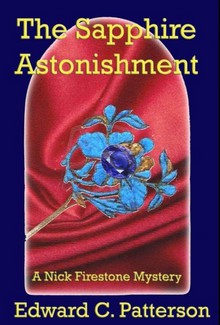
Nick Firestone and Crew search for a missing Imperial Chinese Heirloom only to discover deeper and darker secrets.
The last time we encountered Nick Firestone (in The People’s Treasure and In the Shadow of Her Hem - Book 4 and 5 of The Jade Owl Legacy) he was a five year old scamp, precocious and filled with the spirit of adventure. Now he’s all grow’d up, as Simone DeFleurry would say, and itching for an occupation worthy of the scratch. It’s 2025 in San Francisco (post-earthquake of 2020) and things have changed for the adventurer as he wakes up to the sparkle of a rare relic – a Chinese hat-pin called The Sapphire Astonishment.
This first Nick Firestone mystery will take you on a wild ride through the city by the bay as young Firestone seeks the provenance of the curious hat-pin and its secrets. Many want this prize, including characters familiar to the readers of The Jade Owl Legacy series, but you won’t need that story to enjoy this one. So, slip into your eShirts and hold on to your gillifrickers for a ride down the hills of San Francisco into the world of the youngest China Hand. Your GlimmerGlasses will never feel the same.
Excerpt
Chapter One
The Break-in at Han Ch’i-wangs
1
Chinatown, San Francisco had seen better days — days ablaze with neighborhood life and tourism, but since the 2020 quake, any structure not converted to withstand the shock had either crumbled or burned. This was not the first time a catastrophe had struck the area and, since the neighborhood abutting Grant Avenue had been slowly consumed by glass and metal high-rise buildings, all in the shadow of a monstrous tower, Meridian One, only the remaining below-code buildings were affected. Most were gone now, the streets looking much like any other place in San Francisco from the Castro to SOMA. But the aroma of rotting cabbage lingered in the morning air along with a pagoda sloped roof — here and there. Mandarin was spoken less, replaced by riffs, which buzzed between the GlimmerGlass windows, as they now say. But it still could be called Chinatown, although many of the ethnic portion had drifted away along the former BART line into the suburbs. The Chinese architecture was particularly dilapidated — quaint but still visited by tourists who read on their guide tablets of things to be seen and had, and for the explorers of exotic beyond-the-glimmer-glass purchases. There was plenty of GlimmerGlass in Chinatown, hawking restaurants and trips to the People’s Republic. But for the tourist who rode the only remaining cable car line along California Street to Grant Avenue, they could be rewarded handsomely from the past.
Tucked between a dance palace called The Ging Gong Club and an eSuit boutique — Sony Circuit Fashions, stood a lopsided shop with an unconverted display window, smoked with age. Those who peered through it could see a riot of Chinese bric-a-brac — touristy hoopla, but also a promise for a true bazaar of unique specimens from a time beyond the GlimmerGlass information bombardments in the shadow of Meridian One. Here stood Han-ch’i-wangs Chinese Antiques, owned in absentia by a Chinese antique himself, Xiao Win-t’o, and run by two gay men, whose specialty went beyond the ordinary.
When Grant Avenue was in its prime — the glory days of the Twentieth Century, there was little to distinguish it from a street in Shang-hai or Hong Kong. Neighborhood folk choked the vegetable markets calling for live eel and bitter melon. Bicycles clogged the lanes with laundry baskets filled with uptown wash. Children begged for steam cakes and almond cookies, and the clash of old country music crashed about happy tourists, who snapped old-style cameras to record their trip to the City by the Bay. Now, even the cats were safe from the butcher block so little was the call for fresh wok-helper; and the old Apothecary Shop only opened twice weekly to serve up remedies to a few drifters from Oakland or San Carlos. But Han-ch’i-wangs could still bustle on a Sunday afternoon, because both the fashionable and downtrodden sought a happy forgery to grace their coffee tables. Or they longed to don a silk dragon robe for those chilly summer mornings, which, despite the drift of time, never seemed to change in San Francisco. So between the warped beats of new style horse-dancing at the Ging Gong Club and the hi-tech apparel at Sony Circuit Fashions, the proprietorship of the old Chinatown don, Xiao Win-to (in absentia) thrived both in fact and fiction.
2
Warren Ch’u sat bolt upright in bed. He was a light sleeper. He twitched about, waking his partner, Marsh Eliot.
“Did you hear that?” Warren whispered, anxiously.
“It’s just a rat or something. Go back to sleep.”
“No, Silky. Someone’s in the shop.”
Marsh, whom the world called Silky for his flaxen hair — hair less flaxen since his thirtieth birthday, rolled over trying to ignore his husband. Warren tossed off the sheets and swung his legs over the bed’s edge, groping for his glasses. There was a time when those glasses made him the picture of a Chinese geek boy, but since his adventures in China, he had fleshed out into someone who could scare people in a dark alley. He leaped to his feet.
“Shit,” Silky said, sitting up. “Must we do this now?”
“The new shipment.”
Silky grumbled, but reached for something to cover his ass. A silk shift would do. Then a distinct rattle of glass came from the shop below, followed by creaking from the ancient floorboards.
“Fuck,” Silky groaned. “Grab your gizmo. We might need to call the cops.”
“Why didn’t the alarm go off?”
“How should I know? I’m a battle-scarred warrior not a fucking grid jockey.”
He rarely called himself a battle-scarred warrior since that day years ago, when he helped save the world in China — an event never discussed by its participants through agreement and cash arrangement. But occasionally Silky tipped his hand when speaking to those in the know — those who shared in the settlement.
Warren didn’t bother with clothes, except a pair of slippers to protect his feet from possible broken glass, which he assumed was already somewhere in the shop. He appeared odd — a naked brawny specimen with pink fluffy slippers, a gift from Silky’s adoptive mother — a renowned drag queen.
“That’s a picture,” Silky said, peering through the dim light in the hallway. “Any rat seeing you like that will run back to the trash can.”
“I don’t see you running,” Warren whispered, then handed Silky the gizmo, not having a pocket to put it in.
Silky, still half-asleep, managed a chuckle, but then another noise came from the lower floor — this time metallic, followed by a distinct rumble.
“I hope that was one of the fakes,” Warren said, moving steadily to the top of the stairs.
“Now’s not the time for the Tsa-la-gi way,” Silky remarked, referring to a code taught to Warren by a dedicated local artist, who happened to be Cherokee and sworn to a distinct martial arts code. “If there’s someone in the shop, he could have a gun. I’m in no mood to mop up your blood.”
“You have a sword you could use.”
“Not if I can help it.”
“Then we’ll rely on Griffen’s code.” Warren punched his own fist. “Be ready to jump in.”
As they descended into the shop, groping the banister, the noise increased — certainly not a rat. In fact, Warren saw a shadow — briefly, but definitely a human form.
“He’s in the back room,” he whispered.
“The new shipment.”
“Maybe it’s the real owner come to collect his shit.”
Silky clicked his tongue.
“We have regular business hours.”
Warren halted, raising his right hand high and putting his left index finger to his lips. The shadow appeared again, and then a shape — a man in a hoodie and, no doubt, nimble to be able to navigate in the dark over Han Ch’i-wangs considerable clutter. Warren saw light from the street, flooding through a circular cut in the front door’s glass. It had been some time since any light penetrated the smoky windows. The door was open.
“We’ll do this the Tsa-la-gi way,” Warren grunted, and then hopped forward to the light switch.
Suddenly, the place was bathed in incandescent light from the overhead bulbs, startling both the intruder and Silky.
“Take it easy,” Silky warned, but to no avail.
“Stop right there,” Warren shouted.
He bolted forward, the thief twisting about, rushing to the door, but Warren caught him by the shoulder, pulling him into a shelf of marked-down vases and plates. These crashed to the floor, sending shards in all directions. The intruder was quick — not as powerful as Warren, but quicker. Warren tried to pull the hoodie off, but only succeeded in tearing part of the sleeve, and just enough to lose his grip.
Silky threw himself into the fray, but the thief reached for a shard, only to be pushed aside, grasping a small brown parcel in his other hand — a parcel Warren recognized. He lurched for it, but too late. The thief slipped it into the hoodie’s belly pouch, and then seized a round silk-covered box from the table nearest the door. He whipped around, slamming the box into Warren’s head, glasses flying off.
“Shit,” Warren shouted, covering his face.
“China Doll,” Silky gasped, a nickname he hadn’t used in years.
Warren felt like a China Doll, cracked in the head and bleeding, consciousness escaping to the shop’s ceiling. He tried to concentrate on finishing the job — to get the parcel or to grab a shard and catch the thief’s leg. He glimpsed the thief’s face, but was too woozy to recognize him and, without his glasses, it was useless. The thief looked like a blonde teenager, and he had a mark on his inner right arm, but every teen had tats and this tat wasn’t clear to Warren’s dazed eyes. The thief fled.
Warren tried to remain standing, Silky helping, but then the ground gave way and the lights went out . . . in China Doll’s mind, at least.
3
“Warren,” Silky whispered, shaking him.
Warren was suddenly awake — fuzzy, but as lucid as he could be with a throbbing head hit by a brick, or whatever that shithead used to conk him. He touched his head expecting a crater, instead feeling an egg-sized bump. There may have been blood, but he couldn’t tell — just wet. Then he realized it was residue ice from the compress Silky was applying.
“Warren.”
“I’m okay, Yellow Hair Boy. Where’s my specs?”
He groped the air, Silky fitting the glasses over his ears.
“There, and you’re not okay and you haven’t called me Yellow Hair Boy in years.”
“Well, I thought I heard you call me China Doll, and in front of the enemy.”
“The enemy? You’ve got too much Griffen Jones in your fucking head. This isn’t warfare. It was a break-in by some dumb-ass teenager, probably looking for drug money.”
“Then he’s cleaned out the register?”
Silky appeared stunned, and then puzzled.
“Here, keep this pressed to your head.”
He darted away.
“You mean you didn’t even check if he took the cash?”
Silky shouted back something, and then returned, shaking his head.
“That’s strange,” he replied. “He didn’t take anything. I mean, since GlimmerCards, there wasn’t much in there — just a few Hyperbucks and GovCoupies, but . . . you must have turned the lights on before he had a chance to raid the till.”
“Shit on that,” Warren said, stirring unsteadily to his feet. He kicked aside some glass, and then reached for Silky’s shoulder. “He was leaving when I surprised him. He had finished taking what he’d come for and I saw it. He took the brown package. You know which one.”
Silky grinned.
“If that’s all, we’re in the clear.”
“I don’t get it. From what I saw, he got away with something rare.”
“Possibly rare,” Silky replied. “But he’s got nothing, because I wasn’t sure about that thing, so I asked John to have it checked out with his uncle.”
“John’s got it?”
“Yep.”
Warren laughed, and then squinted in pain.
“Then the little shit head got nothing for his whooping.”
“Looks like you got the whooping,” Silky said.
He stooped, retrieving the silk covered box, which had played the deuce with Warren’s forehead.
“That thing,” Warren exclaimed. “That’s been here since . . .”
“Since the shop opened back in whenever. Back before the Old Grandmother bought the place.”
Warren took the box, examining it. It was a round container, palm size and covered in crimson silk, a lake scene embroidered on one side and a phoenix on the other. This box had been on every shelf in the shop as a hard to sell whatnot, because as a box it was a failure, with no visible way to open it. A paperweight? A doorstop, if the Chinese ever started using western style doors? Anyway, Xiao Win-t’o had tempted many a browser with the prospects of having a conversation piece on their coffee table or desk, but never had takers. Old lady Ching had expressed an interest just last week, but when she wanted to look inside, she turned away disappointed, because there was no inside, apparently.
Warren examined the box as if it had been the final insult in the assault. Then he turned it over and saw that the silk cover had been torn.
“It’s ripped,” Silky observed. “Now we’ll never sell the damn thing.”
“Ripped or not, we never had much chance of . . .” He paused, cocking his head.
“What?”
Warren’s fingers poked through the tear. A silvery shimmer danced beneath his middle finger. He raised the tear to his eye.
“No one has ever thought to remove the cover?”
“Obviously not. Let me see.”
Warren passed the box to his husband.
“Could be silver. Could be . . .”
Warren winced, his head throbbing with pain.
“Could be the fucking Queen of Chinatown for all I care now.”
The silk box was set aside. Silky raised the gizmo.
“You should go to the ER. You could have a concussion. And we should call this in.”
“No,” Warren said, swiping the ice pack and pressing it to his head again. “If the bastard got an empty package and we only lost a bunch of crap we were only throwing out anyway, I’d say it would be a waste of time. We’re out only the front door glass. And as for my head, I’m the apothecary’s son. Let’s wake my father and get one of Magoo’s mystery seaweed poultices shoved up my nose.”
Warren opened the door and started out.
“Hey,” Silky called.
Warren stopped, shrugged, and then remembered he had nothing on but an ice pack, his glasses and Simone DeFleurry’s pink fluffy slippers. He chuckled.
“I see what you mean.”
“I don’t think I’d get far either in my fashion statement.”
He twirled about, the silk robe revealing a similar display. So they retreated over the glass, back to the stairs, where Warren flipped off the lights.
“No sense inviting him back,” he said.
“No sense.”
Suddenly, the burglar alarm sounded.
“It’s about fucking time,” Warren snapped.
They laughed — two naked gods of irony.
Chapter Two
At the Painted Ladies
1
For a century and a half, San Francisco’s Painted Ladies peppered the streets of Haight-Ashbury in various states of disarray. At times these glorious Victorian structures were the pride of the rich and, at other times, the suffragettes of depression, their wondrous pastel walls, dabbed with battleship-gray paint begged from the navy, convenient and affordable. Gradually these wooden landmarks fell to earthquakes or to weather, but a few marvelous examples were gussied up and sold for small fortunes, especially the suite which climbed Steiner Street across from Alamo Park. Not so fashionable were the survivors of the last quake in Haight-Ashbury — a crowded remnant of high-shouldered ladies, paint fading, each sporting a steep stairway up to a doorway’s open gawp — a startling welcome to apartment dwellers who could afford the steep rent. Among these tenants (at 456 Ashbury Street) were two bachelors initiating their young adventurous lives, although one of them had had more adventures when a child than the majority of San Francisco’s citizens.
John Gray and Nick Firestone rented the second floor two bedroom apartment in this old painted lady — not as luxurious as the Steiner Street suite, but still a spacious flat with morning sun and a glimpse of Buena Vista Park through a gap in the building across the street. John had a good job with Ruggers Inc., a financial analysis group. He also had part-time work with his uncle Xiao Win-to, the owner of Han Ch’i-wangs Chinese Antiques. However, despite meeting his share of the expenses, John Gray could never afford the full bull of rent. Nick Firestone, on the other hand, could, if he kept a steady fist on his trust fund, a task which always seemed to elude him. Nick had shared in a unique settlement from his childhood along with his mother, father, and John’s father — Rowden Gray (and among others — The China Hands). It seems this group had saved the world . . . not figuratively, but literally and . . . the world didn’t know about it, nor would they. The People’s Republic of China was manifestly clear that the so-called Jade Owl affair was never to go beyond the small circle of those in the know. So, the Chinese government did what they did best. They snowed the people of the world, claiming that the unusual activity in Western China was caused by weather inversions and earth tremors. Anyone who guessed the truth was invited into a private cell. But that wouldn’t due for the heroes of the event, who were sworn to secrecy, silenced with fat annuities, pensions and, in little Nicky Firestone’s case, a trust fund. The hush money didn’t necessarily squelch conversations between the China Hands, but Rowden Gray had advised the recipients to have a care and cleave to the arrangement. One never knew who was listening or when the money would be replaced by an invitation for an all-expense paid trip to a Bei-jing detention center.
2
“Get your ass out of bed.”
Nick Firestone stretched under the satiny sheets, mashing his face into his pillow. He tried to hold on to the last vestiges of his dream — an image of a sweet feminine face often visiting him at the edge of slumber — a happy relief from another sort of dream, one filled with dragons and green hulky monsters and a host of other bizarre creatures belonging more to his own brand of reality rather than the realm of dreams. Many nights Nick awoke sweating from his childhood terrors — the bravery of his past. He found no comfort in it. But now the sweet lovely feminine face was disturbed by a wake-up call from that face’s brother.
“Get your ass out of bed,” John Gray repeated, stripping off the top sheet, leaving Nick Firestone bare-assed in the morning sun.
“Too early,” Nick grumbled, snatching the covers and pulling them back.
“Tomorrow’s rent day,” John replied.
“I’ve got it,” Nick said.
“You’re tapped out. I know you are. So you’ve got to get over to Mr. and Mrs. Trust Fund and bring your begging pail.”
Nick knew this was so. He could afford the rent, but he was unemployed, or at least, employed at being Nick Firestone — a man indulging his own interests at his own pace. He had run through his monthly allowance and the rent money was gone. He needed to pay a visit to his parents and plead for some of that Chinese hush money. With it would come a lecture from Mrs. Mei Lin Firestone, who spent most of her life controlling household men — from her Chinese uncles to her own afflicted husband.
Nick sat up, puffing his cheeks. He reached for his GlimmerGlasses — not for vision, but for Internet access.
“Damn,” he said. “There’s not much oomph left.”
John tossed something on the dressing bureau, and then continued his prep for work, tying a gray and red striped tie under the collar of a crisp white shirt.
“You have mail,” he chirped, laughing, and then left the room.
“I might. Your sister sometimes leaves me a good morning call.”
“Even after your battle royal?” came John’s voice from the bathroom.
“Sometimes.”
Nick went to the bureau, opening the middle drawer and snatching a pair of tighty whities, slipping them on with a few tugs. He then reached for his eShirt, slipping it on quickly, fitting the scaly sleeves about his arms — stretched over the fading tattoo on his inner forearm. Once the shirt was secured, he looked into the mirror and grinned. He wasn’t above admiring his sexy smile and his fetching wink. He had an alluring Eurasian appeal, much like John, who’s dearly departed mother also had been Chinese.
“Well,” John called. “Are you up? Because . . .”
“Yes, I’m up and trying to get my mail.”
Nick raised his arm, found the start button on his eShirt, and then waited. The fabric vibrated gently, and then he whisked his hand down the sleeve, a shimmer dancing beneath his palm. Once lifted, the text — green and glowing, breezed through the air and came to rest on the mirror. He leaned into the glass and read.
“Nothing much,” he mumbled, scanning for the one email he wanted — a good morning message from Amy Gray. But they had had words yesterday, a frequent occurrence when he disagreed with her. Two strong willed twenty-somethings should probably not date, but here they were or weren’t, as the cycle progressed. “Nothing.”
He sighed, and then noticed the object that John had tossed on the bureau — a brown package, long and irregular, loosely taped, the remnants of string flopping around the edges. Nick touched it, curiosity being his middle name, but wondered if he should take a peek. It wasn’t his business after all.
“I bet you didn’t hear from her,” John called out.
“You’d bet right,” Nick mumbled, pawing the parcel. “Why not? What the hell?”
He breached the tape and tossed off the string. With two quick turns, the package was opened, the contents staring at him.
“What the fuck?” he mumbled.
Lying on its brown paper bed was an ornamental piece — a dark blue stone on a lighter blue enamel framework of leaves and mounted on a long golden spike. Nick slid his GlimmerGlasses down from his forehead hoping there would be enough juice remaining to magnify the piece. He tapped the spectacle’s rim, waiting for a familiar buzz. He grinned when it came; and the ornament now became a gigantic relic ready for his exploration.
“So you’ve found it,” John said, suddenly beside him. “I knew you would. But you should know that hairpin’s hot.”
“Hot?”
“Yep. There was a break in last night at Han Ch’i-wangs.”
“No shit,” Nick said, turning, unbalanced because he now saw John Gray’s face magnified by ten. “Did they get much? I mean, the most anyone could steal from the antique dealer is a fake vase or Chang Kai-shek’s imitation chop sticks.”
“Well, you’d know more about it than me. I just help out when I can. And Silky said they didn’t get anything. Warren confronted a teenager, who got away clean, but got away with nothing. But they’re certain whoever it was, he was looking for . . . looking for that hairpin.”
“It’s not a hairpin.”
Nick raised his glasses, and then lifted the piece, weighing it in his hand.
“How do you know that? Or should I ask? You and your obsession.”
“It’s not an obsession. My father’s the greatest conservator of Chinese antiquities in the business. Don’t you think his son would have the knack?”
“Well, it looks like a hairpin to me.”
Nick sat on the bed’s edge.
“Well, if this was a hairpin, the lady who used it would be deaf.”
“Deaf?”
“You’ve been around Chinese women enough to know that hairpins are also used to clean their ears.” He touched the end of the piece. “This one’s sharp and has some kind of hook at the end. It’d puncture an ear drum if used as a traditional hairpin. I’d say it was a hat ornament of some kind . . . and a fancy one at that.”
“It’s kind of gaudy.”
“Gaudy or not, the stone’s a sapphire, if I lay a bet on it and the setting’s gold and lapis lazuli.”
“And I’m supposed to be impressed?” John said, reaching for it. “The reason it wasn’t stolen last night is because it arrived at Han Ch’i-wangs by mistake. It came through the mail slot and taken in with the usual bric-a-brac shipment. Silky thought it odd and asked me to take it to Tangy Win. I mean, it’s my uncle’s after all as the shop’s owner.”
“True, but I think your father should have a look.”
John rolled his eyes back.
“How about if you see my father and I see yours — for the rent money?”
“I’ll go see Professor Rowdy,” Nick said, grasping the ornament closer. “My father isn’t the holder of the purse strings anyway.”
John Gray bowed.
“Mama Ch’en, eh?”
“You got it, and it takes a silver tongue to get around her.”
“Okay. I’m going to be late.” He stared into Nick’s ebony eyes. “But don’t lose it or hock it for the rent money. Warren would have my balls if I lost it. Okay?”
“Cool. Go. You’re late already and I’ll get to my parents sometime today.”
John nodded, and went for the door, grasping his jacket as he passed the chair. He reached inside the coat grabbing his own GlimmerGlasses, popping them on and tugging his eShirt to activate a daily to-do list. He suddenly stopped.
“You know, my mother wore hats with fancy ornaments when she performed at the opera. I remember them. I was a kid then, but she did. She had them at the house at one point, but since . . . well, since she’s gone now, I don’t know if they’re still there.”
“Nice to know.”
“You might ask my father.”
Nick shook his head, and then continued his examination of the ornament.
3
Being the son of a former conservator of Chinese antiquities rubbed off on Nick Firestone. Although his father didn’t practice his craft now due to an uncommon affliction, the study of things Chinese gripped the son as much as it had the father. So when a mysterious ornament showed up on his dressing bureau, it beckoned further study. It called for an understanding of its time and place. Nick had no formal education in these matters, but having been a lynch pin in the China Hand events — events sufficient enough for hush money, his exposure to China’s past was powerful, matching his inquisitive nature, which exceeded the usual youthful assimilation of the mundane into the grand.
Nick sat by the window, the morning sun now optimal. He raised the ornament into the rays, studying the blue stone carefully with his GlimmerGlasses in magnifier mode.
“No scratches,” he mumbled. He turned the ornament. “No bubbles either and . . .”
The sunlight penetrated the stone, reflecting an azure ray, which struck the opposite wall. Nick grinned.
“It reflects blue and no other color.” He bounced on the bed. “I’m no fucking gemologist, but it’s a good chance this thing is a genuine sapphire.”
He drew the piece closer, studying the setting, which could be painted enamel, but he suspected it was lapis lazuli, rare these days and generally faked — easily so. His eyes wandered through the magnification as he tilted the piece left and right until the light caught flecks of gold.
“Yes,” he shouted, to no one in particular. “Yes, yes. Flecks there be, Sonny Jim.” He giggled. “A genuine sapphire set in real lapis lazuli. Do I know my stuff or what?”
Then his attention turned to the pin itself — the framework and long line leading to the stem. Authentic gold was a harder determination and, without a number of tests, he probably couldn’t get that one on the nose. He knew the old bite test was bogus and proved nothing, and might damage the piece. The magnet test also proved nothing, only eliminating suspicious metals, never proofing gold as gold. So he examined the whole, looking for silver patches — wear and tear revealing baser metals beneath. He saw none, which also was inconclusive, except the ornament wasn’t necessarily ancient, as in thousands of years old.
“Probably mid-Nineteenth Century,” he reasoned. “Or later.”
He then looked for hallmarks or inscriptions. None appeared in the framework, but as he scanned the pin he saw something.
“What the . . .”
He pressed his eShirt sleeve button to raise the magnification on the GlimmerGlasses. There, just above the strange termination point was inscribed a symbol he knew. In fact, he had one tattooed on his inner forearm — an insignia shared by all the China Hands, a memento from those unspeakable days on the mainland. They all shared this mark and the hush money.
“Cutting the day from day,” he muttered, and then looked to his arm, shushing the sleeve to reveal the mark.
Nick squinted. This character was similar to another, but commoner one — chung, which meant the middle or center. Chung-guo was the real name for that place the West called China, because the Chinese called their nation The Middle Kingdom.
“I bet it’s chung,” he said. “My tomb mark is much older, as I should know. This piece isn’t that old. So chung it is.”
Although he had no explanation why the character was inscribed there, nor a reason to seek out John’s father, or even his own father, he could use this sinological inquiry as an entree excuse to approach his mother for some cash. He sighed, and then glanced down at the ornament.
“This’d fetch a fortune on the black market, I bet.”
But that was not his game, although no option was ever totally dismissed from Nick Firestone’s mind. Suddenly, he needed to know more, but he didn’t have enough juice to do a full net search. So he took a deep breath and tapped his elbow three times. His eShirt vibrated.
“C’mon, Amy, pick-up.”
He went to the mirror and waited for a flash, which, when it came, revealed a beautiful, but scowling face.
“Hey, Fly,” it said.
He was glad to hear her. Amy had several names for him. Fly was a neutral one — indifference, but not the angry Firestone, but far from the flirty Nicky, dearest. So Fly it was.
“Hey, Babe,” he replied.
“Don’t Babe me, Firestone.”
Whoops.
“Sorry. I thought we were over that . . .”
“Not yet. I’m at work, so what’s up?”
Amy worked at the perfect place for this task — Simon, Fischer & Moore, a computer and network firm, where she sold access licenses and eTime share.
Unlimited juice.
“I need a favor.”
“If you’re nice.”
“I’m always nice.”
“Huh?”
He held up the ornament. Her eyes bugged.
“What’s that?”
“Something your brother brought home from Han Ch’i-wangs.”
“Oh, a fake gagoo for Chinese ladies with strong necks?”
“No. I believe it’s much more. Much much more. I’m thinking of bothering your dad with it, but I’d like to do a net search first.”
“But you ran out of juice again. How many times have I told you that . . .”
“I know. I know. But after our little discussion last night I was so upset that I forgot to . . .”
“That’s so much Chop Suey and you know it. So, Fly, what do you need?”
“Just see if this comes up anywhere and let me know. There’s a lunch in it for you.”
“Yeah. I’ll hold my breath. You’re tapped out.”
“Taking care of that.”
She laughed.
“That time of the month, eh?”
“Not looking forward to it. But will ya . . .”
“Send it over.”
Nick flipped his GlimmerGlasses down, focusing on the piece. He touched his right shoulder and snapped a digital picture, and then another one covering the reverse.
“That should do it,” he said. “And thanks, Ba . . . Amy, dearest.”
“I’ll Amy, Dearest you,” she said, not unkindly. “I got it. Let you know. Got to go.”
The mirror lost Amy Gray’s face, replaced now with Nick’s handsome image. He grinned, winked, and then departed for his first stop — the East Asian Art and Antiquities Museum.
Chapter Three
The Chicken Coop
1
The East Asian Art and Antiquities Museum was a far cry from the former San Francisco Museum of East Asian Art and Culture, which it replaced. The grand old palace in Golden Gate Park — the scene of many scintillating expositions — the home of John Battle Memorial Hall, was gone — leveled to the foundations and replaced with a roly-poly, earthquake proof monstrosity now housing Pan American displays. The Asian treasures were moved to a new location opposite City Hall, the abandoned Library building offering a vacancy. Only half the former displays could be shown in what Curator Rowden Gray called the Chicken Coop. The former museum’s loss, and especially John Battle Hall, had an emotional toll on the China Hands, but the city fathers had spoken and earthquake proof facilities ruled the day. Besides, Latin culture was deemed a better draw for tourists than all that Asian stuff. With Chinatown in shambles and Japan Town nearly a memory, the space seemed to fit the means if not the temperament of a string of Latino mayors who had dominated the scene.
Of course, with the current curator, Chinese relics dominated the tighter space with an occasional doff to Japan and Korea. Formerly Persia or India received treatments, but now the East in East Asia was underscored and the distinct anti-Islamic bent pervading the public consciousness brought the curtain down on alternatives. The former library building wasn’t so much a Chicken Coop as the curator proclaimed. It was larger than most metropolitan museums around the country and well funded. But San Francisco was once the hub of Pacific Rim artifacts, so relics had over spilled the museum’s confines. Now in these cramped quarters, the curator had to be more selective. Several storage facilities were maintained around Union Square and SOMA — spaces too dispersed to maintain the specimens in a satisfactory rotation. In fact, the old Golden Gate Park museum’s basement was still packed with relics, buffered by a new rolling earthquake foundation, layers supporting that Pan American Mousetrap (as Rowden Gray dubbed it). But the city fathers often proclaimed that the great treasures from the east were fortunate to be protected from Saint Andreas and His fault, a fact borne out after the last quake. The Chicken Coop held its ground, while many a stuffed shirt speculated that the old Golden Gate Park edifice would have come a-tumblin’ down. But things change in the shadow of the Meridian One Tower, and not always for the best.
2
Nick Firestone was a frequent visitor to the East Asian Museum, although he hadn’t visited in a month or three. Now, with the ornament in his backpack, he raced up the stairs into the grand foyer. He scarcely remembered the older building or the monumental John Battle Hall, but he certainly respected its memory. He was a China Hand, after all — a tyke then, but nonetheless part of the great mystery that turned the wheel of the world. His fellow Hands were the products of that old Museum, which they referenced frequently.
Nick marched past the guard, who nodded in recognition, and then past the ticket booth, which he ignored (having a free pass). He grinned as he came into the main hall — Brewster Canyon, so named after the founding librarian in 1917. The ceiling had an impressive vault sporting a line of octagonal gilded potholes, which led to a grand staircase at the hall’s end. On either side, white marble columns buttressed a balcony of galleries. The floor was polished red and cream marble — not shabby to Nick’s mind, although he still recalled that this place was regarded as an outhouse when compared with the grand mausoleum of John Battle Hall. From the central vault hung a massive chandelier, elegantly Viennese and more befitting a library than an oriental reliquarium. However, there was no doubt where Nick stood. At the base of each column were porcelains in glass cases — Ming blue and whites, Ch’ing exportware and pale green Sung celadons. At the far end stood a display of Shang bronzes and, directly beneath the chandelier, a lotus pool surrounded a statue of Lord Buddha — Northern Wei vintage, or so Nick supposed as no docent tag graced the pedestal and he never had asked. Yes, he knew where he was, and then a voice summoned him.
“Mr. Firestone.”
The voice, British accented, but not high Brit (somewhere east of Basingstoke) chilled him. Nick turned to the owner, a man in his mid-thirties, balding and bespectacled, and not with high tech GlimmerGlasses, but the black horn-rimmed variety, much like a pair Nick’s father Sydney wore in the days before his affliction.
“Cope,” Nick replied. “Nice to see you.”
He said it, but didn’t mean it. Cope was cloying and, once acquired, difficult to shake.
“What brings you here today, sir? You haven’t made the rounds in some time.”
“Rounds? You know I just pop in now and then to say hi.”
“Hi, then to you,” Cope said, and then laughed at his own unfunny joke.
Copeland Phillips, as obnoxious as Nick regarded him, was clever and knew much, being Rowden Gray’s chief conservator. However, he had helped engineer Sydney Firestone’s dismissal from the museum during the transfer from Golden Gate Park. Cope managed to put a few relics in Sydney’s way and, given Sydney’s power to conserve anything he touched, these pieces were irreparably ruined, newness not the hallmark for an antique relic. Despite Rowden’s battle with the Board of Trustees, Sydney Firestone lost his position, retained now as a consultant only. Copeland Phillips, humbly mortified at the loss, was not so mortified to refuse Sydney’s vacated post.
“Well, it was nice to see you,” Nick said, glancing toward the stairs. “I need to see Professor Rowdy.”
“He’s tied up now, I’m afraid, but if I can help you with anything.”
“Tied up?”
“An expression. He’s not literally tied up.” Cope laughed, his pugnacious grin turning Nick’s stomach. “He is on a conference call to New York. One of the Mets’ curators is coming for a visit. Perhaps later.”
“I can wait.”
“If you insist. Come with me. I’ll show you the latest . . .”
“That’s okay. I know my way around. I’ll browse until then. I’ll try to figure out if that Buddha is Northern Wei or Later Chou.”
“Northern Wei,” Cope said.
“Well, mystery solved. But I still . . .”
“Nicky,” came a voice, a sweet feminine voice — filled with the echoes of home.
Nick turned about, happy for the rescue. An old woman approached, a cane helping her along. Her hair was snow white and her grin was grandmotherly crimson.
“Aunt Millie.”
Millicent Pierce had been the secretary to Rowden Gray and his predecessor, but was now retired. She was also Nick Battle’s Grand Aunt and the proprietress of an old Victorian on Balboa Street, where the garden had become the final resting place for many unspoken relics — a hush garden, so to speak.
“Nicky,” she said, giving him a hug. “What brings you here?”
“Just a friendly visit and perhaps a question or two.”
“Always a question or two. Like we don’t have the answers and some questions of our own. But I’ve learned not to press.” She glanced at Copeland Phillips. “And you were taking him to see the Curator-General, Mr. Phillips?”
“The curator’s on a conference call,” Cope replied. “I told Mr. Firestone to come back later or to take in the sights as he sees fit.”
“Nonsense,” Millie said. “Professor Gray is quite free to see little Nicky at any time.” She hesitated, giving Nick the once over. “Well, he’s not so little any more. I was just in the curator’s office and it’s true he’s on a call with New York — with that Carter Vein fellow. But it wasn’t important enough that it couldn’t be interrupted with a plate of apple cinnamon cupcakes fresh from my oven.”
“Sounds wonderful,” Nick replied.
“And you shall have some.” She took his hand and led him away. “And Mr. Phillips, if there’s some left over, you’re welcome to a taste.”
“Thank you, ma’am,” Cope said, smarmily.
He trailed the woman and her captive to a corridor behind the grand staircase. As they passed an alcove, Nick stopped.
“So that’s where they moved it,” he said, pointing to a wall with cascading framed photos and docent tags.
“Yes, yes. I was afraid my nephew’s testimony to his father’s work would remain in a packing crate somewhere adrift in storage. But you know Simone DeFleurry. One snap of her drag queen fingers and a dozen monument men went searching for the exhibit; and up it went.” She stood proudly before the memorial. “John Battle should never be forgotten, even in these days when the world is more interested in bits and bytes and those shimmery glimmery goggles everyone wears.”
Nick adjusted his GlimmerGlasses and grinned sheepishly.
“I’m glad too,” he said.
“Well. The world moves on. Always does. But I’d like to see some techno egghead replace my apple cinnamon cupcakes.”
“It’ll never happen.”
Aunt Millie bobbled her head like a doll, assured that some things would be remembered after the old guard had shuffled to the clearing at the end of the path.
3
The Curator-General’s office was a hole-in-the-wall where the public would least expect to find him. Nick assumed it was by design. But perhaps with space at a premium, it made more sense to reserve larger quarters for conservancy and exhibits. When Nick entered the office, Professor Gray was indeed on his gizmo. He looked up, grinned, and then waved them in. He pointed to a chair, which Nick immediately gave up to Aunt Millie, who declined it, fetching a cupcake instead. Copeland Phillips drifted to the library shelves, which were the walls in this windowless office.
“Yes, Carter,” Rowden said to his caller. “I agree, but disagree. If you want to come, come, but there’s just so much leeway. Yes, yes. But . . .” He nodded his head and smiled again, as Nick dived into the cupcake. “You know, we’ve been going around in circles. I’ve an appointment and he’s arrived. I hate to cut you short, but . . .”
A few more nods and yes, yes’s and the final goodbyes were said. Rowden clicked his gizmo off, tossed it in the IN-BOX, and then jumped to his feet, hand extended.
“Nicky, my boy. It’s so good to see you.”
“Thanks, Professor Rowdy. I know it’s been some time.”
“I hope you’ve kept up your studies and are still hell bent on following in your dad’s footsteps.”
“I’d like to think so,” Nick replied, licking his fingers. “This is delicious, Aunt Millie.”
“I know,” she said, as if the word delicious was defined in Miriam-Webster by example with a photo of her baked goods. “Have another, and, Mr. Phillips, help yourself.”
“I would love it,” he replied, “but I’m trying to cut back on sweets.”
Aunt Millie frowned as if the world’s supply of sugar cane would wilt in the fields.
“Well, on that note, I shall be leaving.”
“Must you?” Rowden asked.
“I must. I only came to fatten you up. It’s a sure bet that your sweet tooth hasn’t waned.” She gave Nick a kiss on the forehead. “Have some more, Nicky. Have Mr. Phillip’s.”
Aunt Millie swept Cope aside with her cane, and then disappeared to the world of ovens and confections, leaving Nick to pursue his business.
Rowden cracked his knuckles, and then stared at this young man who had helped him save the world.
“Not much has changed here since your last visit.”
“I see the John Battle Retrospective is up.”
“Yes. Simone had a fit. Shame it can’t be more prominent, but there’s just so much space and too many other wonders to display.” He cracked his knuckles again — a noiseless gesture this time. “So have we kept to our agreements?” He glanced at Copeland Phillips. “You never know who’s listening.”
“Yes.”
“Not even telling John or Amy?”
“John’s inquisitive, but doesn’t press. Amy’s always trying to get something out of me, but I haven’t slipped yet.”
“Yet?”
“Well, she gets real pissy when I won’t tell her anything.”
“That’s my daughter. It’s a good quality. Her mother had it.” He was suddenly demure. He sighed. “There’s something to be said for a woman who keeps her man on his toes.”
“She’s not my woman.”
“I thought . . .”
“On and off. Friends, always, but . . .”
“I see.” He winked. “So what brings you here today?”
Nick looked about. Cope was listening intently.
“I have something to show you.”
“Let’s see it.” Rowden glanced to Cope. “If it’s a piece, you can show it in front of my conservator. I mean, we’re all in the same game.”
Nick didn’t like that answer, but what could he do? Perhaps two opinions would be better than one. He flipped open his backpack, withdrawing the brown paper parcel. Unwrapping it on the curator’s desk, Nick carefully raised the ornament to his eye.
“Latex,” Cope shouted. “You shouldn’t handle pieces with bare hands.”
“It’s okay,” Rowden said. “I know this piece.”
“You do?” Nick asked.
Rowden sighed — deeply.
“It’s a replica of a famous ornament worn by the Dowager Empress Tzu-xi.”
“A replica?”
“Yes. My wife had one she wore in a headdress for the opera. She had many headdress replicas fashioned for authenticity. This one I recognize, because she wore it at a prestigious exposition we gave at John Battle Hall — The Really Big Show. She sang fully costumed, her voice . . . lovely and her p’i-p’a playing . . . exquisite. Really . . .”
Suddenly, he broke off and turned away. Nick heard sobbing — controlled sobbing, and was sorry to have evoked such memories. Nick paused, and then glanced at Copeland Phillips, who stared at the piece as if it was an ice cream cone. If he wasn’t cutting down on sweets, he might have taken a bite. Rowden turned, his eyes swollen, but his breathing more controlled.
“You think that this may be that replica, Professor Rowdy?” Nick asked quietly.
“Perhaps. The piece has enough fame to inspire many happy forgeries.”
“Well, this can’t be one of those,” Nick said, confidently.
Copeland laughed.
“We have a budding conservator in our midst, sir. He can tell the genuine from the fake at a glance.”
“Enough, Cope,” Rowdy said. “Nicky, what makes you think this isn’t a replica?”
“It’s real, Professor Rowdy. The sapphire’s genuine — it reflects only blue light, has no scratches or bubbles. The lapis lazuli is the real magilla — gold flecking and all. And I’d say the gold is real too, but you . . .”
Rowden reached for the ornament, Nick relinquishing it. Rowden stared at the sapphire, but having no ready light, couldn’t test it.
“There are flecks in the framework,” he muttered. “It’s lapis, alright.” Then he popped his loupe in, while Cope came behind him, penlight in hand. “Yes, yes,” Rowden added. “It does reflect only blue light.” He turned to Cope. “Could you get me a copy of Fairchild — the volume with the good photo of the dame in question? You know the one.”
Cope nodded, and then went to the shelves, scanning the binders.
“It has an inscription at the tip,” Nick said, eyeing Cope.
As Rowden scanned the tip, his eyes lit up, the loupe falling out. Nick shushed up his eShirt sleeve, revealing his mark. Rowden did the same, his mark darker, but a match.
“You think . . . “
“No, Professor Rowdy. I think it’s just the character chung.”
“And why? Tell me, smart boy.”
“Because the piece isn’t that old.”
“Bingo. You’re really using your noodle.”
“So you agree that it’s real?”
“I do, and moreover, I believe it could be the Astonishment.”
“The Astonishment?”
Rowden grinned, obviously having sprung a surprise — the kind he always liked to spring.
“The Sapphire Astonishment — the lan-bao-shr jing-ya or lan-bao-shr hu.”
“Hu.”
“Yes, a classical language trick. Instead of using jing-ya, astonishment, sometimes the hu exclamation particle is used to denote astonishment.”
Nick reached for this ornament again, as if reexamination would make it obvious that this was the one and only lan-bao-shr hu! Cope returned with the book, opening it across the desk to a specific page.
“This could be valuable valuable,” Nick speculated.
“As they say where I come from, no shit José,” Rowden replied.
He winked and pointed to the open page. Nick came around to see. There was an old photograph of the last de facto ruler of the Chinese Empire, the Dowager Empress Tzu-xi. She sat on a throne-like chair surrounded by her court ladies. She was a petite woman, but confident in demeanor — imperial in every respect. The photo was monochrome, but even at that, her robes shimmered with high ornamentation, embroidered with phoenixes and wisteria — thickly brocaded like an oriental quilt. Her feet were perched in Manchu-style platform shoes, but her hair, unlike her ladies, who wore the Manchurian flat plaited T-bone coif, was a nest of soft buns and waves. And on her noggin, a headdress — a jin-guo, with two bejeweled pins spread to each side like butterfly wings and, in the center — chung — the Sapphire Astonishment.
“Holy shit,” Nick muttered, bringing the book to his face. “This is incredible.”
“An astonishment,” Rowden said. “But a puzzlement.”
“Could this be the same piece?”
Cope swooped the ornament up, looking from the piece to the page.
“Wherever did you get this?” he snapped, his interrogative tone seeping with suspicion. “You aren’t dabbling in the . . .”
Nick snapped the piece back.
“It isn’t any of your business.”
“Nicky,” Rowden added. “It is . . . really. I certainly would like to know. Even if this is a genuine mock-up of the Sapphire Astonishment, it should be cataloged and conserved. It’s a museum piece.”
Nick clutched the piece, realizing he might have made a mistake bringing it here. He might have been able to deduce its nature on his own or with Amy’s help. Perhaps Xiao Win-t’o knew more. It was his after all.
“John brought it home,” he snapped.
Rowden was taken aback.
“John?”
“It belongs to Xiao Win-t’o. It came in a shipment to Han Ch’i-wangs and John was going to see what his uncle wanted to do with it and . . .”
“Well, if Mr. Xiao is smart, he will make it available for study and conservancy,” Cope said.
“If he’s smart, he’d sell it on the black market,” Rowden replied. “Which he might do.”
“It’s his, after all,” Nick said.
“You know that’s not true, Nicky.” Rowden shook his head. “There’s a government that both you and I know that would take anyone to task for trafficking or even displaying such a rarity, even if the provenance is shaky.”
Nick sat with a thump, and then covered the Sapphire Astonishment with the brown paper. He was prepared to stuff it back into his backpack and make a run for it, but his GlimmerGlasses buzzed.
“You should take that,” Rowden said.
Nick sighed, touched his sleeve and saw an image both welcomed and unbidden.
“Amy?”
“Hi, Fly. You won’t believe what I found out about that sapphire thingy you’re toting.”
“Is that my daughter?” Rowden asked. “Is she involved in this too?”
“Are you with my father?” she asked.
“Yep. Here. Say hi.”
He tapped his glasses, and Amy’s image flew through the air, settling on the surface of Rowden Gray’s computer tablet.
“Hi, Papa.”
“Hi, Sweets.”
“I was just calling to confirm that the boy’s taking me out to lunch.”
“I’m not a boy,” Nick snapped.
Rowden laughed.
“Where’s he taking you?”
“Lunch at The Monkey’s Paw. Tangy Win will pick up the tab, because it’s . . . well, it’s that time of the month when the trust fund’s thin and . . .”
“I understand.” Rowden winked at Nick, who still clutched the ornament. “Any thing else you’re up to?”
“No, just work, work, and more work.”
“That’s my girl.” He flipped the image back through the air to Nick’s glasses. “Enjoy lunch.”
“What’s going on, Fly?”
“I’ll talk to you over the kung-pao chicken.”
“Don’t be late. I only have an hour for lunch.”
She was gone, and Nick sat facing Rowden like a future member of the family. Cope reached for the package, but Nick flipped him the finger.
“No need for that,” Rowden said. “I understand that if John wanted you to poke around, he doesn’t have a clue what this is, although he should have remembered his mother’s head gear.”
“He did. He asked me to remind you.”
“Curious.”
Rowden opened a side drawer and brought out a small ring box. He snapped it open and held up a pearl earring — an elegant globular pearl which, if genuine, was costly.
“If that’s the real Sapphire Astonishment, there’s a good chance my wife wore it to the Really Big Show. The headdress was made by Win-t’o’s stepsister, Sung Yi-di, and that lady had much at her disposal. So it wouldn’t surprise me. But whether you have Tzu-xi’s hat pin or not, if it’s from my wife’s headdress, I want it.” He jiggled the pearl. “Her opera outfits were lost in the move and the only piece I have is this earring. Its mate is also lost, although I turned the house upside down looking for it after the funeral. I bought her these in China and I keep this one always at hand.” He looked to Cope. “So I’m letting Nick Firestone take the Astonishment to Xiao Win-t’o to verify its provenance.”
“But sir,” Copeland said. “This is a breach . . .”
“It’s only a breach if I know about it. But I don’t know about it and . . . neither do you.”
Copeland snorted, and then bowed stiffly.
“How would you like to be my agent, Nicky?” Rowden asked.
“Agent?”
“Yes. Agent. Look at the tip of the Astonishment.”
Nick poked the tip out from the brown paper, giving it the once over.
“It’s a hook,” Nick said. “I found that curious also.”
“It’s not a hook. It’s a key.”
“A key?”
“There are keys and there are . . . keys, as you well know.”
Rowden winked. Nick gasped. He did well know. He had a magical key of his own, one which should have been buried with the other relics in Aunt Millie’s garden on Balboa Street, but one which he managed to keep in a safe deposit box at the Bank of America and visited it once a year. Yes, there were keys and there were . . . keys.
“What does this open?”
“That’s a mystery, my boy,” Rowden said. “There’s been speculation that Tzu-xi hid something of political value — the hallmark to her power, perhaps. I would say that it was either a document or a seal. There was a private seal that she used to publish her edicts. But no one has ever found it or discovered her secret. However, it was known from eunuch gossip that the Sapphire Astonishment, which never left her wardrobe and rarely left her head, was a key to that mystery. Perhaps Xiao Win-t’o’s onto something.”
“You want me to haggle with Xiao Win-t’o for something that’s already his?”
“No. I’d like you to find out as much as you can from him or as much as he’s willing to tell you. He’s a sly old fox, but much gentler now than in days past. Then I want you to be a go-between, to negotiate for the piece . . . either for the museum or . . .” He glanced to Copeland Phillips, who closed his eyes. “Or as a keepsake for me in memory of his niece . . . my dearly departed wife.”
“You trust me to do this?”
“I trusted you to lead us through the . . .” He stopped. “Well, you know where. If there’s anyone worthy of trust, it’s you, Nick Firestone.”
Nick grinned, scooped up the parcel and tossed it back into his pack.
“I’m flattered, Professor Rowdy.”
“Just remember, there are risks. I’m accustomed to risk. I mean, I’m dealing with a slime ball from the New York Met now. It’s a slick ramp. You can land on your ass and on the opposite side of the law. Just be careful and keep me posted. Agreed?”
Nick stood, extending his hand. Rowden grasped it firmly, giving it a good shake. Copeland Phillips remained with his eyes closed as if determined not to be a party to these dealings. He snorted.
Nick began to leave, but stopped.
“Do you mind?” he asked, taking another cup cake.
“Take two. Amy loves Aunt Millie’s cupcakes.”
Nick grab two of the biggest, but knew Amy would never get to taste either.
|