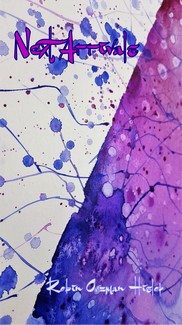
Category: Poetry Type: Non-Fiction
Pages: 147
Copyright: July 2018
Robin Ouzman Hislop's poetry is certainly in dialogue with some of the key architects of the 'poetics of indeterminacy' – both the Modernist strands represented by the likes of Beckett and Stein, and the postmodernist strands represented, initially, by Ashberry and Antin, and later on by poets like Charles Bernstein and Ron Silliman. Next Arrivals, however, also explores and responds to themes only rarely addressed by 20th century experimental poets. Hislop is keenly interested in exploring poetically a range of phenomena loosely related to 'the New Sciences'. His interest is not that of the wide-eyed, but willfully naďve, classical scientist. He understands humanity's darker impulses – particularly our darker collective impulses - too well to buy into the idyllic marriage vows these days being exchanged between the New Sciences and extreme capitalism – however loved-up the happy couple appear to be in public. ~Ian Irvine (Hobson)Vicoria. Australia.2018
Excerpt
we invent them to serve us controlling our existence
to create virtual worlds with hells and heavens
myths domesticate science
fiction and reality blur shaping our reality
an assembly of biochemical algorithms flash fade flash fade
spinning
epidemic is business economy grows
human experience as any other item
in the supermarket a designable product
intelligence mandatory consciousness optional
individuals = dividuals
in carbon or silicon
owned by imaginary gods
who what you are how to turn you on and off
beyond control
beyond
the opaque wall
algorithms can command empire
or an upper class ruling the planet
if words could make dreams come true
a simultaneous instant in the brain of seven billion
emerges the beautiful androgynous face of the serial killer
wheat eater bread winner
& the deluge of data
millions of nano-robots coursing humankind's veins
an Orwellian police state
splits into
the chosen hi-tech Noah’s Ark
a new religion information flow
datism
to merge or not to merge
the human genome as a digital processor
where overwhelming data
garbles the message in dystopian double talk
will the defeaters prevail
or cometh utopia from outer space
our post human descendants
do as you would be done by datism
as we condemned the mammoth to oblivion
your every action
but where no human can follow or need to understand
in the matrix the inter net of all things
where has the power has gone
the cosmic data God draweth nigh
the great flow
to maximise to plug you in voters of the world unite
a colossus astride this narrow world
free market
big brother
watches over every breath you take
invisible hand that flies in the night
between laboratory & museum
voice of a million ancestors
a ripple in the cosmic data flow
shifts homo centric view to data centric view
knowing us better than we know ourselves
forager
scavenger of carrion follower in fear & flight
big brained
Neanderthal Denisovan Sapiens
what drove you for 2 million years
a big bum?
what bound
small divergent groups of differing tongue & taboo
into the framework of humankind
but fiction
collective myths woven into our reality
from money to the nation state
imprisoned
by the archetypes
we've identified them with a virtual reality of cartoon molecules
*
after Yuvah Noah Harari
Sapiens & Homo Deus
Professional Reviews Ian Irvine (Hobson) - The Many Faces of Creative Indeterminacy
Ian Irvine (Hobson) - The Many Faces of Creative Indeterminacy
Poetic Indeterminacy 1:
L=A=N=G=U=A=G=E poetry and Late Modernist Experimental Poetry
When Marjorie Perloff, long-term critical advocate for L=A=N=G=U=G=E poetry (indeed for experimental poetries generally), published The Poetics of Indeterminacy: Rimbaud to Cage back in 1981, she wanted to trace a particular kind of poetic ‘indeterminacy’ back to its 19thcentury roots in Rimbaud. Early on she quoted Barthes’ perspective on Rimbaud’s poetics: ‘Rimbaud … destroyed relationships in language and reduced discourse to words as static things … In it, Nature becomes a fragmented space, made of objects solitary and terrible, because the links between them are only potential.’ Perloff then traced the 20th century developments in this emerging poetics via chapters on Gertrude Stein’s ‘word-systems’, Samuel Beckett’s ‘poetics of absence’ and John Ashberry’s ‘open field of narrative possibilities’ (elsewhere termed a ‘field poetics’). Her book concluded with studies of the ‘marginless’ poetics of David Antin and the chance-operations poetics of John Cage, who wrote of his later works: ‘They begin anywhere, last any length of time … They are therefore not preconceived objects … They are occasions for experience.’ Perloff’s book led to further studies in which she announced L=A=N=G=U=A=G=E poetry as a further chapter in this century old poetics of ‘indeterminacy’.
Robin Ouzman Hislop’s poetry is certainly in dialogue with some of the key architects of this well documented ‘poetics of indeterminacy’ – both the Modernist strands represented by the likes of Beckett and Stein, and the postmodernist strands represented, initially, by Ashberry and Antin, and later on by poets like Charles Bernstein, Bruce Andrews, Lyn Hejinian and Ron Silliman. Next Arrivals, however, like Hislop’s second collection Cartoon Molecules, also explores and responds to themes only rarely addressed by 20th century experimental poets.
In both Cartoon Molecules and Next Arrivals we start to catch glimpses of a hulking phantasmagoric something (a transhumant creature perhaps?) as it ‘slouches’, ‘transforms’, ‘self-engineers’, ‘machine learns’ it-self into being under cover of the postmodern twilight. Culturally speaking, something new is being born/engineered/programmed in these early decades of the new millennium and all three of Hislop’s collections, in my opinion, work hard to capture the cultural zeitgeist surrounding aspects of this transhuman nativity drama (one interpretation of the collection’s title, i.e. literally, the Next Arrivals). Hislop senses that new poetic forms - what we might label a new (perhaps quantum influenced?) ‘poetics of indeterminacy’ - may be called for here and, like US poet Amy Catanzano, he is courageous enough to initiate new experiments with poetic form in order to address the urgencies of our time.
Poetic Indeterminacy 2:
Eulogies for the Passing of Mechanist Science
All this is to say that Hislop is keenly interested in exploring poetically a range of phenomena loosely related to ‘the New Sciences’. His interest, however, is not that of the wide-eyed, but willfully naďve, classical scientist. He understands humanity’s darker impulses – particularly our darker collective impulses - too well to buy into the idyllic marriage vows these days being exchanged between the New Sciences and extreme capitalism – however loved-up the happy couple appear to be in public. His unease and ambivalence regarding this pairing is evident in many of the poems featuring New Science themes. At times key poems descend into states of existential vertigo brought on by what is unfolding. Such themes are most directly addressed in one poem (p.59) of the collection:
we invent them to serve us controlling our existence
to create virtual worlds with hells and heavens
myths domesticate science
fiction and reality blur shaping our reality
spinning
Similar notes of caution and critique accompany references to genetic programming, Artificial Intelligence (and the much publicised ‘approaching Singularity’), Virtual Reality obsessions (Hislop’s meditations on Bostrom’s ‘Simulation Argument’ are particularly interesting), quantum computers, and, so on, throughout the collection. He asks us to be wary of the way the New Sciences are merging with what he refers to as ‘datism’, and then warns us that ‘algorithms can control empire/or an upper class ruling the planet’ (p.60). Later in the same poem (p.62) we read: ‘free market big brother/ watches every breath you take’. The New Sciences, of course, were founded on a profoundly ontological understanding of ‘indeterminism’, arising as they did, out of the discoveries of a range of early 20th century physicists - especially Heisenberg (with his so-called ‘uncertainty principle’).
Our need to explore these kinds of ontological uncertainty suggest a second major way to understand contemporary experimental poetries as ‘indeterminate’ – a way that brings Hislop close to the concerns of a growing band of writers creating what some are calling ‘Quantum Literatures’. What kinds of art, philosophy, poetry and poetics should we develop to address fundamental ‘indeterminacies’ of matter and consciousness (rather of consciousness observing matter)? Hislop does not, of course, advance explicit theories on such topics in this collection, but a poetic response to the challenges posed hovers above a number of the best poems in the collection. Such concerns also – whether consciously or unconsciously – seem to affect the formal flow of the collection.
Next Arrivals can, in theory, be entered via a range of gates, since the 2nd to last poem in the collection mirrors the collection of lines used to construct the table of contents. Though there are no titles to each discernible segment of poetry – no capitals and headings to interrupt flow – we slowly become aware (via a kind of gentle memory murmur) that the first line of each new segment also appears in the table of contents (and will appear again at the end of the collection). In a sense then, our reading choices – i.e. whether we browse/surf the collection or proceed more conventionally from start to finish – ‘collapse’ a range (or field) of reading (and meaning) possibilities into a particular reading outcome. The experience, however, is always ‘hologrammatical’, since poem fragments from across the collection are embedded in secondary poems – producing the uncanny sense that every poem is linked to every other poem. Another term for this – a term directly related to the New Sciences - is ‘entanglement’. Specifically, we are talking about a poetics of entanglement. It is perhaps an intuitive development –possibly arising naturally out of Hislop’s deeply held ecological vision (as outlined in a number of the collection’s other poems). We note, however, that a poetics of entanglement may run contrary to the kind of language atomizing poetics we sometimes find in the more extreme manifestations of contemporary anti-representational poetry.
Although Hislop uses a range of L=A=N=G=U=A=G=E poetry techniques, the poems in Next Arrivals are never completely ‘anti-representational’. Rather meaning-creating choices, options, possible worlds/selves are offered up to the reader at every turn. The poet invites us to contemplate a new kind of reading freedom — a freedom built upon expansive notions of subjectivity, linked, in turn, to up-dated Existential and New Science perspectives. A subjectivity, in short, subliminally aware of the multiverse. Barthes’ summary of Rimbaud’s poetic (and, retrospectively the poetics of late Modernism and Postmodernism) – i.e. a poetics of ‘objects solitary and terrible’ – is not, in the end, Hislop’s poetic. Rather, we are talking about a poetry slanted toward human vulnerability and the facts of our inter-relational entanglements – a poetry addressing readers staring at the approach of an A.I. and big-data determined - perhaps Simulation programmed - future that may well see ordinary humans made obsolete and irrelevant – in a word ‘surpassed’. Interestingly, however, I suspect that for Hislop the risks associated with the fast approaching A.I. Singularity confront us as contemporary manifestations of what amounts to an age-old curse.
Perhaps a classical allusion is in order. As we read Next Arrivals we become aware that we are still negotiating the Minotaur’s death-haunted labyrinth (in many ways the structure of the collection resembles that of a literary labyrinth). The face of the Minotaur, however, continuously shape-shifts into that of Saturn (old Father Time himself, or, put differently, the inevitable human encounter with death/mortality). There are thus a number of moving poems in Next Arrivals exploring mortality, ageing and the general fragility of human life. Two lines, for me, best summarise the collection’s new spin on this very old theme (p.69):
but I brimmed in apocalypse under the welter of bones
yield to the inevitable
Poetic Indeteminacies to do with Editing, Translating and New media Technologies
Hislop and his wife, Amparo Perez Arróspide, have edited the online literary and visual arts publication Poetry Life and Times (PLT) since 2006. In this age of global communication networks, it becomes increasingly difficult to separate a poet’s poetry from a poet’s elsewhere contributions to literary and online cultures. Everything swims together in a kind of ‘electronic soup’ of interactions and information nodes on the WWW (representing perhaps another kind of ‘field poetics’ or ‘poetics of indeterminacy’). For better or worse, the specialized poets of the 20th century have slowly been replaced by a new breed of transmedia savvy ‘uber-artists’. Some poets are well equipped for the new role. Hislop, certainly, is comfortable communicating in a range of genres, across a variety of conventional and new media platforms (e.g. reviews/nonfiction essays, translations, video-poems, teaching, poetry performances, etc. ), as well as through publishing the works of other poets at the PLT site (and we note that all good literary journals seek to construct ‘an open field of narrative possibilities’).
There is no doubt that PLT, here including work published via its sub-sites Artvilla and Motherbird , expresses a truly internationalist poetics. Its contributors herald from all over the planet and the various sites feature a range of poetic styles—traditional, modernist, postmodernist, experimentalist, etc . The editors are also committed to publishing the poetry of non-English language poets (translated, in many cases, by the editors themselves). We note here that ‘translation’ is itself a notoriously difficult and ‘indeterminate’ activity – there is always a trace of the translator in the finished product, however much he or she strives to eliminate any evidence of input. Overall, PLT augments ,and expands upon, the very same poetics of indeterminacy we encounter in Hislop’s own poetry.
*****
The creative Indeterminacies I have located in Hislop’s overall oeuvre are cause for celebration. Exploring such ‘creative indeterminacies’ will introduce us to zones of hybridity – the interstitial plazas and market-places that exist between the monolithic, but ultimately delusionary and oppressive, certainties fed us daily by governments, media moguls, religious leaders and ideologues. There is something liberating and eminently human about embracing the expanded notions of self we encounter in Hislop’s poetry. We note that John Cage also sought a more expansive definition of creative practice when he labeled his later experiments ‘occasions for experience’. We may apply the same terminology to the poems in Next Arrivals – they are, each and every one of them, ‘occasions for experience’. Hislop’s ‘occasions for experience’, however, highlight the ambivalences and anxieties, as well as the joys and occasional epiphanies, experienced by ordinary people attempting to make sense of our globalised, corporatized, information-saturated post-postmodern world.
Ian Irvine (Hobson), Victoria, Australia, 2018
E.M. Schorb - “Simplify, simplify,” wrote Thoreau, and we get Einstein’s formula E=MC² .
E.M. Schorb - “Simplify, simplify,” wrote Thoreau, and we get Einstein’s formula E=MC² .
Some might say that Einstein had simplified the immense complexities of the universe in a manner that Thoreau would approve.
To the uninitiated, Mister Hislop’s Next Arrivals might seem unduly complex; but it is the absolute opposite of complex. This epic poem—for it is not a book of poems—it is an epic of time and space, of variable time and elastic space.
We mustn’t look at this poem flat on, as we might when we look at Milton’s “Paradise Lost,” like a map. Milton fills in his spaces. Spaces are the subject of Mister Hislop’s Next Arrivals; the electric universe and its interstices. We are singing the body electric with Whitman, but in a different way. We are singing the universe, its mysterious nooks and crannies, and to sing it, as Mister Hislop does, we must see it through all the points of the compass at once, and we must see it between those points. Think a wheel with spokes: the author suggests that there is something important between the spokes, something that must be felt and found, perhaps a final reality, and as we fill in these interstices, the parts of the poem almost miraculously clamp together.
life deceives the disobedience of art
plunged into never waking obsession
the play is yet in flux
a crowd of events jostling for a place amidst the shambling shadows
(p. 55)
There is a handful of the stuff between the spokes. These metaphorical shadows are also real spaces. We cannot make similes because we do not understand what is there, but we have no doubt of the crowds in space and time. They cry for attention. They beg for notice. Mister Hislop is attentive. He listens. He attends. He is a poet.
vast unoccupied
regions of outer space
night wrapped up in immutable energy
a silicon chip may stay put there for eternity in infinity
or blip
to be resurrected on a google bandwidth
(p.75)
Patches of words are spaced in such a way as to suggest what is next—the Next Arrivals—and there they are—what is in the spaces. Next Arrivals is a space epic, not science fiction, but a silicon epic of the spaces, what is in there and out there in language and reality. But an epic must have movement, narrative; and what we are advised to read is the narrative of digital tapping. There is no past, no future, now is the moment and we are actually in flight!
Tap! Gluon! Tap!
It makes one wonder if we have produced a machine or rather if we are, if the universe is, the product of an even greater machine, and if, ultimately, some kind of god, a deus ex machina, may emerge from the machine and solve the tragedy we all live—I’ll call it “The Tragedy of the Trees.” Mister Hislop makes us feel this almost supernatural—let us say ontological—journey. This is a brilliant poem, and we must thank the author for it.
Captivating.Reviews. JD. Amazon.com
Next Arrivals shows again that poet Robin Ouzman Hislop is not afraid to arrange words in new ways. Here are three points I liked:
The book is far from spare with nearly 150 pages of verses and thoughts. Too often, poetry collections are brief and quickly strung-together. This book offers much.
Poetry becomes prose in some places, and the lines are blurred. As I tell my students, there is no one way to write best. Hislop’s work is a verbal playground.
As should be the case, words work well together in each selection. Windows are given personified powers, syllables bounce off of each other. The poems work as they should, capturing experiences.
The songs and art in this book are about our collective emergence after the pandemic and trauma of the last few years - comprised of 5 collections: World as Refuge, Where We Live, In Our Hands, Rhythms of Change and What We See & Sow.