
Kindle Edition
Amazon
authorsden.com/asadseeley
amazon.com
Category:
Mainstream
Publisher: KDP
Type: Non-Fiction
Pages: 66
Copyright: May 28, 2019
Price: $4.99 (eBook)
The gifted and fascinating Urban Poet, Asa D Seeley, once again speaks. He introduces a New Genre of Poetry...Reality Confrontation. Juxtaposed with Essay and staying true to his unique style, Asa brings a breath of...fresh air...to the world of poetry.
INTRODUCTION
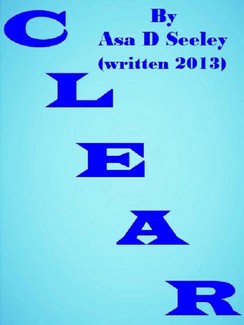
The concept to format “Clear” in juxtaposition with that of poem and essay was done to further the reader’s understanding of the author and primitive artist, Asa D Seeley, (his logic, ethics, creative gene and core values), that resulted in the creation of an unique genre of poetry; Reality Confrontation. In addition he wanted to show that something that is of huge importance could hold its value though being significantly modified. Last, he wanted to show that something considered small can have enormous meaning.
Reality Confrontation’s purpose is to evoke thought that surpasses our set standard of mental agility, to prove that better reasoning does and should exist. Also, it is an attempt to reiterate primitive fundamentals that humans have strayed from due to modern innovation and commercialization, leading to a mass decline in the immersion into one’s self... leading to more focus on others than themselves.
Reality Confrontation is primitive in structure and in many aspects, a novelty. Its founded on the Author’s reality who realizes an individual’s reality does not just consist of actual events. A person’s reality embodies acts, dreams, feelings, beliefs, sub-conscious and conscious thought. This is why animation is very seldom included into this genre. But when included, its input is meticulously formatted within the poem. This precautionary measure is taken as a result of a concern of not wanting to give renewed vigor to the illustration which is the poet’s actual reality. Reality Confrontation is the recognition of thought being just as much reality as action.
Since thought is existing matter, whether acted upon or not, the practitioner of this genre must decipher their own imagination and extract and utilize the majority of thought required to successful transition from mental activity to that of action. This further explains why the poet's selections of metaphoric and symbolic elements are minimal. It is also a very selective wording process. This allows the poet to fully express himself not using circumlocution as opposed to brevity. It is an integrative stand, a need and desire for the well being of self as much as for the well being of others.
AsaDSeeley
Excerpt
CHAPTER VI
THE LIFE OF...
Admittedly being a fan and practitioner of modern avant-garde, I struggle with the process of fictional assembly. My personal portfolio contains some, but I have successfully not completed far less than what I completed. Not because I am less in favor of fictional works than nonfictional. I have done a great deal of soul searching for the proper reason for this and the conclusion I have come to is; I am just as passionate about the process required for creation of fictional projects as I am about others. And wholeheartedly in love with the art in its totality, its substance is not drawn out of the same part of my soul. My integrative wit becomes stubborn and struggles to lend contribution to assist that part of me of which my fiction is conceived. I know it's complicated, but I suspect there are some that understand.
The reason I bring this into the conversation is because of an article recently posted in the Baltimore Sun. A screenwriter is in the process of taking an autobiography and integrating it with fictional contents. His reasoning is to entertain the audience and to defy film makings conventional tradition. I must say, I'm not familiar with the work of this artist but I am very familiar with reviews of his work. I in no way question the integrity of his work nor his skill and artistic ability. However, there is difference in our outlooks surrounding this.
When it comes to autobiography configuration, my confusion is where, when and how do I go about the assembly of questions and answers. To be completely honest, the entertainment of the audience in other forms of my works such as paintings, essays, memoirs, fictional screenplay, etc are very low priorities for me and are not a concern of mine. My want to pursue the creation of the person, persons, event or events has to come from a personal connection to that of the subject matter. And so, the contents for the story line should only be drawn from legitimate sources such as the main character, friends, associates, contemporaries or family. And if not directly from these sources then most definitely from validated and documented materials. If any additions to the original story line are to be attached seek permission from the source. Additionally, the source’s opinion should be applied as to when, where and how so these additions can be properly placed. Why should these precautions be taken as long as the audience is entertained? AND WHO CARES? We all should!
And I am most certain that the ones that are being re-created care deeply too.
Therefore, although symbolic falls underneath the same realm as roman comedy, mid-evil, traditional drama, do-da surrealist and pastoral, it most certainly has its own lane. And it is its make-up of truth and cohesiveness to reality, even with the use of imagination that gives it its majestic and eccentric independence.
I look at all genres as being social events, but every social event is a different occasion. One is a funeral, the other a ball-room dance and another a wedding…and so on. And so, every art-form has its individual uniqueness.
FIGURATIVE AND LITERAL
Outer beauty…
no longer moves me…as it once did
Kind gestures…and
flattery…too no longer am I
appeased by…But
there are acts carried out
over a non-specific course of
time that I fully take notice
of…and…
words that are reflective
of those acts…
I then truly admire
|