This highly-accessible, dynamic collection offers existential ponderings, comic situations, poetic meditations on death, musical riffs, political commentary, striking imagery and more.
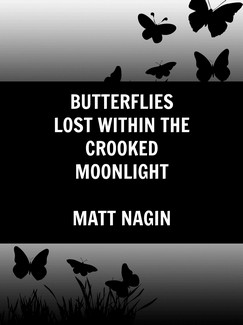
This highly-accessible, dynamic collection offers existential ponderings, comic situations, poetic meditations on death, musical riffs, political commentary, striking imagery and more. The 45 poems in this collection represent a range of styles and subject matter. 18 of these poems were previously published in such journals as Antigonish Review, Grain Magazine, Arsenic Lobster, Dash, Spillway, The Charles Carter, Downtown Brooklyn, and many, many more. This debut collection of poetry from Matt Nagin is sure to, as the title suggests, comment on the way even the most delicate and majestic of us tend to be drawn, willy-nilly, towards the crooked moonlight.
Excerpt
Begin Where You End
The wounds leak out my chest like sparrows
like cantankerous verbiage like masks at a
carnival like the time I lost my keys like margins
of error like you looking like an emu solving a
rubix cube like mysticism at the birthplace
of eternity like a tsunami of metaphorical language
crashing a haiku party like flying fish settling
down on the edge of a wave like I don’t even
know anymore if I’ve forgotten the compass
lost hold of what I was saying like it is all
another like even this like blending into the
mix like enmeshing is freedom like the answers
are beginnings like love is enough like I
gave up before I even started like what I need
now what could really save me is a well-chosen simile.
Professional Reviews
Powerful verse from a writer of real talent.
Nagin’s verse is a torrent, and readers will thrill as it carries them off.
This poetry collection—which tackles themes of art, authenticity, and desire—is as energetic as it is infectious. The author tackles many themes but seems especially concerned with craft—poetry about the struggle to write great poetry. The best adjective for describing his most effective verse is “breathless,” and it often seems that Nagin is so possessed by his subject that his words pour out: “The wounds leak out my chest like sparrows / like cantankerous verbiage like masks at a / carnival like the time I lost my keys like margins / of error like you looking like an emu solving a / rubix cube like mysticism at the birthplace / of eternity.” The “leak” in the first line quickly becomes a rush, and soon enough we’re not reading Nagin’s words, we’re riding them. Such passages recall the early work of the Beats; Kerouac and Ginsberg also understood poetry as effusion, and Nagin seems to have learned much from these countercultural icons. This author is no one-trick pony, however, and his other pieces are sparer, more condensed. The middle of “Poems from the Head” is a thin string of fragments: “Poems from the gut / new endeavors / Poems that strut / magical stew. / Poems defy / swirling black rivers / desperately / desperately / carrying through.” The lines here are so fleeting that we almost miss the touching rhyme of “stew” and “through.” This is the poet writing in the gnomic mode, but the fact that Nagin can work so persuasively in both registers is a testament to his estimable skill.
Powerful verse from a writer of real talent.
--Kirkus Review
Readers Favorite Review
Matt Nagin’s Butterflies Lost Within The Crooked Moonlight is a collection of poetry that speaks about all aspects of life. The voice that crosses every page feels like defibrillation treatment. It has a commanding jolt that makes the reader sit up and take almost immediate notice. One of my favorite lines and there are many within the entire book, comes from the poem Wondrous Admonition on page 13, “…wiry meth heads resembling scarecrows in the field.” His poems don’t hold back, they don’t paint pretty pictures, because life in its purest form is far from pretty. But what Nagin’s poems do express is truth and how the world is today. A few of my top favorites were At The Funeral, Inspirational Chat, and Poetry Assassin.
In Butterflies Lost Within The Crooked Moonlight, Matt Nagin delivers in stark and jarring completeness. There are no two poems that are the same. And that is one of the aspects that I love most about this collection. Each poem feels distinctly new and apart from the one before it and yet they all feel part of the same body. You can feel the frenetic energy spinning round in a spectacular fervor and slowing down at other times. It’s a steady path of pushes and pulls that will suck the reader into the moment and the sheer movement of the poem. I can easily say, without any doubt, that anyone who reads Matt Nagin’s Butterflies Lost Within The Crooked Moonlight will be affected by it, and possibly even changed for the rest of their life.
Dystopian power in forty-five poems.
Star counts are one person’s opinion. This book’s title should prepare you for its content, but not for Nagin’s power of communication. So, as always, do not let my star count override your judgement of content. More on the stars, counting, and my rating challenges later. Let’s get to the point: Nagin’s work.
For a prose poem, turn to Immigrant Love Story, which begins thus: “Your face is my face and my future is your future and yet your face is kept behind a fence and coils of barbed wire and your face is told it needs signed documents….”
For an interesting piece of social commentary, turn to Outside Hotel Gansevoort, which ends with this: “Every man tries to look away; /seem nonchalant; fixates on /petty, obtuse concerns— uselessly. /These women run the show.” If you think that’s a spoiler, turn to this poem when you have the book.
For a fascinating relationship, turn to Wrong One, which has a surprise ending. For an even more disturbing relationship happening, turn to Night at the Waldorf.
I generally find myself annoyed about writing that’s about writing, but some authors can pull this off really well with an experience that takes you in. Nagin has done this in Report Card, which is mostly about life and other people’s expectations.
Nagin is writing experiences which will happen to you when you read. In Tinseltown Hierarchy you are caught up in a happening between various ‘actors’ and are part of this alien world. Here’s a snippet from the beginning: “The assistant spoke into the microphone /reflecting back the order from the publicist /who signaled to the grip who collaborated with….” It’s impossible for me to give you the speed of this ongoing development. Buy the book and turn to this piece.
Nagin does not live in a perfect world. For an unpleasant self-assessment, turn to Twelve Years an Adjunct Professor.
I have other favourites in this work, but the above should give you a decent feel for what’s on offer here. Now for my star count boilerplate.
My personal guidelines, when doing an ‘official’ KBR review, are as follows: five stars means, roughly equal to best in genre. Rarely given. Four stars means, extremely good. Three stars means, definitely recommendable. I am a tough reviewer. I try hard to be consistent. Nagin stands tall with the best of them, but in his own way: more personal than W.H.Auden (The Shield of Achilles,) more gut-wrenching than Robert Frost (The Lovely Shall Be Choosers,) a bit like Archibald MacLeish (What Every Lover Learns.) Five stars here feels right on; extremely recommended.