
Kindle Edition
Audiobook
Download to your Nook (eBook)
Amazon
SteveBassettWorld
Amazon
BN
Category:
Military
Publisher: Red Hen Press Xeno Imprint
ISBN-10: 1939096243
Type: Non-Fiction
Pages: 324
Copyright: Nov 9, 2018
ISBN-13: 9781939096241
Price: $0.99 (eBook)
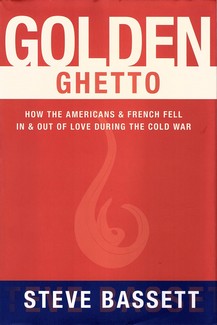
Considering the suspicions, jealousies, bigotry, and crass opportunism inherent whenever one foreign power occupies another, award-winning journalist Steve Bassett’s “Golden Ghetto: How the Americans and French Fell In and Out of Love During the Cold War” pieces together an improbable love affair that ended in betrayal by French President Charles de Gaulle.
It is a Cold War tale of birth, growth and death of a huge U.S. Air Force base as relived through the heretofore dormant memories and voices of both the occupier and the occupied. Tens of thousands of American GIs passed through Dèols-Châteauroux Air Station during the sixteen years that it was the largest U.S. Air Force supply base in Europe.
Bassett has woven a tapestry composed of hundreds of hours of interviews and long forgotten photos providing for the first time a unique blend of voices seldom if ever heard. French citizens describe what it was like to have foreign troops roaming the streets of their city. The Americans recount what it was like to be viewed with initial distrust and suspicion, if not outright hatred, fueled by a local communist, anti-American propaganda machine under the direct control of the Kremlin.
When the end came and the base was padlocked in 1967, it was our reluctant ally Charles de Gaulle who administered the coup de grâce by booting out of France not only the United States, but all of NATO. Although “Golden Ghetto” is uniquely a French and American story, this saga is also a microcosm of what was experienced by the 120 million American men and women who served in the military during the Cold War, 27 million of them overseas. Historians, Cold War veterans and their families, as well as the casual reader will be drawn into a rare snapshot of American history.
Excerpt
EXCERPT from: Golden Ghetto: How the Americans and French Fell In and Out of Love During the Cold War”
The Black Market -- The presumption that American military bases overseas provided foster homes for black marketeers is certainly true at Châteauroux. But to what degree? Few Berrichon who admitted their involvement conveyed a sense of embarrassment or guilt, and from their vantage point, why should they? Hadn’t Uncle Sam arrived in order to provide opportunities? So with a sticky finger here and there, a GI boyfriend in the right place, or access to the goodies at the base, why not take advantage of them?
“There were plenty of opportunities to make a buck, black market for example. Cigarettes and whiskey, as well as blue jeans. I can’t remember how many pairs of blue jeans I bought at PX prices and resold in the villages nearby, making a dollar or two on each pair. So I made a buck (laughter),” recalled Annette Gagné while taking a break from the kitchen at Joe’s From Maine.
“I remember everybody took advantage of the U.S. presence. When they decided to extend the runway, a local company was supposed to bring raw material for the concrete by trucks,” said James Bessett, who earlier recalled he and his companions had no trouble spending the money that fell from the pocket of a drunk GI at Le Lido. “It was said that one of every two trucks that came into the base full of material, left full of material, too. The trucks were not unloaded each time. The company made a lot of money.”
“My manager was fired for black-marketing cigarettes,” said Madelaine Dagot, a clerk who succeeded her boss at the La Martinerie PX. “I recall him telling me at inventory to total the boxes of cigarettes even though they were empty. Cigarettes and whiskey were two of the most popular black market items.”
“There were a lot of young girls in Châteauroux. They liked chocolates, cigarettes and nylons. So, are you getting the picture? You might say there was a lot of testosterone flowing,” said Dave Bankert. “And it was cheap, you could buy chocolates and cigarettes for nine cents a pack and trade them in town.”
“The black market was big. Coupons for gasoline, everybody wanted them, cigarettes, whiskey,” said Alain Birckel. “I worked out a deal with my friend Danny at the base. One of my best customers was Monsieur Rafa, the owner of the best men’s clothing shop in Châteauroux. He was a Jew and a Zionist. It was usually two cases of cigarettes and two cases of whiskey. I understood he didn’t do this for himself. He would sell them for a profit and the money would go to Israel for the Zionist cause.”
Bob Goggin, a JAG attorney at CHAS, recalled a one-man black market operation that while humorous, at the same time indicated how widespread the black market was. Goggin was ordered from Châteauroux to defend an accused airman. “It involved an Air Force officer who was staying at a Paris hotel and when he went to bed, he realized he was sleeping on U.S. Government issue sheets. It turned out the sheets came from one of our air bases in France. An airman at the base, he was either a sergeant or a master sergeant, was the quartermaster who handled the linens. He decided he was going to help the French economy by supplying hotels with sheets and linens at a cut-rate price. I defended the guy. He was busted in rank, but remained in the Air Force.”
“With what the Americans had to offer, it was not a problem for us,” said Gypsy Marien, the operator of a downtown Châteauroux bar who insisted his “hostesses” were not “working girls.” “It would take place in bars. We would make deals for the tax-free gas vouchers the GIs would get. There was business concerning whiskey, cigarettes and gas. A guy would also bring a pair of jeans or a shirt from the PX. That’s when we would exchange dollars, Americans were never paid in Francs.”
“The black market was extensive. Every American had at least a few things he could dump off to make a buck, but not everybody did it. There were some people who specialized in it,” said René Coté. He noted that as the French alcoholic palette became more sophisticated, their tastes ran up the connoisseur’s chart from rye to bourbon and finally to upper-crust scotch.
Black-market profiteering involving U.S. military personnel in Europe had been around for quite awhile. It has reached such proportions that as early as August 1946, Colonel Francis P. Miller, an Army Intelligence officer, told a congressional committee in Washington that he was “morally shocked” by the widespread black-market activities in Germany going back to 1945, which clearly pointed to the “moral disintegration” of all military ranks.
Predictably, congressional investigations followed revelations such as these. As a political firestorm engulfed Washington, the U.S. military tried to repair what had become a serious public relations disaster. By comparison, the black marketeering going on in Châteauroux during the Cold War could be called bush league, with military brats exchanging chocolates and nylons with hopes of female favors, blue jeans pulling in a big two bucks profit per pair, and with illegally obtained gasoline coupons used to fill the tanks of a Deux Chevaux.
The Cold War and the bundling of the United States with eleven other nations into NATO was something new for Uncle Sam. The burgeoning black market in post-war Europe was conducted in comparative peace and tranquility, and if you were to believe the leniency of penalties, it received de facto acceptance by the authorities.
When Josh Getzoff received his captain’s bars shortly after his arrival at CHAS and began drilling and pulling teeth at the base dental clinics, he had only one thing in mind when it came to his off-duty hours: have as much fun as possible. He loved Paris, virtually camping there on weekends, often with special service officer Godfrey Friehofer Russman, Jr., one of his two roommates in Châteauroux. It did not take long for him to discover the magnetic pull of that city’s black market. “But there’s one thing I want to tell you that I’m not too proud of,” Getzoff said.
“I went to Paris with Russman and he told me, ‘Go buy all the cigarettes and Johnny Walker that you can and other stuff like that from the PX.’ So we drove into this place in Paris, each with a suitcase of clothes and another stuffed with things from the PX.
“It was a prearranged meeting place. I was sitting in the backseat of the car when this guy, a Frenchman, got into the front seat and we started driving around Paris. We stopped and he goes around to the trunk and takes the suitcase out with the stuff from the PX and then he disappears. Here’s what was going on. You could make enough money in Paris to comp your entire weekend without paying a cent, just by selling the stuff from the PX. They went kooky over the Johnny Walker and you could really get top price for that.
“Then later I got to know of other people in Paris who were a lot seamier. This guy approached me one time, he was an American ex-patriot and he said to me, ‘I know you’re a doctor. Can you get me penicillin? I’ll pay you really good for it.’ I can’t remember what the price was, but I will tell you it was an absurd amount of money. I told him, ‘Look man, I don’t do any kind of drugs.’ What they did in those days was to water the penicillin down and then sell it. I’ve heard that they even used soda water to cut it down. So ten units of penicillin would become 100 units. I don’t know how widespread this was at the 7373rd AFH. There was one guy from Châteauroux and he was caught and shipped back to the States, probably to Leavenworth. He’s the only one I know of.”
Eleven years before Getzoff’s arrival at CHAS, deaths caused by the underground sale of penicillin was common knowledge, enough to form the basis for a Graham Greene novel, The Third Man. By the late 1950s and early 1960s, black marketeering in and around Châteauroux was banal by comparison, with blue jeans, cigarettes, booze, gas coupons, and possibly frozen chickens and turkeys providing the way for GIs and the French to make a fast buck or two, posing the question as to whether the Golden Ghetto represented progress.
|