|

Click here to buy this book!
Kindle Edition
Lulu
Internet Archive
Academia.edu
Category:
Philosophy
Publisher: Self Imprint
ISBN-10: B09DCJVVVR
Type: Non-Fiction
Pages: 51
Copyright: 23 Aug 2021
This ‘overdue’ work, may lead the ‘denied’ Hindu castes as well as the favored folks for an objective approach to the in vogue Bhagvad-Gita which could dispel the misgivings of the former and the delusions of the latter, which could be of interest to the students of logic and reasoning as well.
The Manusmriti, the social doctrine of yore, and the Bhagvad-Gita, the spiritual tome in vogue that lay down the discriminatory dharma (duties) of the four social classes (castes) have been the bugbears of the Hindu backward classes. However, to their chagrin, of late, as the latter is being mindlessly promoted even though the former was constitutionally debunked, they began advocating that it too should be dumped in a dustbin.
Ironically, the improbability of their progenitor Krishna, the architect of the Gita, relegating his own ilk to the social margins failed to dawn upon these that Gita supposedly slights, even to this day! Thus, their intellectuals, instead of seeking to reclaim their priceless heritage, albeit after ridding its interpolative garbage, tend to rubbish it a la throwing the baby with the bathwater, and needless to say they must ponder.
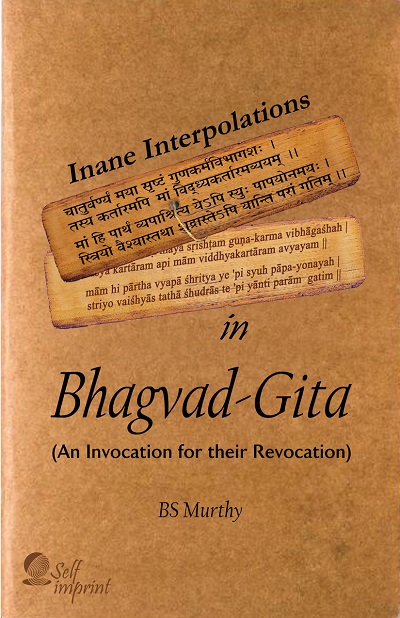
Also, it is high time that the Gita-class stop laying store by the self-aggrandizing verses in this Vyāsa’s classic, evidently inserted by their progenitors that came to bedevil the Hindu spiritual integrity and social harmony. Likewise, the grumblers of the dalit desertions must see the need for setting the Hindu house in order to prevent the fractious poaching by the Church, if not to facilitate the ‘hoped for’ return of the prodigals. So also those who take pride that Hinduism is the only religion that reckons all faith as true, should be concerned about the ‘in vogue’ Gita that belittles some of their caste fellows. Besides, this work beckons the feminists to reckon the second of the two interpolations from it cited in the cover image that degrades them in unspeakable terms.
This ‘overdue’ work, may lead the ‘denied’ Hindu castes as well as the favored folks for an objective approach to the in vogue Bhagvad-Gita which could dispel the misgivings of the former and the delusions of the latter, thereby bridging the Hindu emotional gulf with its abridged book that restores its original form. Whether or not one concurs with its propositions, this original work could be of interest to the students of logic and reasoning as well.
Excerpt
Gita's Double Jeopardy
Bhagvad-Gita, often referred to as the Gita, comprises eighteen chapters, which, in all, contain seven hundred slokas (verses) that is not counting the unnumbered opening number of its thirteenth chapter. Though it has gained prominence on its own steam, in fact it is a part of the epochal Mahabharata, which, with over 100,000 slokas, is the longest tome in the world of letters. Moreover, this epic, probably compiled around the third century BCE, whose authorship is attributed to Vyāsa, is regarded by the Hindus as the panchama veda (the fifth Veda) and the Gita, its divine part, is celebrated by the world as an unrivalled philosophical work.
Yet it is a safe bet to aver that while most (mainly Hindus) might have heard about it, hardly any would have read it (much less appraised it) though it contains no more than seven-hundred verses, excluding the above cited unnumbered one! Not only that, possibly, this classic could be the only epic in the world that is admired without application of mind and debunked with reasonable misgivings as it, as it is, sanctions the inimical caste structure in the Hindu polity that is as opposed to the Torah, the Bible, and the Quran, which seek to inculcate emotional unity amongst their respective adherents!
Whatever, on one hand, William von Humboldt, the philosopher of yore, eulogized it as “the most beautiful, perhaps the only true philosophical song existing in any known tongue …. perhaps the deepest and the loftiest thing the world has to show”, and on the other, Vijay Mankar, the Ambedkarite of the day, debunks it is as a rotten work deserving to be thrown into a dustbin for “it advocates inequality of man based on caste, stigmatizes women as an inferior kind, and legitimizes violence.” Equally significantly, neither Humboldt was alone in lifting it to the skies for he had the illustrious company of many a Western thinker such as Arthur Schopenhauer, Albert Einstein, Aldous Huxley, Henry David Thoreau, Ralph Waldo Emerson, only to name a few, nor Mankar lacked company to castigate it as a book of bigotry, for Ambedkar the Dalit intellectual colossus, who piloted the Indian Constitution, was unsparing about it.
It is possible that the Western intellectuals, who could have internalized the Semitic religious notion of the Lord God’s alleged partiality towards his chosen peoples, might have seen nothing perverse in Krishna’s creation of the caste inequity in the Hindu social fold sanctified in the Gita thus:
Ch4, V13
chātur-varṇyaṁ mayā sṛiṣhṭaṁ guṇa-karma-vibhāgaśhaḥ
tasya kartāram api māṁ viddhyakartāram avyayam
It is I who engineered the division of men into four varna (castes) based on their guna (innate nature) and karma (earthly duties) but yet although I am the creator of this system, know me to be the non-doer and eternal,
Or, maybe, they would have simply concerned themselves with its fascinating philosophical postulations, bypassing its alleged espousal of the caste inequities in an alien polity the nuances of which they were unfamiliar with.
However, in contrast, the improbability of their progenitor Krishna, the architect of the Gita, relegating his own ilk to the social margins failed to dawn upon the Shudras that it supposedly slights, even to this day! Thus, their intellectuals, instead of seeking to reclaim their priceless heritage, albeit after ridding its interpolative garbage, tend to rubbish it a la throwing the baby with the bathwater.
Well, if only they apply their mind, bearing Krishna’s advice to Arjuna in mind,
Ch18, V63
That thee heard of this wisdom
For task on hand now apply mind.
iti te jńānam ākhyātaṁ guhyād guhyataraṁ mayā
vimṛiśhyaitad aśheṣheṇa yathechchhasi tathā kuru,
then, it would be apparent to them that their ancestral work was infested with umpteen interpolations that sanctify their social inferiority and further the Brahmanical religious interests, which together muddy its pristine philosophy besides affecting the sequential conformity and structural economy.
However, to be able to discern the Gita in proper perspective, and to be able to visualize its fouling interpolations, one must appreciate its context in the epic of Mahabharata that is at the threshold of the battle royale between the estranged cousins, Pandavas ‘n Kauravas, when Arjuna, the spearhead of the former, suffers from qualms about the prospect of slaying his kith and kin for power and pelf.
In this urge to usher in Gita’s votaries, as well as the sideliners, into its ancient granary so as to enable them to segregate its grain from the interpolative chaff, the quotes in verses are excerpted from the author’s eBook, Bhagvad-Gita: Treatise of Self-help, which, as already stated, is in the public domain, and the interpolations (in boxes) are obtained from other sources, however, in both cases with the Sanskrit slokas of the in vogue text.
Ch1, V28
Thus spoke Arjuna:
Disturb kinsfolk here gathered
Feel I parched, it nauseates too.
dṛiṣhṭvemaṁ sva-janaṁ kṛiṣhṇa yuyutsuṁ samupasthitam
sīdanti mama gātrāṇi mukhaṁ cha pariśhuṣhyati
Ch1, V37
See I no gain by their end
Why then kill our kith ’n kin?
tasmān nārhā vayaṁ hantuṁ dhārtarāṣhṭrān sa-bāndhavān
sva-janaṁ hi kathaṁ hatvā sukhinaḥ syāma mādhava
--------
Download ebook here above
|