Category: Action/Thriller Publisher: University Press of Kentucky
ISBN-10: 0813196507
Type: Non-Fiction
Pages: 432
Copyright: Dec 6, 2022
ISBN-13: 9780813196503
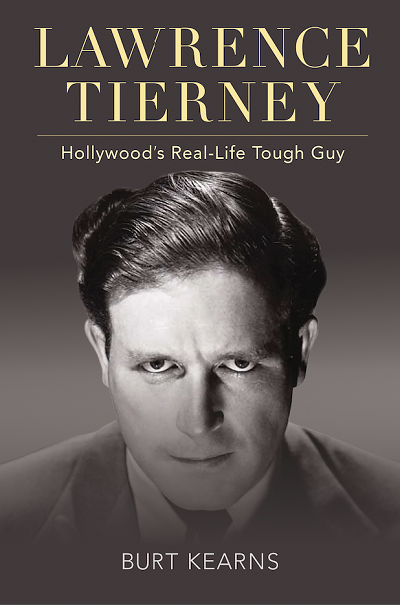
The first biography of the infamous movie tough guy, whose promising start as the star of Dillinger (1945) was soon curtailed by his addiction to alcohol, violent behavior, bar fights, assaults, and arrests.
Author Burt Kearns traces Tierney's storied life from his days as Dillinger, to his clash with Quentin Tarantino at the end of his film career, to his final public appearances. The first official biography of the late actor, the book draws on the writings of Hollywood reporters and gossip columnists who first reported on Tierney's antics, and exclusive interviews with surviving colleagues, friends, family members―and victims. Through their words and his research, Kearns paints a portrait of Tierney's brutish behavior and the industry's reaction to the pugnacious star, drawing parallels―and the line―between the man and the characters that made him a Hollywood legend.
Professional Reviews
Lawrence Tierney Bio Etches Vivid Portrait of Hollywood’s Real-Life Tough Guy
RogerEbert.com:
Not for nothing did Quentin Tarantino dedicate his "Reservoir Dogs" script, in part, to the late Lawrence Tierney. Along with influences from Timothy Carey, Roger Corman, Andre de Toth, Chow Yun Fat, John Woo, Jean-Luc Godard, and Jean-Pierre Melville, Tarantino infused his debut film with the spirit of Tierney, who made his bones onscreen with his first lead performance as "Dillinger" in the hard-boiled 1945 B-movie classic.
A friend, C. Courtney Joyner, read Tarantino's script and was struck by Tierney's inclusion in the dedication. "He was the toughest guy of 'em all," Tarantino enthusiastically explained. "He was a wild man, and he got killed in Mexico. Shot to death in a whorehouse."
Joyner corrected him. Tierney was still alive and living behind the Hollywood library. "I see him like every other day," Joyner said.
An introduction was made at a party, with Tarantino geeking out on Tierney and how his films "captured a time in cinema which was the epitome of the postwar generation" and so on. Tierney's response: "Yeah, kid, you're a real smart guy. Tell me, do you know where the can is?"
This is just one of the too-good-to-not-be-true stories author Burt Kearns relates in his punchy bio, Lawrence Tierney: Hollywood's Real-Life Tough Guy. The book takes full measure of the prolific character actor, whose bumpy six-decade career was marked by bouts of erratic behavior, pugnacious on-set antics, and alcohol abuse. He told a reporter, "I threw away about seven careers through drink."
Generally, an actor's work is his legacy, an iconic role, an indelible performance. Not exactly with Tierney. He was the real deal, who walked the walk and talked the talk, often to his detriment. This is why when I first cracked open this book, the first thing I did was turn to the index so I could skip right to the backstories on two of his most infamous contretemps, his dust-up with Tarantino that led to a profanity-spewing shoving match on the set of "Reservoir Dogs," and his lone guest shot on "Seinfeld" as Elaine's intimidating father.
Kearns' retelling of both did not disappoint. Suffice it to say that what could have been a recurring role on "Seinfeld" was a one-and-done. Says Julia Louis-Dreyfus: "He was a total nutjob" but "a wonderful actor because he was so amazing in that show. And it's too bad he was so cuckoo because I'm sure he would've been back otherwise."
Tierney was born in Brooklyn in 1919. He died in 2002 at the age of 82. He was never an A-lister, more like the Prince of the B's, Robert Mitchum-adjacent. According to Kearns, he reported to work at RKO Radio Pictures in 1943 fully formed:
"He had acting experience, a street-savvy survival instinct that would allow him to support himself no matter how show business turned out, and all the elements that would lead to trouble ahead. The anger, temper, weakness for alcohol, violence, and even the seeds of mental illness he'd carry through 'Reservoir Dogs and beyond, were part of his DNA when he entered the world ... into a home that had its share of love and pampering, but also a hotbed of violence, chaos, and drunkenness."
That newspaper editor in "The Man Who Shot Liberty Valance" might have been talking about Tierney when he said, "When the legend becomes fact, print the legend." Kearns has his hands full printing the facts, only slightly less colorful though they are. Take how Tierney landed the plum role as gangster John Dillinger. To hear Tierney tell it, the then-broke and out-of-work actor heard about the "Dillinger" project, snuck into the studio executives' office, stole the script, and the next day barged into their office and acted out one the script's big dramatic scenes. He was signed for the film.
"That was how it happened," Kearns writes. "But not quite." After take two of the story, he concludes, "That's exactly how it happened—only not exactly." Tierney bedeviled Kearns probably as much as he did directors and costars.
There are a lot of "man behaving badly" anecdotes here, but Kearns does not glorify Tierney or winkingly give him a pass. Still, Tierney is an undeniably colorful personality. Oscar-nominated screenwriters Larry Karaszewski and Scott Alexander, whose unconventional screen bios lean toward larger-than-life, off-center characters, were Tierney's neighbors for a time. Recalls Karaszewski, "He must've seen me with a script, and it was like, 'Oh, you're in the movie business? I'm an actor.' I immediately looked him up—and looking up Larry in the days before Google was a matter of opening my Hollywood Babylon book ... Every picture I could find of Larry had him with a bloody face. But he was just a big old guy who lived next door."
Hollywood loves a comeback story, and the tireless character actor enjoyed a Tierney-assaince in the 1980s. He has the distinction of barking out the last words heard on "Hill Street Blues"' final episode. He was the manager of the California Angels in "The Naked Gun." Critics cited him as the best thing about Norman Mailer's otherwise panned crime drama, "Tough Guys Don't Dance." Finally, he landed a plum role in John Sayles' epic ensemble drama, "City of Hope."
Such was his heat that Karaszewski and Alexander created a role for him in "Problem Child 2," which they scripted. But at the audition, he "was in one of his moods," Alexander tells Kearns. So the scene was cut from the film.
And then came "Seinfeld." No spoilers here; read the book. But if you want a tease, Tom Cherones, who directed this particular episode, recalls watching an increasingly tense confrontation between Seinfeld and Tierney and thinking, "We're in the land of the sick now. We're in really scary territory."
The "Reservoir Dogs" incident actually becomes violent and ends with Tarantino throwing him off the set. But years later, Kearns writes, they patched up their differences after the director graciously acceded to a request to call Tierney on his birthday. They spoke for 25 minutes, after which Tierney said, "He's okay, that Quentin. That was very nice of Quentin to do that."
But some bridges remained burned. When Tarantino was casting his segment for the anthology film "Four Rooms," he insisted that Tierney was the only one who could play the part of a gruff hotel night manager. He broached the subject with Tim Roth, Tierney's former 'Reservoir Dogs" costar and who played a bellhop in "Four Rooms." Roth threatened, "If he is in the role, I walk."
Kearns etches an unforgettable portrait of an actor whose most significant and most challenging role was of himself. In the book, Alexander and Karaszewski share a telling detail. Tierney, Alexander recalls, drove an old, used Volkswagon Bug. It had a bumper sticker—seemingly from the previous owner—that read, "I love your smile."
Offers Karaszewski, "If we ever wrote a movie like the Coen Brothers movie with Javier Bardem as the murderer, we would have the mass murderer have a car with 'I love your smile' on it."
- By Donald Liebenson
Lawrence Tierney: Hollywood’s Real-Life Tough Guy
Publishers Weekly:
Journalist Kearns (Tabloid Baby) delivers a hard-boiled if somewhat off-balance biography of movie tough guy Lawrence Tierney (1919–2002). Kearns tracks Tierney’s long and tumultuous career, which was bookended by his 1945 breakout role starring in Dillinger (a film so successful that it “machine-gunned box office records”) and a role in Quentin Tarantino’s directorial debut, Reservoir Dogs. Tierney had a few successes after Dillinger, among them the Oscar-winning The Greatest Show on Earth, but more notable were the roles he was considered for but ultimately lost (as Moses in a biblical epic and a spot in On the Waterfront). Kearns mostly focuses on his subject’s rough-and-tumble lifestyle, in which he played “the hard-drinking tough guy in real life” and was once stabbed in the stomach during a fight. Kearns outlines his reputation in the industry for alcoholism and brushes with the law, making for a moving look at a figure whose anger, temper, and mental illness got in the way of his talent. This portrait of a man who “could have been a star” is a nice departure from the traditional Hollywood rags to riches story. (Nov 2022)
There is no mystery on this journey to hell. You are witness to the crimes dealing out the death sentences... each justified by one of the seven deadly sins.
Enter a glamorous world controlled by one of San Francisco's ultra-wealthy socialites an
Jack London’s cousin writes a heartwarming, young adult story about the glory of life. It is also a heart-pounding adventure to a new and strange world.