Category: Religion Publisher: Raven West
Type: Fiction
Pages: 317
Copyright: July 29, 2023
ISBN-13: 9798854225663
Price: $4.95 (eBook)
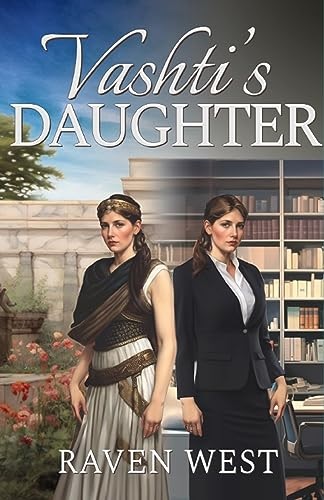
“Vashti’s Daughter” delivers “The Whole Megillah”. The novel is rich, layered narrative that combines history, mystery, mysticism, time travel, previous lives, fact and fantasy and feminist reimagination into one compelling package.
The Book of Esther, also known as the Megillah, is one of the five stories in the Writings section of the Old Testament. The story is well known to both Christians and Jews as the tale of the heroic Esther who saves her people from annihilation by the evil Haman.
The holiday of Purim is celebrated every year by the Jewish community with costumes, parades and tri-cornered fruit-filled pastries called Hamentashen.
But before Esther, there was Vashti, the king’s first wife. Her defiance of his order to debase herself for the amusement of his cronies led to her being banished from the kingdom. This paved the way for Esther to take her place, and Vashti was never heard from again.
Until now.
Throughout the centuries, Vashti has been both vilified and praised. She s portrayed as the bitch of the land, or hailed as the first Feminist. The argument has been raging for decades.
Vashti’s Daughter definitively ends this debate.
Actual events and locations both from the past and the present, plus several actual religious, astrological and reincarnation authorities, lend credibility to a fictional story that could very well be real.
Professional Reviews A Look Inside Book Review
Vashti’s Daughter” by Raven West is a captivating blend of historical mystery, romance, and supernatural intrigue that weaves the lives of two protagonists across time and space. With skillful storytelling and rich character development, the novel transports readers through a seamless fusion of past and present, as ancient Persian history becomes intertwined with the lives of modern-day individuals.
The story introduces Anna Steine, a newly divorced book publisher, who stumbles upon an unsolicited manuscript titled “Vashti’s Daughter.” Reluctantly attending her friend Elaine’s Purim costume party dressed as Queen Vashti, Anna’s life takes an unexpected turn when strange occurrences begin to unravel around her. As she experiences vivid dreams of a past life, she becomes Adara, the daughter of Queen Vashti and King Darius.
The author masterfully navigates between timelines, seamlessly transitioning between Anna’s modern struggles and Adara’s ancient challenges. As the two women’s stories unfold, the mysteries of their connections deepen, and the novel expertly explores themes of identity, love, and destiny.
Nathaniel Braverman, an archaeologist and author of the manuscript, plays a significant role in the narrative. Nate’s encounter with a mysterious voice at the shrine of Queen Esther propels him to deliver his manuscript specifically to Anna. Their meeting marks the intersection of past and present, and as their relationship grows, the story’s complexity deepens.
The novel’s pacing is well-crafted, maintaining a delicate balance between the romance that blossoms between Anna and Nate and the historical intrigue surrounding Adara and her mother Vashti. As Anna’s world collides with Adara’s, their shared experiences and the discovery of hidden truths become pivotal in shaping their futures. With its engaging narrative and compelling characters, the novel offers a unique and thought-provoking exploration of human connection across time and generations.
LOVED IT! - Nicci Attfield
An insightful and beautiful story about time travel, spirituality and identity.
This book is a wonderful exploration of identity, thinking through what it means to be Jewish as well as what it means to be a woman, both in times gone by and in the current world.
It questions the power imbalances of the past. While present power imbalances, represented in Anna’s ex-husband’s mistreatment, are a part of a curse, the author does describe the wider power imbalance that many women still struggle with.
The author untangles gender-based discriminations, showing their perpetrators as weak rather than symbols of true strength. It’s only limit is its lack of messiness, showing that women can excel while the men in their lives remain vindictive. Even in current society this is often hard to achieve.
I found Vashti’s Daughter to be a gentle, thoughtful, and deeply spiritual novel that looks at how the past impacts the present, the injustices that linger as ghosts to haunt us, and the need to change the stories we tell about women.
This is a book I would recommend to readers who are interested in exploring Jewish identity. It’s great for mystical readers wishing to explore how spirituality intertwines with social injustice. Feminist literature has been shown to help women understand and resist discrimination, so I would also recommend this book to teenagers and young women everywhere.
At the heart of the novel is Anna Steine, a modern-day book publisher whose life takes a mysterious turn when she begins experiencing vivid dreams connected to ancient Persia. As the story unfolds, Anna discovers she is the reincarnation of Adara the daughter of Queen Vashti linking her present-day struggles with a powerful past rooted in the biblical Book of Esther . This dual timeline creates a fascinating narrative that seamlessly weaves together past and present.
Bold imagination, intellectual ambition, and feminist reclamation is at the heart of Vashti’s Daughter.
What makes the novel especially compelling is its refusal to accept silence as an ending. By returning to Vashti the woman erased to make room for Esther, West challenges centuries of inherited interpretation and invites readers to reconsider who gets remembered, who gets blamed, and who gets written out of sacred history. Her framing of Vashti not as a footnote, but as the catalyst for everything that follows, is both provocative and deeply resonant.
The narrative bridge between ancient Persia and the present day is handled with confidence and creativity. Anna’s experience haunted by dreams, drawn toward truth through scholarship, spirituality, and intuition mirrors the larger inquiry of the book itself: how the past insists on being heard, even across centuries. The use of reincarnation, Kabbalistic insight, archaeology, and historical detail gives the story a layered credibility that makes the speculative elements feel grounded rather than sensational.
I want to say this plainly: that kind of storytelling matters.
By engaging scripture, feminism, and spirituality in conversation rather than opposition, you open space for readers of many backgrounds Jewish, Christian, spiritual, skeptical to participate in the question rather than be handed an answer. The novel does not merely argue that Vashti was misunderstood; it dramatizes the cost of silencing women and the power of reclaiming narrative authority.
Seen this way, Vashti’s Daughter is not only a reimagining of a biblical story, but a meditation on legacy, agency, and the courage it takes to defy systems that demand submission. Anna’s urgency her deadline, her curse, her emotional risk mirrors Vashti’s ancient defiance, reinforcing the idea that unfinished stories seek completion through those willing to listen.
I don’t believe revisionist historical fiction succeeds by shock alone. I do believe it succeeds when it combines research, empathy, and moral clarity. Vashti’s Daughter does exactly that, offering readers a story that is intellectually engaging, spiritually curious, and unapologetically centered on women’s voice – Gloria Exley
A collection of 109 tract type messages, that are geared to anyone that has ever asked the question "What does the bible have to say about specific subjects that are not usually addressed in Church sermons??"
These messages deal with all fa
Jude: The Easy Study Bible Commentary
Completely Revised and Greatly Enhanced!
Not for scholars but for anyone who struggles to understand the New Testament!
The Easy Study Bible Commentary takes The Easy Study Bible Diagra




What makes the novel especially compelling is its refusal to accept silence as an ending. By returning to Vashti the woman erased to make room for Esther, West challenges centuries of inherited interpretation and invites readers to reconsider who gets remembered, who gets blamed, and who gets written out of sacred history. Her framing of Vashti not as a footnote, but as the catalyst for everything that follows, is both provocative and deeply resonant.
The narrative bridge between ancient Persia and the present day is handled with confidence and creativity. Anna’s experience haunted by dreams, drawn toward truth through scholarship, spirituality, and intuition mirrors the larger inquiry of the book itself: how the past insists on being heard, even across centuries. The use of reincarnation, Kabbalistic insight, archaeology, and historical detail gives the story a layered credibility that makes the speculative elements feel grounded rather than sensational.
I want to say this plainly: that kind of storytelling matters.
By engaging scripture, feminism, and spirituality in conversation rather than opposition, you open space for readers of many backgrounds Jewish, Christian, spiritual, skeptical to participate in the question rather than be handed an answer. The novel does not merely argue that Vashti was misunderstood; it dramatizes the cost of silencing women and the power of reclaiming narrative authority.
Seen this way, Vashti’s Daughter is not only a reimagining of a biblical story, but a meditation on legacy, agency, and the courage it takes to defy systems that demand submission. Anna’s urgency her deadline, her curse, her emotional risk mirrors Vashti’s ancient defiance, reinforcing the idea that unfinished stories seek completion through those willing to listen.
I don’t believe revisionist historical fiction succeeds by shock alone. I do believe it succeeds when it combines research, empathy, and moral clarity. Vashti’s Daughter does exactly that, offering readers a story that is intellectually engaging, spiritually curious, and unapologetically centered on women’s voice – Gloria Exley