
Kindle Edition
Amazon
JAMES RONDINONE PUBLICATIONS
CHOICES. CHOICES. CHOICES.
Category:
Religion
Publisher: Kindle Direct Publishing
ISBN-10: B0CM1HZL8B
Type: Non-Fiction
Pages: 115
Copyright: Oct 27, 2023
ISBN-13: 9798865674177
Price: $1.99 (eBook)
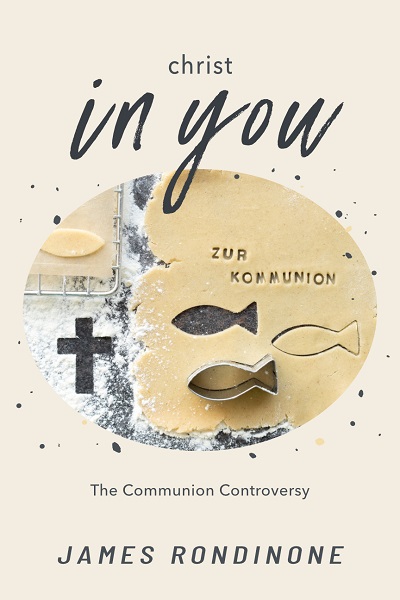
This book is about three biblical topics that are considered controversial depending on who you talk to.
Are the elements of communion to be taken literally or figuratively?
What constitutes spiritual growth?
What causes someone to become a child of God?
This book is about three biblical topics that are considered controversial depending on who you talk to.
Does the bread and wine at communion turn into the literal (transubstantiation) or spiritual (consubstantiation) body and blood of Christ, causing the participant to become more like Him?
Does a believer grow spirituality by obeying the tenets of their faith and partaking in communion, or is there another avenue to consider?
Does Christ come into a believer’s body through communion, or is there a different person of the Trinity who’s received in another manner?
Ultimately, we’re considering two of the essential aspects of the Christian faith: salvation and sanctification.
Excerpt
Introduction
What inspired me to write about this topic was a conversation I had with a friend who was a Spanish teacher at the same high school where I taught mathematics. Being devout to a particular faith, he occasionally asked me about my relationship with God, which differed significantly from his.
I told him that in my youthful years, I would attend a local church with my parents, having participated in the various aspects of it. Initially, I was baptized (sprinkled) in water as a baby, which according to their doctrine causes an infant to become a child of God or a son of light. First comes repentance that the parent(s) of the child provide. And afterward, at the time of the sprinkling, the congregation would be praying for the Holy Spirit to show up. This, they argue, would bring about the forgiveness of sins.
John 3:5 Jesus answered, Verily, verily, I say unto thee, Except a man be born of water and of the Spirit, he cannot enter into the kingdom of God.
Literal water, along with the reality of the Holy Spirit, would allow an infant to enter God’s kingdom. This, they’d say, is the baptism that now saves us as supported by Scripture. The sacrament of water baptism is the sacrament of regeneration. The result of this rite is that the new child of God becomes freed from the power of darkness, liberated from sin, and is brought into the realm of the freedom of the children of God.
Years later, when I reached the age of seven, I began attending catechism, which was the mechanism used to teach the fundamental truths of the faith. This instruction prepared me to receive certain of the seven sacraments, which are ceremonies that point to what is sacred, significant, and essential. I eventually received my first communion (the elements of the bread and wine are that which nourish the disciple with Christ’s literal body and blood for his or her transformation into Him). A short time later, between the ages of eight and twelve, I was confirmed. According to this sacrament, the Holy Spirit was given at this time to those already baptized in order to make them strong and perfect Christians and soldiers of Jesus Christ.
Attending church weekly, occasionally participating in the confession of sins to a priest, observing the six days of obligation throughout the year, as well as the two church fasts of Ash Wednesday and Good Friday, became my routine. At some point, a neighborhood friend who was an altar boy in a local Catholic church I attended, asked me if I, too, wanted to become an altar boy. I said yes and proceeded to enroll in special classes at the church for this purpose.
I told my colleague at the school where we taught that as I grew older, in my teens and early twenties, I stopped attending church altogether. I felt that something or someone was missing. Church became boring. It seemed as if I’d never met the God I was trying to obey and follow.
In my mid-twenties, not being thrilled with how my life was turning out (e.g., job difficulties, girlfriend relationship issues, family conflicts, alcohol abuse, etc.), I decided to go on a quest to determine if God existed. I reasoned that if He did, He’d help me address these problem areas of my life.
So, how was I to begin? Where might I find this higher power? I’d assume in church. There are so many faiths; it would be hard not to figure that He would be operating in at least one of them. Which one? I had no idea. So, I decided to attend just about every church assembly in my home city. As I’d enter and leave the church setting of each faith, there was nothing I heard in any of their teachings that I heard tha stood out. What I mean is I recognized that there were evident differences in theology, but for the most part, the way to heaven was similar. Obey the church’s teachings, and hopefully, when you die, you might make it there.
This approach didn’t sit too well with me. I needed some kind of evidence that substantiated a God reality and an assurance of eternal life. Eventually, something happened to me that changed my life forever. I heard about this through what I now believe were providential circumstances. A certain church Bible study was being conducted near where I was living at this time. I attended the study and after the pastor gave the message, he asked if anyone wanted to have a personal relationship with God. He said God’s desire was to come into a person’s life and indwell, thus providing them with a new nature, a new life, a divine purpose for living, and a secured afterlife. This got my full attention. I wondered what I’d have to do in order for these spiritual possibilities to take place in my life.
He went on to say that in order for God to come into a person’s life, they must respond to what is called the gospel. The gospel? This gospel is otherwise known as good news. The good news is that if an unbeliever repents (acknowledges and expresses a desire to turn from their sins) to God the Father and believes in His Son Jesus Christ, then their life will forever change at that moment.
I decided that I wanted this new life. So, I repented (God, I acknowledge my sins and no longer want to continue committing them) and repeated the following words about Jesus out loud after the pastor verbally expressed them. I believe in Jesus, who:
• Pre-existed time as one of the members of the Trinity (one God in three persons), the other two being God the Father and God the Holy Spirit.
• Came to the earth (God come in the flesh), deity (having divine nature), and took upon Him the form of a man, being born of a virgin.
• Lived a sinless life.
• Listened to and obeyed the directives of His Father.
• Went to the cross and paid for the penalty of and forgave (wiped away the debt) the sins of the whole world.
• Rose from the dead after three days, never to die again.
• Walked the earth for forty days in His glorified body, witnessing His resurrection.
• Ascended into heaven.
After which, he mentioned to me that according to Scripture, whosoever repents and believes in Christ will receive another member of the Trinity, this being the Holy Spirit, who’ll come inside their body and reside. I followed his lead, but unfortunately, nothing happened. I thought to myself, shouldn’t I somehow be aware that God had come into my life?
Then, after a few moments, the pastor made a comment that surprised me. He said that I was currently involved in an illicit relationship with a married woman and needed to confess this sin to God the Father and not continue with this involvement any longer. I admit that I was taken aback by this declaration. How did he know about this? I confessed this interaction as a sin and stated that this wouldn’t continue. Immediately, I was filled with divine peace and joy that permeated my whole being. God the Holy Spirit had come into my life.
When I told my fellow colleague about this God encounter, he responded that, likewise, God had come into his life, albeit in a different manner. He said that when he partakes of the elements of communion at church, the bread becomes the literal body of Christ and the wine becomes the literal blood of Christ. And the more frequently he chose to receive communion, the more he’d experience an increase in Christ-likeness (i.e., a lessening of racial and national prejudices or neighborhood resentments, and an increase in neighborliness, compassion, patience, and forbearance towards others1). He was essentially saying that partaking in the elements of communion resulted in him being spiritually nourished by Christ’s literal body and blood. And this is what would change his character into evidencing divine qualities toward others.
He asked me what my thought about this particular teaching was. Well, having been a member of this church, I was aware of this church doctrine as being otherwise known as the doctrine of Transubstantiation. This view states that when any member of this faith partakes in the elements of communion, the bread turns into the literal body of Christ, and the wine turns into the literal blood of Christ.
My response to him was that I believed there could be an alternative interpretation concerning the purpose of partaking in communion. According to this perspective, the bread symbolizes Christ’s body, and the wine symbolizes His blood. For what purpose? We’ll find out as this study progresses. I then proceeded to ask him the million-dollar question.
Why does this church believe in the literal perspective of the elements of communion?
He said that their belief was based on a view held by most of the early church fathers (these are Christian writers who lived during and following the lifetime of the original apostles of Christ) whose writings reflected the history, doctrines, and traditions of the early church. I wondered if what he’d just told me had merit (basis, in fact). I told him that I’d write a paper on this subject and when it was done, I’d bring it to him so that he could read it over and provide comments.
With that said, some of the questions that this study will attempt to answer are the following.
Do the elements of the bread and wine actually become the literal body and blood of Christ at communion?
Did most of the early church fathers believe this to be the case?
Does the partaking of communion frequently cause the participant to increase in godliness, thus exhibiting Christ-like compassion, patience, and forbearance towards others?
By the way, I’m not writing this study to give offense to what this church might consider a cardinal doctrine of their faith. Like any biblical topic, shouldn’t Scripture be the basis for such if it’s to be substantiated? So, let’s see if this is indeed the case.
Did you know that this doctrinal belief isn’t just ascribed to this faith? There are a few other religions that also believe in this literal view.
Some of the names of these faiths are as follows.
The Catholic Churches are located throughout the world and have 1.345 billion members.
The Oriental Orthodox Churches are comprised of over sixty million followers that are part of the World Council of Churches. Most live in Egypt, Ethiopia, Eritrea, India, and Armenia.
The Eastern Orthodox Churches purportedly has over two hundred twenty million members. Most live in the former Soviet Union, parts of Europe, the Mediterranean, and the Middle East.
The Church of the East is comprised today of two separate, distinct churches totaling about one million adherents. Many live in India.
The Anglican Church, known as the Church of England, has over eighty-five million members worldwide. Their view on the elements of communion differs from the Catholic position of Transubstantiation. According to their theology, the literal body and blood of Christ are received at the intake of the bread and wine for spiritual nourishment and growth, but the bread and wine don’t literally become His literal body and blood.
Many of my studies and books that I’ve written on various biblical topics provide in-depth analysis and contrast from opposing views so that a reader will understand why their church believes what they espouse and why other churches believe differently. Hopefully, this kind of teaching will incorporate accurate scriptural interpretation called hermeneutics, which is based on an analysis of grammatical features and historical background that will reinforce one’s belief system or provide an alternative perspective.
Are you ready to join me in the search for truth in this crucial doctrinal subject?
I ask you, Lord, to help me in this endeavor. Provide me with your insight utilizing the Word of God and the ministry of the Holy Spirit. Amen.
We’ll begin by taking a look at what verses are used to substantiate that the elements of communion become the literal body and blood of Christ and, likewise, which ones are used to support the narrative that the components of the Lord’s supper are figurative or symbolic of the body and blood of Christ.
But before we do, you might be thinking, why should I study this at all? What’s the fuss, whether the bread and wine turn into Christ’s literal body and blood, or not? Well, I have left an article for you to read on this very sentiment.
____________________
PROTESTANT FRAY OVER [THE] MEANING OF BREAD, WINE
Lutherans vote this month for or against 'full communion' with four [faiths.]
Since the early days of Christendom, the meaning of the Lord's Supper - the ritual sharing in churches of bread and wine - has been a battleground for the faithful. Martin Luther, disbelieving in a literal transformation of bread and wine into the body of Jesus Christ, broke with Rome partly over the Lord's Supper. Protestants waged bloody wars in Europe over whether Jesus was actually - or figuratively - present in the Eucharist. In the theologically calmer 20th century, most mainstream American Protestants have tended to view the Lord's Supper, one of the most sacred of the church rites, as a figurative or symbolic act commemorating Jesus.
Yet [today,] a shift in that view of the Eucharist is under way. A core group of liberal Protestants, many trying to reclaim 16th-century reformer John Calvin's ideas, are moving their denominations closer to the position that Jesus is physically or "actively" present in the bread and wine of communion. They want to find common sacred ground and, through this rite, offer "meaning, mystery, and majesty." The shift is still limited to a scattering of theologians and pastors. But a push to recognize the "real presence" of Christ in the eating and drinking of the Eucharist is manifesting itself in more communion services, new hymnals and prayer books, ecumenical dialogues, and workshops across the Protestant spectrum. Though now small, the change could reopen one of the deepest debates of the Reformation, having to do with the character and nature of Christ Jesus. But it also represents a potential shift in theology and worship that may echo into the 21st [century] and in time move many Protestants closer to an evolving Roman Catholic view.
Later this month, for example, the largest Lutheran church in the US will vote on whether to accept "full communion" with three other Protestant churches. If accepted, ministers would be interchangeable among the four faiths. But differing views of the Eucharist remain a sticking point. Lutherans believe that Jesus is present in the bread and wine. In order to join with the Lutherans, the other three, the Presbyterians, the United Church of Christ (UCC), and the Reformed Church of America, have been reexamining their [roots] and finding new ground to share with Lutherans. "There's a recovery of tradition," says Gabriel Fackre, a UCC theologian. "We can all affirm the real presence of [Christ;] we just differ in the mode. We agree the Lord's Supper is not just a visual [aid] but represents the real presence in a sacrament that ought to be celebrated every Sunday."
Rediscovering sacraments
"[It’s fair to say there’s] a stronger push among mainstream Protestants to find the presence of Christ in the Eucharist," says Geoffrey Wainwright of Duke University Divinity School. "The Catholics are rediscovering the word, and the Protestants are rediscovering the sacraments." The new UCC hymnal includes a classic Catholic hymn by Thomas Aquinas, stating that "underneath these forms lies your reality," a notion of Christ "in" the bread and wine. A new Methodist prayer reads, "Pour out your Holy Spirit ... on these gifts of bread and wine. Make them be for us, the body and blood of Christ." The most recent Presbyterian "book of worship" urges more liturgical services for the Eucharist.
Other Protestants, from evangelicals to the mainstream, say the evolving emphasis is misguided and smacks of betraying church history. Much of the Protestant reformed tradition has held that Christ is purely spiritual, can't be evoked by a rite, and is not "containable" in a finite ceremony. "As a conservative evangelical, I don't believe in the physical presence of Christ," says Wayne Gruden of Trinity Evangelical Divinity School in Deerfield, Ill. "I think this is a willingness to sacrifice historical distinctiveness in our views in order to preserve church structures in the face of declining membership."
The Lord's Supper is a form of ritual worship that dates back roughly to AD 1000. The rite usually takes place after the sermon, involves a sharing of bread and wine or juice, and derives from Jesus' command to his disciples before his crucifixion to "take" the bread and wine as his body and blood. The ceremony can be modest or elaborate, depending [on] the church tradition followed. Evangelical churches, and, until recently, many mainline Protestant churches, [haven’t] stressed a formal Eucharist rite. Protestant denominations traditionally require about four communion services a year. Yet that number increased dramatically in the 1980s and continues to rise today. [It’s] especially popular among younger people as a ceremony that adds color and evokes mystery. Advocates say it restores a sense of the sacred in churches that are criticized for emphasizing a social-justice [agenda] or that are "too secular."
A Presbyterian study shows 40 percent of its churches have monthly communion. "When I was growing [up,] there was a sense that the more frequently you celebrated communion, the less it meant," says the Rev. Gregg Mast of First Church, Albany, N.Y., a Dutch Reformed church. "That's changed. Now you see a number of churches moving to a weekly ceremony." For some critics, the Eucharist - as an answer to [the] lack of spirituality in church - is a chimera. "T.S. Eliot used to say that when the church stops hearing serious biblical [preaching,] it compensates by elevating the mystical," says one leading East Coast theologian. "I think that's what we are seeing."
The taproot of today's debate dates to a historic 16th-century showdown between Martin Luther and Swiss reformer Huldrich Zwingli. Luther, who earlier revolted against the Catholic idea of "transubstantiation" in which Jesus Christ becomes bread and wine when the right words are said, still felt that Christ was present in the Lord's Supper. To Zwingli, the spiritual nature of Christ was absolute and above the possibility of entering material elements. Zwingli felt communion was a symbolic act made meaningful by the subjective prayers of the worshiper. The two reformers fought unstintingly at a meeting called the Marburg Colloquy in 1529 - creating a gulf between Protestants that helped spawn a war that itself took Zwingli's life in 1531. (A typical exchange. Zwingli: "This is the [Bible] passage that will break your neck." Luther: "I don't know what it is like in Switzerland, but in [Germany] necks don't break so easily.")
In many ways, the Protestant world has since remained divided along the Luther-Zwingli lines. Lutherans hold [to] the idea that the infinite Christ can enter into the finite elements of the Eucharist. Many in the reform wing feel that Jesus' famous act of sharing the cup is not to be taken literally. "Jesus didn't mean the cup he was holding was itself the new covenant," says Dr. Gruden, "he meant it as a symbol."
View from the pews
Studies show that in the pews, most believers, even many Catholics, lean toward [the] notion that the bread and wine isn't the real body of Jesus Christ. [Yet, for some Protestants,] the views of Zwingli seem too transcendent for the building of bridges with liturgical [advocates] like Lutherans. "Pastors and theologians have a higher view of the Lord's Supper and are less Zwinglian now," says Theodore [Gill,] a spokesman for the Presbyterian Church. "They are looking for ecumenical answers that could link Presbyterians with Lutherans and even with the Roman Catholic church eventually." For that task, the upper Protestant echelon is rediscovering John Calvin, who split the difference between Luther and Zwingli on the question of the presence of Christ.
Whether Lutherans will later this month join a pact agreed to by the three reform churches is unclear. "Is the finite capable of holding the infinite? We say it is," says John [Reumann] at the Lutheran Theological Seminary in Philadelphia, speaking of the view that Christ is objectively present in the bread and wine. "The other side disagrees. And we say finally that theology matters."2
|