Kindle Edition
Audiobook
Amazon
Category:
Action/Thriller
Publisher: CDMBOOKS
ISBN-10: 9798255876518
Type: Non-Fiction
Pages: 198
Copyright: 4/10/2026
Price: $14.95 (eBook)
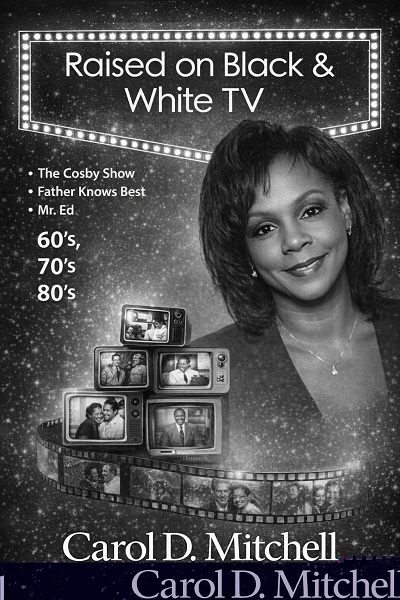
Raised on Black and White TV is Carol Denise Mitchell’s intimate, unflinching memoir of growing up in a world where television became both a refuge and a mirror. Through the glow of classic black‑and‑white programs, she learned about family, justice, love, and the contradictions of being raised Black in America during a time when the screen rarely reflected her reality. With sharp insight and emotional clarity, Mitchell revisits the joys, wounds, and defining moments that shaped her voice as a writer and her understanding of the world around her.
More than a nostalgic journey, this book is a powerful examination of identity, resilience, and the quiet strength required to rise above circumstances that were never designed to nurture her. Mitchell’s storytelling is vivid and deeply human, weaving humor, heartbreak, and triumph into a narrative that speaks to anyone who has ever searched for themselves in a world that didn’t expect them to shine. Raised on Black and White TV stands as both a personal testimony and a cultural reflection—an unforgettable portrait of a girl who grew into a woman determined to tell her own story.
Raised on Black and White TV offers a remarkable and unconventional exploration of the author’s television experiences, spanning from the monochrome broadcasts of the 1950s to the vibrant visuals of the Enterprise in Star Trek (The Original Series), which debuted on September 8, 1966. Who among us would confess to disliking Star Trek? You must delve into the book to discover the answer. The prose in Raised on Black and White TV is candid, insightful, and captivating. Its distinctive revelation of behind-the-scenes occurrences finally brings to light what has long been concealed. After engaging with this book, your perception of Father Knows Best and Hazel will be forever altered. At last, someone has had the courage to articulate what others have hesitated to express regarding A Raisin in the Sun. Was that film as provocative as Amos ‘N’ Andy and Beulah? Or did the NAACP choose to spare the burdensome Walter Lee from the criticism he rightfully warranted? What sets Raised on Black and White TV apart is the author’s willingness to confront the authentic lives of our beloved actors behind the curtain. Furthermore, Mitchell explicitly states in her introductory pages that this book is not intended for contemporary readers. It is crafted for those who have yet to be born. Raised on Black and White TV is poised to initiate a much-needed conversation about the programs that shaped our past.
Excerpt
Chapter 2
James Brown
This story is about what happened when a Black man appeared on a white show and created an event comparable to the celebrations of Independence Day. For, to see a Black person on TV during the late 50s and early 60s, was truly a time to celebrate! That celebration ignited throughout our household and within the entire Black community. This one performance open doors for all that was to follow, including the Black and White TV shows that would come under fire, by the NAACP.
James Brown was already a moving legend, and the Black community was captivated by his unapologetic soul. In the early 1950s, James Brown became a member of Bobby Byrd’s group, the Flames. They gained recognition on the Chitlin’ Circuit for their electrifying performances, and in 1956, they released the million-selling single "Please, Please, Please," which established his name in the industry. Thus, before the television acted right and Mother awakened everyone to witness this man, it was an unexpected delight to see him perform live on TV.
He followed this success with "Try Me," which reached number one on the R and B charts in 1957. By the early 1960s, he had become unstoppable. In 1963, he released the groundbreaking live album Live at the Apollo, which remained on the charts for 66 weeks and solidified his status as a national icon.
Between 1963 and 1966, he produced hit after hit, including: • "Prisoner of Love" • "Papa’s Got a Brand-New Bag" • "I Got You (I Feel Good)" • "It’s a Man’s Man’s Man’s World" James Brown was a monumental figure in the Black community, and as I reflect on this memorable television moment, his appearance on the Ed Sullivan Show continues to thrill me to this day. People remarked that he could dance exceptionally well, and this was the primary description we often heard about James Brown back then.
Before May 1, 1966, he was already a star, but in Black neighborhoods, he represented something entirely different. He was the subject of whispers in barbershops and beauty salons. People claimed he danced faster than the speed of light. They described how he slid, dropped, spun, and snapped as if he had electricity coursing through him, prompting Mother to say, "Girl, you know I have to see that."
To say, seeing James Brown on TV was exciting is an understatement. In the Black community, this was a significant event. Mother would call all her friends! Bobby, Wilhemena, and Duke.
"James Brown is going to be on Ed Sullivan tonight, Chile. Make sure nobody falls asleep during James Brown's performance." These were remarkable and thrilling times for Black individuals; it was a significant era for Black music featuring artists such as Stevie Wonder ("Uptight," "Blowin' in the Wind") and Wilson Pickett ("634-5789," "Land of a Thousand Dances"), The Temptations ("Get Ready," "Ain't Too Proud to Beg"), Percy Sledge ("When a Man Loves a Woman"), and Ray Charles ("Let's Go Get Stoned"). Those from the South who witnessed Brown perform live reported that he left audiences screaming, fainting, and rushing down the aisles, and he certainly appeared quite impressive.
However, there is something about Brown that I simply cannot forget. Wow! Before the advent of social media and gossip columns that piqued our curiosity, there was my mother, the “Gossip Queen.” What she said about her friends behind their backs was funny!
I remember her telling her friend Miss Ida that she resembled James Brown. Girl, I am lying. Mother said. “Ida with that wig you got on, girl you look just like James Brown!” It sent me rolling. Hard to please Carbara, my opinionated older sister, got a real kick out of that one. Poor Miss Ida. Mother’s statement about her wig led to Miss Ida ceasing communication with my mother and that was not half as bad as when mother told her friend Monical her slippers looked like they belonged on Bruce Lee! But truth be told; Miss Ida truly did bear a resemblance to James Brown. I can see you laughing. I am laughing as well. Thus, when news circulated that James Brown would appear on the Ed Sullivan Show, it was not the technical excellence of his career, nor the chart-topping records or live performances that compelled Black families to pay attention. It was a chance to at last see a Black person on TV. My family was utterly astonished that evening. "Did you see that? Look at that man move, will you? I mean..." That was the atmosphere in our living room that memorable evening of Black and White TV, and the following day, as phone calls regarding Brown's performance spread through word of mouth, the blend of disbelief and pride could not be ignored. We were not merely observing a chart ranking; we were witnessing a miracle. We were watching a Black man seize a stage that had never been designed for him, and he accomplished it with such intensity that the entire audience sat up in amazement. Tears spilled. Heart fluttered, as his feet were a whirlwind, his voice was a powerful shout, his presence was a tempest, and we understood that we were experiencing something unforgettable.
Looking back on this in retrospect, I will carry the memory of that evening with me for the rest of my life. Now, I want to tell you how the events I have described unfolded.
|