|
|
| 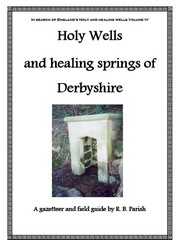 | | Holy Wells and healing springs of Derbyshire
A field guide and history of the county's holy wells, spas and folklore waters
The first book to cover sites in the county was Naylor (1983) in his ‘Ancient wells and springs of Derbyshire’, however this did not contain many holy wells (13 true holy wells) and appears more concerned with industrial uses of water. Hope (1893) covers a number of sites and the author himself was a Derbyshire man and after his death, his notes made for a second edition, were passed onto the Reverend Binnall. Thanks to him, these additional notes as well as those already published were collated for an article for the Trans. Derby Antiq. and Nat Hist. Society. Harte (2008) provides the most co | |  | | Holy Wells and Healing Springs of Essex
In search of the holy wells, healing springs, spas and folklore waters.
An Overview (from the Introduction)
In regards to healing springs, Essex has been better served, in regards the study of mineral waters and particularly notable surveys are Allen (1699/1710), and more recently Christy and Thresh (1910). Both have touched upon holy wells but this was certainly not in an exhaustive manner. Cowell (2000) updates much of this work but again only touches upon holy wells. This work attempts to catalogue and update these previous works, with the aim of providing the definitive accurate guide to both mineral spas, holy wells and water bodies with associated folklore | |  | | Holy Wells and healing springs of Hertfordshire
Volume I explores holy wells, spas and folklore waters in this field guide and history
No book has comprehensively covered the topic in the county; which is surprising considering the fame of its most noted site St. Alban’s Well. The nature of this work, indeed all volumes, is thus to describe the sites under the respective parishes giving historical details and present conditions (with directions if the sites can be accessed). I have adopted Francis Jones’s (1954) category system for wells. The main body of the text covers Class A (saint’s names, those named after God, Trinity, Easter etc), B (associated with chapels and churches), C ( those with healing traditions which in th | |  | | Holy Wells and healing springs of Lincolnshire
Volume V covering a field guide to holy wells, healing springs, spas and chalybeate springs and folklore water of the county
To date there has been a number of attempts to provide a complete guide to Lincolnshire sites, despite a small number of sites is recorded by Hope (1893), Lincolnshire has fared better than other counties he describes, with a sizeable gazetteer in Gutch and Peacock (1908) and various editions of Lincolnshire Notes and Queries (Antiquarius Rusticus (1926–9)). Interest in the topic picked up in the 1990s by two excellent articles by Healey (1995) and subsequent notes and queries contributions in Lincolnshire Past and Present which extended work by the previous authors and notes made by the noted | |  | | Holy Wells and healing springs of Nottinghamshire
A field guide and history to the holy wells, spas and folklore waters of the county.
Morrell’s (1988) work on Nottinghamshire holy wells was one of the first non-Celtic volumes on the subject (ie not Cornwall, Wales or Scotland) in the later half of the 20th century. At first I was reluctant to research the area thinking the work had already been done, but no I discovered double the number of sites. Nottinghamshire can claim record of 94 related sites (including some dubious sites and possible repetition) over 834 square miles. This would give a density of 8.8 square miles per well. This would compare with Leicestershire 9.9 wells per square mile (Rattue (1990) perhaps controv |
|
|
|