|
|
|  | | Beyond the Clouds: Why I Became a Military Writer
Mark Berent is a well-known author of many Vietnam airwar books (Wings of War historical fiction series) and articles. In this article he recounts the people and events that motivated him to write. As he says:
"They're out there now, somewhere beyond our eyes, beyond the clouds, rolling and soaring in towering cathedrals flying beautiful airplanes that need only the fuel of their love. These are the men I honor.”
| | 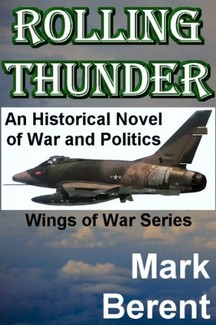 | | Rolling Thunder (Book1 in the five-book Wings of War series)
Rolling Thunder is an historical novel about the decisive role politics played during the Vietnam war. Its characters range from men in the field to the Pentagon and the White House. Fighter pilots and Special Forces warriors try to do their best but are hampered by President Johnson, Secretary of Defense McNamara, and their staff members who despise the military. Only one aging USAF general, who fought in Korea and WWII, is on their side. His clashes with his Commander in Chief, Lyndon Johnson, are epic in proportion and startling in content.
p class="MsoNormal">In i>Rolling Thunder/i>, the time is late 1965 and 1966 in war zone places such as Saigon, Hanoi, Bien Hoa, Da Nang, and Tahkli. While back in Washington, LBJ sits over lunch and personally picks bombing targets in an attempt to fight a limited war. In Vietnam the war knows no limits.
p class="MsoNormal">o:p> /o:p>There, as the hostilities escalate, the fates of three men intertwine: USAF Captain Court Bannister, overshadowed by a famous movie star father who fought in WWII as a B-17 gunner, driven to confront missiles, MiGs, and nerve-grinding bombing raids | | 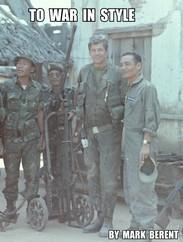 | | To War in Style
An American Air Attaché in war-torn Cambodia finds himself in an unusual and unforeseen position.
In the January of 1973 we in Defense Attaché Office in the American Embassy, Phnom Penh, Cambodia, found ourselves in an unusual situation. President Nixon had declared his Southeast Asia policy of Vietnamization was succeeding. In Vietnam, all US forces were ordered to cease fighting and that included air assets as well as the ground troops. Yet we had authorized air support until August 15.
p class="MsoNormal">What did all this mean to me, the Air Attaché (AIRA) in the Embassy? First off, it meant I was in the loop to approve all B-52 strikes, secondly it meant, |
|
|
|