|
|
|  | | Earth As It Is
Charlie/Charlene Bader is a heterosexual cross-dresser who struggles through the humiliating break-up of a marriage, migrates to Chicago during the Depression where s/he discovers a supportive community of cross-dressers, serves as a dentist in World War II, and ultimately ends up in a small town in Indiana, living as a woman and working as a hairdresser. Her life becomes complicated when she realizes she has fallen in love with a customer who does not know of her male identity.
Charlie Bader comes of age in early twentieth century Texas with urges he does not understand but must act on, fear and humiliation his constant companions. When his young wife finds him wearing her lingerie and leaves in disgust, he tries unsuccessfully to put it all behind him. His efforts lead him first to Chicago, where he stumbles into a community of cross dressers and attends their secret soirees, then to service as a dentist in World War II where his experiences of war combined with the Army's faulty record keeping set the stage for his reappearance in the small town of Heaven, Indiana | |  | | Heaven, Indiana
Heaven, Indiana follows the intertwined lives of three women born in 1954, taking a look at the glories and horrors of small town life, peeking to see what lies hidden underneath the flatness of the Heartland.
One hot week in August 1954, in Heaven, Indiana, a baby is delivered twice: once in a barn by her grandfather, the second time to the tent door of a carnival fortune-teller by her grandmother Helen. The baby, Nadja, becomes part of a long tradition of well-kept secrets in the tiny town of her birth. She grows up traveling with her adoptive grandmother, the fortune-teller, learning to develop her own gifts of precognition, reading the remains of lunches and dinners to see what lies ahead in her clients' lives. Meanwhile, two other girls born in Heaven that same year are growing to maturity. Ell | | 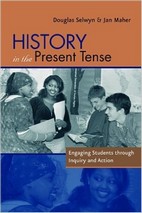 | | History in the Present Tense: Engaging Students through Inquiry and Action
In this practical guidebook, Douglas Selwyn and Jan Maher propose a different way of teaching history—start from today and keep asking questions. As students investigate possible answers, they make connections across miles and centuries. Along the way, they experience that essential insight of the social studies: Point of view has everything to do with how one perceives the world.
To this end, each chapter explores a particular kind of project that is centered on students' concerns, but connected to core curriculum content and concepts in history, geography, civics, and economics. Projects include timelines, collages, photodocumentaries, and more. While students dig deeply into issues of personal relevance, they also master the content and skills mandated in state and national standards. Students learn about history—and about themselves.
View an excerpt on the publisher's website:
http://www.heinemann.com/shared/products/E00570.asp | |  | | Most Dangerous Women: Bringing History to Life through Readers' Theater/2 e
The history of the international women's peace movement told through documentary drama with music; additional chapters guide teachers and community theater producers and activists in working with and extending the content of the play in classroom and community settings.
From Foreword by Harriet Hyman Alonso
Nikki Nojima Louis and Jan Maher have written a beautiful play which evokes the passion and commitment of various women who have dedicated their lives to achieving world peace. Most Dangerous Women, a combination of emotional music, passionate statements, and a strong sense of social justice, is based on the history of two strands of women’s peace activism—the work of the organization, the Women’s International League for Peace and Freedom (WILPF), and the work of individual women who received the Nobel Peace Prize in honor of their dedication to hum |
|
|
|