|
|
|  | | Planck's Columbia Lectures
Planck's theory explained in detail by Planck himself in 1908. Includes abridged and non-abridged versions.
Max Planck delivered a series of eight lectures at Columbia University in 1908. Six of these lectures covered his now famous radiation theory. He received the Nobel prize for his accomplishment in 1915. The complete unabridged version is presented in this book. There is also a rather complete abridged version that was written by Dr. Weldon Vlasak that is presented in Chapter nine. In Chapter 10, Dr. Vlasak relates Planck's theories to modern theories. One of Planck's theories, that has received but little attention, was delivered in Planck's seventh lecture. There is a short introductory comme | |  | | Secrets of the Atom
Dr. Vlasak provides further depth to his studies of the hydrogen atom as an electronic circuit. Never done before, he debunks the so-called "barrier" at the center of the atom and shows how and why the electron tends to avoid the proton. Also included
are graphical representations of inter-atomic forces in real time that show how the force of gravity is produced. This book is the third on this subject; the first title being
"The Secret of Gravity", which is intended for a broader range of readers.
Quantum mechanics is the preferred choice of analysis for contemporary physicists. Unfortunately, no one seems to understand the theory very well, and only limited results are obtained, such as the determination of the probable radii of the electrons
within the atom.
Also, many of the abstract theories and predictions of the past half decade of science have not been proven to be correct. Examples are the theoretical "graviton", gravitino, and "superparticle", none of which have ever been detected. Therefore, a
new atomic theory that relates to real world sensations is in ord | | 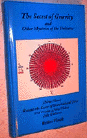 | | The Secret of Gravity
A completely new theory that leads to the solution of the greatest mystery in the history of science. The first plausible gravitational theory leads to a new insight as to what constitutes matter. Other new mysteries have also been unearthed in probing the depths of scientific knowledge. A book that is based on reality to substantiate new theories.
From Chapter XIX, describing the current approach of quantum physicists and the problems with their theories ---Up to now, no one has yet been able to establish an all-encompassing, unified field theory that accounts for the various forces that exist in nature. Scientists have examined the "strong forces" within the nucleus of atoms in an attempt to show that they produce the very weak force of gravity. Strong forces can oppose one another, and some success has been made in getting the addition right, such that the forces add together by the right amount to produce the gravitational force. Jus |
|
|
|
Virolution
by Frank Ryan
|
 Our human genome is full of viruses similar to HIV-1. These have played an important role in human evolution and still play an important role in human embryology and day-to-day chemistry. Just how important are they to our evolution past and future? Our human genome is full of viruses similar to HIV-1. These have played an important role in human evolution and still play an important role in human embryology and day-to-day chemistry. Just how important are they to our evolution past and future? |
Member BookAds
|
|
|
|