|
|
|  | | My Voyage Around Spray with Apologies to Captn. Joshua Slocum
My Voyage Around Spray ( with apologies to Captain Joshua Slocum) is not only about the author's love boats and sailing, it is a social commentary about the return of native son and his re-discovery of Australia after an absence of nearly 40 years.
Val Wake describes himself as an itinerant journalist. He worked in Sydney, London, Toronto and Ottawa but spent a lot of time on the frontier learning about making life tolerable in difficult circumstances. He learnt how to survive when the odds were against him.
On retirement Val Wake settled in Port Macquaire on the Australian eastern seaboard. He found that he was part of a mass movement popularly known as the sea change movement. He was quoted as saying:
" When we first came to Port Macquarie there was one set of traffic lights. Today there are more than 10 and counting. | |  | | No Ribbons or Medals
The non-fiction story of one of Australia's first spies and a founder director of the spy agency ASIO.
This is a deeply researched work that has the subject's eldest son discovering things about his father he never knew. Valdemar (Val) Wake travelled to four Australian states and Territories in pursuit of his father's story and even visited the home of the spy agency in Canberra ASIO. Val Wake convinced ASIO to release his father's personall files which have now become a treasure trove for researchers trying to get the dirt on ASIO (almost a cottage industry in Australia.) The story deals in detail with World War Two and Bob Wake's work with the British and Americans. At the start of the Japane | | 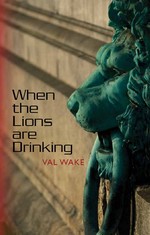 | | When the Lions are Drinking
This is a novel set in the corridors of power of the British Foreign Office. It is told through the eyes of Felix Manners, the Liverpool born head of a government film unit that employs its black arts to support the British Government in various theatres around the world where it is trying to win hearts and minds.
When the lions are Drinkng is a title taken from an old Thames waterman's saying about the embankment lions along the Thames River which during spring tides often used to have their bronze snouts in the river, an early sign that flooding was likely. Val Wake has used this riverman's story as a methaphor to illustrate the state of the British civil service when faced with the demands of modern politics during the Thatcher era.
On the back cover of the book is a reference to Dean Acheson's famous statement made in 1963 that Great Britain has lost an empire but has not yet found a role. | |  | | White Bird Black Bird
The story of the native rights movement in Arctic Canada when southern consumers were pressing for more oil and gas.
The story starts with a young journalist working with a Toronto weekly. He is learning his craft but he thinks that there must be more to journalism than covering parent teacher associations and council meetings. Warren leaves the weekly and starts working for the august Globe and Mail. Warren is already having trouble taking care of himself and develops a drink problem. He finds his work at the Globe unrewarding. He joins CBC Northern Service and is sent to Yellowknife to become the north's first locally based trained reporter. Warren arrives just at the native rights movement is getting org |
|
|
|