|
|
| 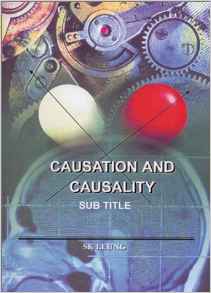 | | Causation and Causality
SK Leung ridicules Spinoza's idea of causation in teh form of 'Given a cause, its effect will follow as of necessity'. The question whether there is a causal necessity or whether causation is merely a constant conjunction, is transformed into questions of understanding events and its preconditions.
P class=MsoNormal>Author introduces the notion of 'epistemological priority' and 'temporal continuum' to explain the ordinary conception of causation in connection with space and time. The author separates the understanding of causality from that of causation in a way that allows the conception of causation not to end up as circular arguments, like that of Spinoza's and others, so that there is no need for 'causation' to be a 'Category' of a priori principles that governs man's perceptual reality. The origin of 'causality', to the author, lies squarely in an existential question /P>
P c | |  | | Language and Meaning in Human Perspective
This book offers a philosophical basis for its anti-thesis.
SK Leung refutes the separation of reference from meaning, the long-held logical principle of the identity of the indiscernibles and, of course Wittgenstein's non private-language philosophy.
P style="TEXT-ALIGN: justify">The book shows how this public 'reference' is possible without having to accept that the content of meaning is inevitably public. Here the author introduces the term 'reactionary response' for the co-ordination of public understanding which is merely a 'pointing' (reference) to something instead of an identity of something. ?xml:namespace prefix = o ns = "urn:schemas-microsoft-com:office:office" />o:p>/o:p>/P>
P>SPAN style="FONT-FAMILY: 'Times New Roman'; FONT-SIZE: 12pt; mso-fareast-font-family: 'Times New Roman'; mso-ansi-language: EN-GB; mso-fareast- | |  | | METAPHYSICS FOR A HUMANIST
New humanism with sound metaphysics and in-depth arguments. The author concludes by showing that, in the final analysis, it is only humanilty that can conceive of reality as necessary
Metaphysics for a look at some of the most established principles underpinning metabpysical thinking. It is at once engaging and provocative, taking the reader through the big issue and the big thinkers from Aristotle to Wittgenstein, taking Descarte's cogito to task along the way.SK Leung addresses this deficit in metaphysics in this book, which will be essential to students in philosophical and humanist thinking. | |  | | Nature of the Self
An in depth analysis of one of the most fundamental problems of philosophy. Each individual is studied as four distince aspects to his or her 'Self': the metaphysical, the physical, the moral and the understanding of othe Self.
P>The author examines some thoughts of the classical Greek philosophers Socrates, Plato and Aristotle, the philosophers of the Englightment and the thinkers of the twentieth century. /P>
P> /P>
P>The text us clear and refreshing free of the technical jargon that dogs most books on philosophical topics. The subject of the book is plainly stated and is covered in appropiate depth within the book. /P> | | 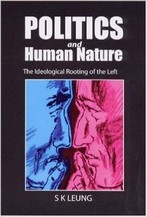 | | Politics and Human Nature
This book is a review, from a philosophical point of view, of the political ideologies of the right and the left with an attempt to examine the difficult notions such as right, equality, liberty, state, society, democracy, ownership and justicein terms of human nature itself.
P>Human nature to the author, is the gateway to political and ethical judgments. This political view is an extension of the author's systematic view of philosophy, the likes of whihc were long dead and buried. /P>
P> /P>
P>The left has always been vigorous in its ideals but weak in its political means for the lack of consistency. Without acknowledging its debts of human nature the left cannot but uses methods more suited to the right. There is no need for a "THIRD WAY" in a cry for consistent means to attain these ideals. /P> |
|
|
|


