|
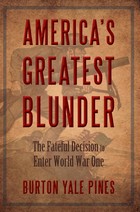
In writing America’s Greatest Blunder, Burton Yale Pines mobilizes his decades observing policy-making and historical crises. Initially trained as a historian at the University of Wisconsin, where he taught undergraduates, he later joined Time Magazine, reporting from Germany, Viet Nam and Vienna, where he was East European Bureau Chief. Then, as a Time editor, he chronicled much of the Cold War. Later, for more than a decade in Washington as a think-tank executive, he witnessed first-hand the making of foreign policy. He is the author of Back to Basics (William Morrow, 1982) and Out of Focus (Regnery-Gateway, 1993). He grew up in Chicago, attended Nicholas Senn High School.
Long fascinated by the question of why the U.S. entered WWI though Germany was posing no security threat to the U.S., he was prompted to write this book by the fast-approaching centenary of the war's outbreak. His several years of research surprised (even shocked) him and led to his conclusion that not only should America have not declared war on Germany and entered the war, but so doing enabled Britain and France to impose their draconian peace on Germany. Had America not entered the war, he concluded, the opposing sides, exhausted and running out of men and resources, would have had to negotiate a compromise peace. There would have been no victor, no vanquished, no Versailles Treaty, no reparations and no German toxic cries for revenge - and thus no Hitler, no World War Two and probably no Cold War.
|




 Share
Share Save
Save [
[