|
Mr. Ed, click here
to update your web pages on AuthorsDen.
|
|
|
|
 Hurricane Katrina Almost Killed Him Nine Years Ago, But Thankfully, He's Still With Us Today
On August 29, 2005, when Hurricane Katrina struck,
It''s been estimated that half a million companion animals
Lived in and around New Orleans and the devastated Gulf Coast.
Those of us who went there were able to rescue about 15,000 of them.
This is the story of one of the left behinds I was fortunate enough to meet.
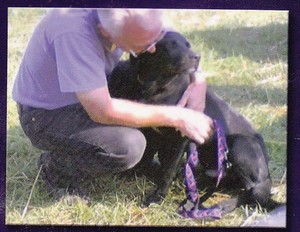
Photo: New Orleans, October 2005
Two months after Hurricane Katrina struck New Orleans, we found him lying on a dark deserted street, barely still breathing. His eyes were glazed over, he was frothing at the mouth, and he was now dying from starvation and dehydration. He was one of the far too many left behind dogs and cats we found down there that we sadly thought would not survive their horrific ordeal.
But as many of us did with rescued dogs and cats that we believed weren’t going to make it, I sat up all night with this one cradled in my arms, giving him IV fluids, petting him, and talking to him. I didn’t even think that he could hear me, but I talked to him anyway – telling him that he was finally safe now, that we would take good care of him, but that he had to fight very hard to survive.
By the next morning, this poor dog had still not stirred, so I finally got up and left his side in search of some much needed coffee.
As I stood several feet away from his pen talking to someone, he suddenly opened his eyes and slowly wobbled to his feet, and now he was unbelievably standing there staring at me and weakly wagging his tail. Someone yelled out: “He’s still listening to you talking; you’ve somehow revived him; so now you know that you have to take him home with you!” And my fellow pet rescuers immediately named him ‘Eddie.’
When I eventually brought Eddie Junior home to meet my spouse, she immediately said: “One Eddie around here is more than enough, thank you; we’ll just call him Junior.” And Junior now seemed extremely happy to be alive and well in his new home. He very quickly endeared himself to my spouse, and he soon became best friends with Tater, one of his fellow Hurricane Katrina survivors.
But two months after I brought him home from the Gulf Coast, Junior got deathly ill again – he was now coughing and hacking constantly. And now, we sadly discovered that he had Heartworm. Junior now had to endure several painful Heartworm treatments and injections, but he very thankfully recovered once more.
Life was good for Junior for the next several years until he decided to investigate a trash can after a backyard BBQ one night. He grabbed, inhaled, and swallowed an entire large corn cob, without bothering to chew it. And now, Junior was extremely sick again – howling out in pain. We rushed him to an all-night animal hospital, where they told us that he might not make it, but they pumped and pumped and pumped his stomach, and he somehow survived this ordeal as well.
And very recently over the horrendous Fourth of July Non-Stop Fireworks Weekend, Junior got extremely sick once more – now he was constantly vomiting, becoming very lethargic, and getting weaker by the day. I immediately thought that it was acute stress from all the fireworks constantly booming and blasting all around us – which Junior absolutely hates and absolutely fears – and which I have to sedate him for every year.
But it was sadly far more than the fireworks. Our vet did some blood work, took x-rays and performed an ultrasound, and soon discovered that Junior had a large Adrenal Gland tumor. He told us that surgery to remove this type of tumor was one of the most difficult procedures in all of veterinary practice, but he referred us to a very skilled surgeon he knew in case we wanted to consider this surgery. For me, the choice seemed pretty obvious, since I knew that since the day I had met him nine years ago, Junior has always wanted to survive.
And now I’m extremely happy to report that Junior has made it through the complicated three-hour surgical procedure to remove his life-threatening tumor; his surgeon says that his prognosis is now good; and today, I was able to bring Junior home once more. And thankfully, he is once again feeling much better.
Good Old Junior – A True Survivor, Nine Years After Hurricane Katrina Nearly Killed Him – And I Don’t Think That He’s Ready Or Willing To Give Up On Life Just Yet.
|
|
|
|
|


lovely read of determination and grit
What a wonderful story of survival. Of course none of it would've been possible without the intervention you provided every time to save his life. In the wild, he would have died, and perhaps be eaten by other carnivores. Survival of the fittest has created impressive natural survivors and kept their populations under control. Our intervention by saving those that would normally not survive and allowing them to breed certainly weakens the gene pool of the canine population.
The fact that so many of those pets could not survive, like humans, in a post-Katrina New Orleans, teaches us something about what we are doing to our survival chances in a real disaster that may come any time in the future. Are we prepared to eat our dogs like the Native Americans did to survive long winter? If not, wolves, coyotes and foxes will probably outlive us.
Ron