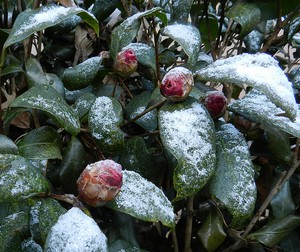
Two meet in Paris but passion dies out as time goes by.
It was Laura’s second time in Paris. An early spring, or so the natives hoped. The buds on the branches peeked green, pink, and white on the Champs Elysee, but frost bit them on the previous April night, leaving them withered and brown in patches. If this were a metaphor for her eyes only, she failed to catch its message as she walked into the city’s heart.
Earlier this morning, Graham told her to get out, but it was their apartment, 50-50 rent, or so went their agreement from the start. Laura hopped on the Chunnel train for a change of pace, leaving everything behind—everything but her packed overnight bag. True, it was only across a pinched strait, but she never found time to get there, not with the demands of Brinker’s Savings and Loans.
Her first trip had been all romance, before she’d moved to London. Just an American in Paris, to use the cliché, but here she met and fell in love with Graham. It somehow felt cruel when she thought on it; her sadistic subconscious brought her here to ruminate on the past six years.
On the Pont Neuf Bridge she paused, elbows on the stone railing, hands folded under her chin, the sun’s descent inevitable to her westward gaze over the brown orange Seine. People idled in the bridge’s alcoves, backs to the river, chatting with friends and lovers, but she didn’t notice them.
She could only see that first impression of Graham, driving a pathetic little scooter in fits and starts and eventually crashing into a sidewalk newsstand, the proprietor yelling in French. She had laughed so hard she almost doubled over, covering her mouth at her embarrassment as its driver turned, hands on hips, staring at her. When the helmet was removed, she was surprised to see not the face of a petite man, but a woman with a shaved head and a dark green tattoo covering the left side of her face. It looked tribal, but her skin was fair, her eyes searing brown.
“What’re you lookin’ at,” the woman said in a southern Irish accent.
“Sorry,” Laura replied.
“For what? I’m the dumbass who can’t drive dis ting.”
Laura laughed nervously. “You’re not from around here either.”
“American?”
“Unfortunately.”
The driver looked down at the bike’s bent front rim. “Well dis ting’s foked. Piece of shite Italian rental!”
The newsstand guy finally threw up his hands and returned to his station.
“Sounds like you could use a drink,” Laura suggested.
“You buyin’?”
“Why not.” She shrugged.
“I didn’t get your name, missy.”
“Laura.” She smiled.
“Graham,” the biker said, stretching out her arm, wearing that leather jacket she so loved.
It was in that handshake that Laura knew there was something there…concrete, strong, not a chance encounter...like the Oath of the Horatii or the forearm clasps of those guys in Ben Hur. No one ever got that about them. They weren’t role-playing. There was neither a “male” nor a “female” in their relationship. It was more homoerotic in the masculine sense than anything. Sure, they weren’t crossing swords, but it was, right up to the end, a delicately held balance of each of them taking on different gender duties…some traditionally XX and some XY.
------
A year after Paris, the two of them stayed with friends in Laura’s hometown of Boston. They were preparing for a wedding, but her pastor said it was an abomination and a “lifestyle” choice he could not condone. This coming from a guy who admitted that he believed the rookery of crows perched on his lawn one day were a physical manifestation of evil. He had both the idiocy to chuck golf balls at the hapless birds and then tell the story of his raven crusade to his congregation the next Sunday. But she was getting used to nonsensical clergy talk by then.
Still, it was Massachusetts, and they wanted to be married. The pastor said it was “unnatural,” and that they were “God haters.” Yeah, Romans will do it every time. Laura had said, “So, do you think we should be stoned, like in Leviticus?”
“Back then, that was the law, but under Christ’s mercy, no,” he said.
“You’re just allowed to hate us under Christ’s mercy.”
“It’s not you; it’s your sin that I hate,” he replied.
“It’s not you I hate, it’s the fact that you love your wife and females in general. How dare you love women the same as me. It’s unnatural,” Laura had said, slamming the door to his office as she stormed out.
She knew what he thought…that she hated her father or was sexually abused, neither of which were true . She knew that the DSM-IV still considered her affection for the same sex to be aberrant…a mental disorder. Graham had said, “Fok him, then. We’ll get married in some other chorch. I’m not Protestant and you’re not Catholic. What’s it matter?” But Laura was too upset about her childhood pastor and churches in general. What had she expected? A dispensation because she had always been a good, nice girl…not like the promiscuous men and women that were portrayed as the epitome of homosexuality?
They never did get married.
They went back to Graham’s flat in London and looked for a bigger apartment together.
“I want to be able to see the Thames,” Graham insisted.
“It’ll be more expensive, and who knows when I’ll land a job here,” said Laura.
“Please, this is the banking capital of the U.K. and you’ve got Wall Street behind you.”
“Doesn’t guarantee…”
“Laura, will you calm down? There are plenty of south London places with a river view.” Then Graham kissed her in that favorite spot behind her ear.
She couldn’t argue with that.
------
Back to the present and the continuing economic meltdown, she was one of the first employees to go, just before Brinker’s went under, along with countless other financial conglomerates. But that wasn’t the source of the ultimate argument. She’d only been out of work for two months and was receiving unemployment cheques.
The sun sank over the river, taking its blood orange highlights with it, and she turned around. A café was in order. To the right was the Latin Quarter, to her left the Ile de la Cité with Notre Dame, then another span of the arched bridge into the Marais. Uptown or downtown, right bank or left bank, adroit or gauche. She pushed her hands into her pockets and hung a right to the south, briskly walking toward the dark narrow streets where so many students once spoke the church’s dead language.
It baffled her why, when the river ran mostly west – east, that the northern portion of the city was called the right bank and the southern portion the left. Maybe it had more to do with being on the “right side of the tracks” than anything. She belonged on the wrong side; of that, she was certain.
Cold chilled her to the marrow. It had to be zero degrees Celsius. Listen to me, she thought, I sound like one of them. Am I European now, she wondered. On a cobbled side street, she saw a familiar pool of yellow light spilling out windows and onto an abandoned patio of wrought iron tables and chairs. She heard murmuring voices from inside. Shaking her head that this was where her feet had carried her, she pulled the oak door toward her and was intimidated for a moment when a few men at the bar stared at her, then returned to their beers.
It was a bar/café, not a true restaurant, but filled with the types that came after work to chat before going to dinner. A skinny model type with black bobbed hair sipped what was probably a pear liqueur as her date talked about himself. Two beards in Lenin glasses discussed under a replica Delacroix painting. A woman past her prime sat alone, mascara running, as she sloshed her vodka back and forth to a jaunty tune only she could hear. Off in a dark corner was a street poor scribbling on bar napkins with an over-sharpened stubby pencil.
Striding up to the counter, she found a place and said, “Une Trappistés Rochefort dix.” She had to translate the last part in her head from ten, but the rest was well known to her. The beer was 11.3%, sweet, malty, and dark. Brewed in St-Remy, Belgium and distributed locally, it was one of the few “French” beers she liked. Half of a 330 ml bottle, drunk fast enough, would conjure up a buzz for the most jaded of drinkers below 130, and she was hardly 115. The thought of weight slapped her with another memory she didn’t need right now.
------
Graham had let herself go over the past few years, excusing the extra weight as being part of her job -- a bouncer at a nightclub. “Muscle weighs more than fat,” she said for the thousandth time, making Laura want to buy a scale that read the percentage for each and destroy the delusion. You know, one that shows water, muscle, fat, and bone, so that even the big-boned copout wouldn’t work. But she knew it was a waste of time. That chick could put it away and the club’s free drinks and deep fried foods after hours were what she smelled like upon staggering into the doorway at 3 am. That and cigarette smoke.
“I’m not smoking,” she would insist.
“I know, I know. It’s just part of your job. At least take a shower before you come to bed.”
“I will, but you gotta fag?” Graham asked with a cocky grin.
“I’m going back to bed now.”
------
Laura shook it off and took a drag on one of her Indian blues. Ever since the indoor smoking ban in France and most other western countries, the inventors of the world had sought to find a product that would eliminate second hand smoke. One had finally been accepted by the E.U. called “Unfumar,” the creation of an Italian inventor who worked for Phillip Morris. In the U.S., the same device was called “Smokeless.” The smoker simply put the cigarette or cigar, depending on the model, inside of the digital camera sized box, clicked the button, and it lit the end while starting up the nearly silent motor that filtered the smoke from ever reaching another patron. After each drag, she blew into the collapsible telescoping funnel, and everything was sucked away like a dentist’s spit cone.
“I’m such a hypocrite,” she said aloud.
“Pardon?” said a man seated to her left. There was no detectable accent.
“Sorry, didn’t realize that came out of my head.” Her glass of beer came just in time to avoid the intros and handshake. She placed a euro ten spot on the counter and watched the foam separate bottom to top into the honey brown malt.
“I’ve never seen you here before,” the man said. He had short brown hair and a shadow of maintained stubble, flecks of gray starting to encroach.
“I haven’t been here in six years,” Laura replied, then put her lips to the
foam, sucking up a mouthful, leaving the glass on the edge of the bar. She licked off the frothy mustache and sighed.
“Who was he?” He started up his charm.
“Don’t ask. You know what this was six years ago?”
He shrugged.
“A gay bar.”
He suddenly looked uncomfortable and scanned the room.
“Don’t worry, it’s not any more.”
“How do you know?”
“It used to be a lesbian gay bar.”
“Oh.” He seemed relieved and took a sip of his whiskey. “I’m a student.”
“Art?”
“What makes you say that?”
“Come on…you’re not studying physics.”
He laughed. “Actually, I’m doing my dissertation on Rimbaud.”
“Nice. You don’t look like the poet type.”
“What, I have to be scruffy and intense, like pencil dude over there?” He pointed with his glass.
She smiled.
“What’s your name?”
“Laura. My annoying friends call me Ra-Ra, but I just give them a sinister leer.”
“Jake. Can I get you a second one of those, Laura?”
“Can I finish this one first?”
“Of course.” He swirled the ice cubes around in his short glass.
“That Jack?”
“Nah, Johnny.”
“Get me one of those instead.”
“He really must’ve been something,” Jake said, turning to the bartender. “’Nother one of these, short glass, pitcher of water, two tall glasses,” he said in French.
The men to her right were mumbling to each other in their native tongue and she glanced through them, losing the reality of the bar in clinking glasses, seeing the frozen shriveled buds merge with Graham’s brown eyes, speckled here and there, winking a blue tattoo.
-------
Snow was falling outside, grouting stones’ grooves and soaping windowsills. The silence said it was closing time.
I find this to be so well written and most engaging from beginning to end. Your story easily awakens the imagination of the reader (me in this case). Very well done, Danae. Thank you for sharing. Love and best wishes,
Danae, there is nothing left to say that has not already been said. I have had to limit my reading to only a few, and yours is priority because of its excellence. I can't wait to read each line you write, and as usual I agree with Ed that you have 'quite a brain.' Of course, that can be a problem! Thinking too much can be depressing. Just channel it, and you'll have success.
I fully agree with both Odin and Ed. You crossed boundaries and borders with ease and the reader never wondered about the change of venue at all. Not only did you make these transitions so transparent, the detail made one feel being there, something that good writing is able to do. It certainly reads of experience, perhaps memoir.
I've found that a good short story has a good ending. I admire a twist that turns the whole thing around. However, in this case, your story seems to beg further examination. It leaves one wondering where Laura's going from here.
I was comfortable in changing the narrative to the first person singular whether it was in fact or not, and whether it was totally fictional or not. The lure and the grip lay in the minute details that conveyed an authenticity as a writer right down to the fag and a wink. Your character is one sexy lady who is toughened with street smarts and quite a brain at the same time. Loved every moment! -Ed
Delving into the protected realm of private and cherished moments of growing up into who we are, you've penned a journey into identity that few might dare relate to. By that I mean few of either gender are willing to admit their female or masculine side of emotional need and resolve is a partnership, both within and without. Here, such a discovery is made with immaculate word and image choices, allowing even the most jaded opinionated "I'm right, and you're wrong" aficionados to open their eyes and accept how they think of themselves and others matters little to anyone but them... unless, of course, unlike this story, you're unwilling to take the risk of finding out who you really are. Big time kudos. This was a lyrical melody even within perhaps the dissonant and disappointing epiphanies for both characters.