The girl stands on the platform before the altar in the ancient stone church. She’s eleven or twelve, with an olive complexion and long dark hair, dressed in a white robe tied with a green rope. A wooden crucifix hangs from her neck. Her face is relaxed, eyes open but soft.
Perched on filigreed candelabra on either side of the girl, candles flicker, casting animated mottles of light and shadow. Tendrils of smoke rise from incense sticks, smelling of pine sap, citrus and balsam. Light streams down from a large stained glass window, tinting the girl’s hair and garments and the altar behind her.
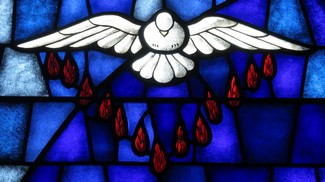
The window, a vertical rectangle topped by an arch, contains intricate arrangements of color and shades. Focusing on a single portion reveals finer and finer forms in a seemingly endless progression. The margins have repeating patterns of leaves, flowers, and fruit, each in a different hue.
Filling the center of the window is a finely detailed meadow, bisected by a brook. The water seems to flow, undulating downstream and flashing white over stone riffles. Behind the meadow, a forest rises up the slopes of foothills. White-capped mountains tower beyond. A stag grazes in the meadow and an eagle soars overhead. Soars in great circles.
The stag twitches its ears and glances up, grass between its teeth. A small wolf races into the picture from the lower left corner. Two men wearing sewn animal skins follow, carrying long poles with sharp points. The stag turns and runs. Two more men rise from the grass ahead of it. They hurl short spears from throwing shafts with a holding cup at the end. The spears fly toward the deer. One pierces its chest. It stumbles and crashes to the ground.
The girl raises her chin, parts her lips and begins singing. Her voice is high and angelic, and echoes off the stone walls.
Abwûn d''bwaschmâja
Nethkâdasch schmach
Behind the girl, the window transforms like a kaleidoscope. The wilderness image breaks apart. Fragments shift, rotate and change color. New details emerge.
The upper half resolves into a line of twelve women harvesting a field of amber wheat. The women squat on leather sandals and wear simple wool robes dyed different colors and long white headdresses bound with a cord across the forehead. They grab fistfuls of grain stalks and slice them near the base with curved sickles. When they can hold no more, they pull out a few stalks, wrap them around the bundle and tie a simple knot. They place the tied bundles on the cleared ground and continue the advance.
The lower half of the window depicts a different scene, a grandiose stone room with gold-painted columns and statues. In the back of the room, behind a red altar draped with white cloth, two six-winged seraphim grip a gold-plated chest. Below, bearded men face the chest and chant. Soldiers wearing leather armor and bronze helmets burst inside. They stab the praying men with spears and short swords, sparing none.
Beneath the window, the girl tilts gleaming eyes upward and continues to sing.
Hagiasthêtô to onoma sou
Elthetô hê basileia sou
The window rearranges itself again. On the upper half, a partly completed aqueduct stretches from a grassy hill, connected stone arches rising high above the ground. Men on wooden scaffolds add stones to the nearest section and trawl cement into the seams. Teams of horses haul carts filled with rocks. In the foreground, two men in fine robes examine a paper scroll and discuss something inaudibly.
The lower half of the window depicts two armies gathering in ranks on a hilly plain. The men in front carry long spears and painted shields. Behind these lines, men ride horses with scaled armor. One side has elephants with towers on top. The two sides shoot arrows at each other, slicing arcs across the sky. Men drop and stain the dirt with their blood. Soundless horns blow and the lines charge each other.
The girl presses her hands together and continues to sing.
Fiat voluntas tua
sicut in caelo, et in terra.
The window shifts again. On the top half, a massive church rises from a hill in a great city. Facing the sun and shining orange and gold, the structure is square with tall piers and rounded roofs. It is topped by an expansive dome covered in scaffolding. Barely visible, men scramble along the walkways and up ladders.
In the lower half, a motley crowd marches to a high palace wall. They carry sticks and torches and shout silent cries of anger. They pry cobble stones from the street and hurl them at the palace. Archers appear in the crenels atop the wall and fire at the crowd, dropping scores. The crowd backs away and sets nearby shops on fire.
The girl tightens her jaw and continues singing.
And forgyf us ure gyltas swa
Swa we forgyfað urum gyltendum
The upper half of the window rearranges into a red and gold pavilion staked into the grass along a wide river. Bearded men are gathered beneath the pavilion, most wearing tunics over chain mail. Others wear the robes of monks or priests. They lean forward with serene expressions. A middle-aged man wearing a red cape and a golden circlet sits in an elaborately carved chair before a small table. Shoulders hunched, he accepts a quill from a shaven-headed monk and signs his name at the bottom of a broad parchment crowded with words.
Beneath this scene, torches dimly illuminate a chamber with iron utensils hanging on the stone walls. Half hidden in shadows, a young man in a cape and a portly monk direct men in dark robes with peaked caps as they gather around three naked prisoners. One, a teenage boy, hangs by his wrists from the ceiling, heavy weights fastened to his feet. Another prisoner, an elderly man, is bound in a spiked chair. Robed figures tighten his restraints, forcing the spikes into his flesh. His mouth opens and he thrashes his head. The third, a young woman, is stretched out on a bench. A robed figure pulls pole-mounted iron claws out of a fire and walks toward her.
Eyebrows knotted, the girl continues to sing.
And lede us not into temptacion
But delyuere us from euyl.
The upper half of the window morphs into a quartet of men on a wooden platform. One mixes paints in ceramic bowls. The other three apply paintbrushes to a curved section of ceiling just above, coloring and shading an outlined woman. Her face and left arm are finished. She is young and beautiful, with flowing curls half wrapped in a blue cowl. The painter in the center, a thirtyish man with a dark beard and intense eyes, directs the other three and applies the finest brush.
Below this image, men wearing steel chest plates and helmets emerge from the entrances of stone buildings. They fire muskets and flintlock pistols at a crowd of unarmed bronze-skinned men wearing bright garments and silver discs. More armored men charge on horseback out of alleyways toward a silver litter lined with parrot feathers. They hack off arms and heads with swords and the remaining crowd flees with panicked eyes and screaming mouths.
Brow wrinkled, the girl drums her fingertips together and sings strained notes.
For thine is the kingdom
And the power
And the glory
For ever.
The upper half of the window rearranges itself. A man stands at a wall-sized blackboard, writing equations with a piece of chalk. He has tousled black hair, a bushy mustache, rounded cheeks, and a dimpled chin, and wears a tweed jacket. He draws a box around each equation and nearly fills the board. In the remaining space in the bottom right corner, he finishes, E = mc2.
Beneath the man at the blackboard, a long train pulls up to a stretch of brick and plywood buildings behind barb wire fences. Thick black smoke belches from tall chimneys beyond. Soldiers herd emaciated men, women, and children out of the train and through a gate with the words “ARBEI MACHT FREI” overhead. Gray-uniformed guards, both male and female, take the prisoners’ suitcases, coats, and shoes and toss them into big piles.
Feet still planted but eyes feverish and darting, the girl’s voice shakes and cracks.
Amen.
The window fades to black. In the upper half, billions of white points perforate the darkness. A searing bright spot commands the left. A small, blotchy gray crescent lies to its right, then a larger blue crescent with patches of green and brown overlaid by white swirls. In the center of the scene floats a space station, a spotlit metal framework with rows of panels stretching to either side and pointing toward the bright spot. A shaft runs through the framework, on which three spoked wheels rotate slowly. A second lattice connects to it; within this, tiny figures and multi-armed spheres hover over a long white cylinder with its own spinning rings and a cluster of smaller cylinders at the far end. A starship.
The lower half of the window also has a black background with white points, but a curved spherical section of blue, brown and white stretches across the bottom. A formation of long cylinders enters the view, blue flames jetting from the ends facing forward. The starships slow and point toward the surface below. Lights strobe on wire-hooped tracks slung beneath the cylinders, and bullet-shaped objects shoot toward the sphere’s surface, where they create bright flashes and expanding rings of dirty orange. The bombardment continues until the entire surface is dark gray.







 A bipolar history of humanity
A rather unique delivery with mostly very detailed, yet still sketchy descriptions of certain events/eras of human history. There is no action except in the descriptions and the woman singer's reaction to the panels. In the end, a very dystopian, apocalyptic ending.
I admire creativity, but I didn't particularly like the story. It didn't grab me emotionally.
Ron