CHAPTER 1: KIELBASA AND PIEROGIES AND DANDELION WINE…
SPERO EVANOFF
My mother’s parents were immigrants when it wasn’t cool to be different. My Poppa Spero Evanoff was from the old Yugoslavia, in the central province of Macedonia, a town called Prilep, 30 miles from the border of Greece. He and his younger brother, Teodor, showed up in Homestead, PA just about the time the steel workers and the Pinkertons were trying (and sometimes successfully) to kill each other over the right to work and a fair day’s pay. His brother changed his name, became Ted Evans, door-to-door salesman. Poppa did the next best thing. He became a barber, and a good one. No one ever killed their barber. He married, he had three children. He lost his first daughter to appendicitis. He lost his wife to post-partum depression. He lost his son to a difference in politics. And ultimately, he lost his daughter for the same reason. But he never lost his granddaughter. I loved my Poppa better than almost anything. On Sundays, he would go to the Greek Orthodox church with friends in Steelton, the Macedonian community was extensive then, the steel mills employed every Bohunk and Slovak that showed up at the window. Sometimes he would take me with him, and the old babas would fuss over me. They patted me with work-worn hands and twisted knuckles from a lifetime of harsh soap and hot water, and gave me nickels and talked to me in dialect that I never learned. I remember a wedding where I learned the old country dances. Then, every Monday, his barbershop was closed. He would get on the trolley (and later the bus) in Hummelstown and ride to Hershey square, and from there he would walk to Trinidad and pick me up for the day. We went to the park, we took walks, we rode the trolley, he took me to Harrisburg, we went out to dinner, he took me swimming, we had endless hours of silent communication, and he seemed never to tire of me, or find fault with me. He was the consummate European gentleman, very proud, very stoic. He was a lonely man, my Poppa. He never got his citizenship, because he couldn’t swallow the politics. His dream of America was very different from the realities of life as a greenhorn. He might have been a Socialist, but he sure as hell wasn’t a hypocrite. He paid his taxes, and had single-handedly raised two children as best he could. His son served in the Army, was with the liberation troops at Auschwitz and Bergen-Belsen. He was as good a citizen as any natural born American. He loved the earth and growing things, he knew where the best mulberry trees were, and he made drinkable dandelion wine every year. But because of his politics, he was not offered citizenship. And he was accused of (but not tried for) subversion. He went through some very bad times during the McCarthy witch hunts, and saw many friends destroyed, literally, their families, their businesses, their lives. And yet he persevered. It was, after all, America.
He died, still not a citizen, on the Fourth of July, 1957. At the very end, he called for a mother he had not seen in over 50 years. He died with a great many secrets. I still dream of him. He comes to me, always in his white linen summer suit. When I reach for him, he disappears. But he’s smiling.
ANNA STROIK EVANOFF
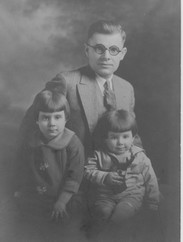
At some point after his immigration to Homestead, Pennsylvania, Spero met his future wife, Anna Stroik, a young woman from the Austrian Ukraine whose brothers were bakers. They married, a self-conscious young man and a strangely shy wife, and had three children: Eleanor, Margaret and Harry. Eleanor died at the age of 12 from complications from appendicitis. Penicillin had not yet been discovered, and her burst appendix poisoned her. At some time shortly thereafter in 1928, when her remaining children were 7 and 3, Anna was institutionalized for attempted suicide (they said) which was really a botched self-induced abortion, because she was pregnant for the fourth time, she had already buried one child, and she had a history of post-partum depression. She finally reached her limits, and she stepped over the edge into a void from which she never emerged.
I never even knew she existed until after the death of my grandfather in 1957. It was several more years before I had the whole story. After several years in the State Hospital, Anna had been finally diagnosed as post-partum paranoid schizophrenic with psychotic episodes and hallucinations. She was deemed incurable. She was not yet 35. She died almost 40 years later in Wernersville State Hospital in a diabetic coma. Someone had forgotten to give her the insulin she needed to stay alive.
I don’t know when I really became aware of Anna as a real person. I know that realization came in the form of a photograph I found in my grandfather’s things in a box in the attic. When I saw the picture, I made the connection. It was like looking into a mirror. I did not resemble my mother or my father. I didn’t look like either of my cousins. At some point, I wondered if I had been adopted. But then I saw the picture, and I knew. My mother, not long before her own death, commented on the fact that I come by my talents naturally.
Your grandmother, she said, was known for her fine needlework.
And she was crazy. I can see me in her eyes.