Dear Ms. Di Bella Barles,
I have read your memoir and reviewed it in the newspaper "Fra Noi" a while
back September of 2004. Attached is a copy of the review. If you are
interested in having other books reviewed please send them to me at the
address below. I cannot promise a review will appear or when, but I do
promise I will read it.
Sincerely,
Fred Gardaphe, Director
Italian American Studies
SUNY at Stony Brook
Stony Brook, NY 11794-5359
(631) 632-1215; fax (631) 632-9612
Fgardaphe.notes.cc.sunysb.edu
September Books
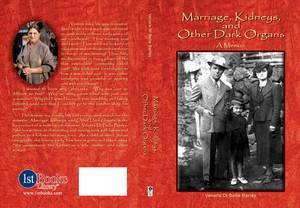
Don’t let the title of Venera Di Bella Barles’ memoir keep you from
picking it up. “Marriage, Kidneys, and Other Dark Organs,” is not about
how to woo, wed and keep a man through a perverse version of the Atkins
Diet. No, this life story covers much more than the troubled marriage of
her immigrant parents and the failure of a too rare kidney dinner she once
served her husband as newlywed. This is a large, sprawling book that takes
us through her life from childhood to retirement, over and through
obstacles that are daunting and sometimes distracting.
This is not a literary memoir. Di Bella Barles, an adept writer, has a
storyteller’s voice that is catchy, if somewhat disconcerting at times.
There’s a tendency to be repetitious, especially in the last third of the
book. I get the feeling that these chapters are essays that she has
written over many years and by the time she put them together in the book
she didn’t know or care about what had been revealed in earlier chapters.
This is where the book gets tedious, but no more so than hearing a relative
tell the same story years later. So this can be forgiven if literary
expectations are lowered. In fact, this book is like having Venera in your
life telling you about hers over the years. Venera tells stories, but
most of them lack the imagery that would have driven this book to a larger
audience.
The most powerful writing comes from her earlier years, when she is growing
up with a Sicilian father and a Neapolitan mother in Albany, New York.
There is a particularly poignant segment covering her year in Linguaglossa,
Sicily during the Mussolini years. A photo from this period is on the
book’s cover and shows a defiant little Venera giving the Fascist salute.
Over the years parents leave the U.S. for Italy when they run out of steam,
only to return.
The father, Salvatore is a jack-of-all-trades, always looking for something
new; he’s charming, handy and ruthless when he’s insulted or depressed,
which happens more often than not. He becomes the antagonist to Venera’s
fearful, but feisty rebel. Between them is Antonietta, the mother who is
too traumatized to do much more than enable the father and daughter to
fight. It’s a story of the inability to love that too often occurs and too
rarely is told by Italian Americans. Venera elopes at the age of 19 and
her relationship with her parents is never the same. It’s as though she
must run away to find sanity in her life; she runs into the arms of Ed, who
will work as a prison psychologist. Filled with all the polish and warts
that good self-portraits must contain, “Marriage” uses actual family
letters that reveal the passion that tries for love but usually explodes in
hatred.
“Marriage” is one of those books that could have used an editor to reach a
larger audience. At times some of the stories are ceaseless. That’s when
it seems she’s writing more for herself, than for her readers; these are
the sections that roll on like home movies and vacation picture shows. We
simply do not need to hear about her husband’s compulsive shopping, or the
trouble you can get into with kids, cats and cars. It’s when she returns
to the actual core of the book, the fears from her early childhood and how
she overcame them to create her own loving family, that’s we see the power
that storytelling has to help us understand and heal the wounds of the
past.
“Marriage, Kidneys, and Other Dark Organs,” ($15.50 paperback) is
published by Author House, www.authorhouse.com ISBN: 0759680604
|