What I found out about Cairo, Illinois, after making a shocking visit in April 2016
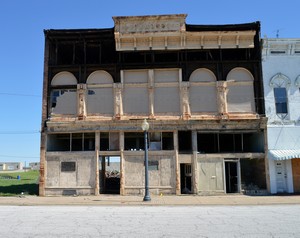
We were lost after crossing the two bridges between Missouri and Kentucky on our trip across the United States in April. After visiting the Kentucky mounds of the ancient Indian civilization from long before there was an American republic, we took the wrong road toward our destination of Harrodsburg in bourbon country. Our backtrack landed us in the southern tip of Illinois, in an area called Little Egypt, where we saw four wrecks of 19th Century buildings off the main highway at the intersection of Commercial and 7th Streets. Elegant old street lamps lined the streets. The biggest structure, the Famous-Barr building, was vacant. A large pile of bricks could be seen through an open doorway and the destroyed back wall. The second building, its ground floor boarded up, had two old battered air conditioning units projecting from upper story and an older model panel truck parked at the curb. The third building was a seedy looking nightclub, its exterior painted pale blue. The gap of a demolished building separated the nightclub from the fourth, a three-story empty structure. We drove over to have a closer look. I was shocked. Neither side of street that extended six blocks north had any buildings, yet the lovely old street lamps remained in place on a broad sidewalk in front of grass or rubble-covered properties. I photographed the ruins while elderly man in a power-operated wheelchair rode down the eerily empty street.
After reaching our final destination in Pennsylvania, I researched the history of Cairo. What I found was a devastating history. Cairo was destroyed by racism. The town’s commercial buildings and industries were owned by white people who refused to hire the black population of the city. In the 1960s, Little League baseball was canceled to keep black children from playing. By 1969 black people were not allowed to gather for sports, to march, or to congregate in local parks. A racist white man rammed his pickup truck into a demonstration protesting a whites-only swimming pool, severely injuring a young girl. The vigilante group called the White Hats policed the town. In 1969 the African-Americans formed the United Front of Cairo to end segregation and boycott white businesses. The white business owners refused to give in, choosing instead to close up their shops. They abandoned their businesses and fled town. Slowly most of the idle buildings were demolished. By 2010 the population was 2,800 persons of whom 72% were black.
This sad story typifies the long history of a city that was once, before St. Louis arose, the main terminal of shipping and crossing on the Mississippi and Ohio rivers. In 1838 Cairo was booming, growing to 15,000 at its largest by 1900. A grid of four by six blocks defined the center of this metropolis-to-be located on land near where Lewis and Clark first camped to begin their exploration of the upper reaches of the Louisiana Purchase. A quay along the Ohio River edge serviced the ferries and the steamboats that paddled up from New Orleans and across the two big rivers. During the Civil War General Grant used Cairo as his supply and troop headquarters for the invasion of the South. During this period slaves sought freedom by escaping to the protection of the Union stronghold at Cairo. The town was an important transfer point on the Underground Railway.
This was the beginning of a large African-American population in the city, much to the annoyance of the white inhabitants. The railroads finally killed the boom in Cairo when the Eads Bridge, completed in 1874 and the longest arch bridge in world at the time, crossed the Mississippi, directing river traffic north to St. Louis. In 1905 the decline was complete when a new railroad bridge crossed the Mississippi at Thebes, a town northwest of Cairo, ending the ferry traffic. After the automobile bridges bypassed the city in the 20th Century, the capitol of Little Egypt became an isolated backwater controlled by a white majority. Yet throughout the late 19th and 20th Centuries Cairo had a large African-American population that was routinely discriminated against. The population of Cairo by 1909 was approximately 13,000 of which 5,000 were African American, a high percentage for a small town that considered itself a place with white traditional southern white heritage.
On November 11, 1909, tensions exploded, a lynch mob hung two men. The first was the African-American Will James, accused of murdering Alla Pelly, a young white woman. The mob strung him up below the arch of new electric lights on Commercial Street at the corner of 8th, one block down from the surviving remnants of the town. Will “Froggie” James didn’t die as intended. The raging population pulled the hung, but still living, James, down from the rope strung across Commercial Street. They burned him, dismembered him, and mounted his head on a pole. James, before he died, implicated another man whom the town pursued without success. They did find a white man, Henry Salzner, who had been on the run for nearly a year for slaying his wife. The mob strung him up too, but didn’t inflict the savagery on him that they did to “Froggie.” He was white, after all.
101 years have passed since the racially inspired slaughter. “Kayro’s” KO-ed center is a total ruin. What’s left is an outlying ring of poor black people’s homes, a few imposing monuments of the past glories: the United States Customs House, the mansion Magnolia Manor of 1872, and a sad commercial strip on the highway north. Donald Trump would probably call this a ghetto, as he famously referred to African-American neighborhoods in bigger, more northern American cities. However the last time a grassroots conservative Republican presidential candidate with southern states’ rights and anti-civil rights views visited Cairo in Little Egypt, there were a lot of white people still around. They have mainly gone now to warmer, more hospitable places, like the aptly named Phoenix, Arizona. Here racists rising from Cairo’s ashes can rail against “Mexican rapists.”
|