A review of the major exhibitions of Pacific Standard Time, a survey of California Art funded by the Getty Center
Pacific Standard Time Profusion
The many exhibitions of Pacific Standard Time: Art in LA 1945-1980
create a fabulous portrait of the diverse creative explosion that burgeoned during the forty years after WWII. There are too many shows to see, but I bet each one adds a rich layer to this portrait. I saw most of the major survey shows: Under the Black Sun: California Art 1974-1981 at MOCA, Pacific Standard Time: Cross Currents in L.A. Painting and Sculpture 1950-1970 at the Getty, Now Dig This! Art and Black Los Angeles 1960-1980 at the Hammer Museum, and Living in a Modern Way California Design 1930-1965 at LACMA. I missed getting to San Diego to see Phenomenal: California Light, Space, Surface at MCASD and Long Beach to see Mex/LA: Mexican Modernism in LA 1930-1985 at MOLAA. These exhibits closed too quickly in my estimation. However what I did see included three other exhibits: Los Angeles Goes Live: Performance Art in Southern California 1970-1983 at L.A.C.E., Breaking Ground: Chinese-American Architects in Los Angeles 1945-1980, at the Chinese-American History Museum and L.A. RAW: Abject Expressionism in Los Angeles 1945 to 1980 at the Pasadena Museum of California Art PCMA). When compiled together the inclusiveness of these shows is mind-boggling. Los Angeles is no backwater. It has been producing exciting, challenging, and technically advanced work since the end of the Second World War to today.
What I found especially engaging is how all these shows support one another and fill in some blank spaces between movements, making a composite whole. With that in mind I will discuss the two exhibitions I most recently saw. The exhibition on the Chinese-American Architects adds a dimension to the Living in a Modern Way Exhibition at LACMA, and L.A. RAW at PMCA provides a wider frame of reference to see the exhibitions Under the Black Sun at MOCA, Pacific Standard Time Crosscurrents at the Getty, and Now Dig This! at the Hammer.
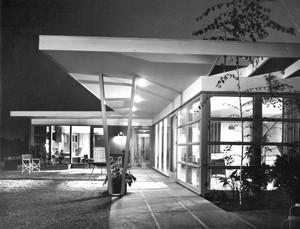
The Chinese-American Museum presents some of the work by four Chinese-American Architects: Eugene Choy, Gilbert Leong, Helen Fong, and Gin Wong. All of these architects were and are Modernists. The Choy Residence in Silverlake, which I was able to visit prior to seeing the photographs and drawings in the exhibition, is modest but equal to the more famous houses by Eames, Neutra, and Koenig. Its open plan and expansive glass, and V-post-supported slab roof have all the elements of the exuberant open living that made California a Modernist Mecca. Choy realized this small gem against odds that other white architects did not face. Chinese-Americans, like blacks, were discriminated against. When Choy wanted to build this house for his family, the City of Los Angeles had a prohibition against land or house sales to the Chinese. When we look at the achievements of the culturally empowered as exemplified in the Living in a Modern Way show, we are not confronted with the difficulties that others like Choy, who had to go door to door in the Silver Lake neighborhood to gain permission to build and live in this formerly whites only enclave, encountered.
Helen Liu Fong was the interior designer on the team at Armet and Davis Architects, which gave LA “Googie Architecture,” an outgrowth of Modernist architecture. Helen Fong in 1951 was a groundbreaking architect at a time when all women, and especially women of color were just starting to gain acceptance in a male-dominated profession. Fong’s role in the team was to enhance the experience of patrons. Googie Architecture wasn’t celebrated in the Living in a Modern Way, but it is one of the enduring images of LA culture. The unique futuristic design derived from coffee shops and vernacular architecture has given us prized pieces of Los Angeles’s cultural history. Many Googies have disappeared, but those that remain are true embodiments of a California confidence in modern living. I can visualize patrons of the 1950s and ‘60s wearing playsuits by Joseph Zukin and dresses by Rudi Gernreich and shaking salt and pepper from the angled aluminum and glass canisters by Henry Keck, while reading a copy of Arts and Architecture sitting in perhaps a Naugahyde booth by Helen Fong.
Modern design was the public face of Los Angeles. Underneath the polished surface in the art world, a more visceral expression was taking place. Artists were seething with sex, questioning the human condition, revolted in horror to the human carnage of WWII and the insanity of the Vietnam War. The title of exhibit at PMCA, L.A. RAW: Abject Expressionism in Los Angeles 1945-1980 from Rico Lebrun to Paul McCarthy, I found a bit twisted. The word “abject” means to be low, worthless, despicable, degraded, or pitiful. Most of the works in this show didn’t fit this description. Perhaps the some of the works of Lebrun, like his “Buchenwald Cart of “1956, or Hans Burkhardt’s “My Lai” painting of 1968, with its attached skull fragments, could be termed abject, but why apply this title to all the works in this exhibition. John Altoon’s “Untitled” pastel drawing, Cameron’s “Peyote Drawing” of 1957, which the LA police department cited as lewd and shut down the Ferus gallery where it was shown, or Charles White’s “J’Accuse” charcoal drawing of 1966 are not abject. These drawings -- I am very partial to drawings – do not depict worthless or despicable experience. The black figure of “J’Accuse” wrapped in a flowing tunic is majestic, a human who rises above the degradation to which she has been subjected. John Altoon’s “Untitled” copulating figures are totally engrossed in sex: the man nestled in the woman crotch, the woman swooning in pleasure. This is not low. It is high, high on life. Cameron’s lewd labeled portrait shows a woman during intercourse while she unleashes her tongue like a serpent. This is not degradation, except to prudes. It is sensual excitement. The show exposes feelings and actions that are mostly hidden, but not degrading.
L.A. RAW is an important show for several reasons. It spotlights a whole raft of artists who largely have been forgotten in the culture of the new, as embodied in work of artists like Ed Ruscha, Edward Kienholz, Billy Al Bengston, David Hockney, and John Baldessari. Rico Lebrun, Hans Burkhardt, Jan Stussy, William Brice, Joyce Treiman, Charles Garabedian, and Cameron were artists active at the same time as these new artists; and, as recorded in the exhibition, some were teachers of the more celebrated artists. Some of these artists, like Cameron, whom I had never heard of before, were shown at the seminal Ferus Gallery that has mythic status in LA cultural history. Cameron -- artist, poet, performer, spiritual avatar, and wife of Caltech scientist and mystic Jack Parson -- was a follower of the esoteric mystic philosopher Aleister Crowley, gave up showing in commercial galleries after the Ferus debacle and devoted herself to artworks and writings that explored the ideas of mystical transcendence. Cameron, who died in 1995, was one interesting woman. Hans Burkhardt (1904 -1994) was an accomplished abstract expressionist painter who linked the West and East Coast movement His painting entitled “My Lai” of 1968 is a bridge to the plate painting of Julian Schnabel. With its powerful impasto gestures and skull fragments crumbled over the surface, “My Lai” is a more powerful image than any of Schnabel’s concoctions. What we may find, since art history has a tendency to criticize then resurrect old artists, is that in the future, when the art of painting and drawing has again become fashionable, these artists in L.A. RAW will be extolled again.
Not all the artists in L.A. RAW are forgotten; quite a few of the more contemporary artists from the 1970s to the 1980s are shown in this exhibition and in several of the other bigger shows. Kim Jones, Chris Burden, and Barbara T. Smith have works in Under the Black Sun. Barbara T. Smith was also included in the L.A.C.E. exhibition. L.A. RAW allows us the chance to see these artists in another context -- that of expressionism rather than conceptual art, where all three have also had an impact. Kim Jones’ "Mudman" costume on display as a discrete object at MOCA is enhanced by the photographs and drawings of the “Mudman” performance actions at L.A. RAW. Chris Burden, whose installation, “Reasons for the Neutron Bomb” of 1979 at MOCA is augmented by the images of his earlier work in which he had himself shot and lay nude next to burning glass at L.A. RAW. We can see the concerns of the artist in a larger context by seeing both shows. Barbara T. Smith was represented at MOCA with a documentation of a performance in 1974 titled Intimations of Immortality. In the L.A. RAW exhibition her “Pucker Painting” performance of 1977 is documented with photographs and text. We get to appreciate the breadth and boldness of this artist, who uses her body to express rich artistic ideas. L.A. RAW is an exhibition that provides the root from which much of the considerable achievements of post-WWII West Coast art grew. This root supported West Coast Pop, Minimalism, Light and Space, LA’s marvelous murals, the delights of Latin American art transformed in bustle and growth of LA, protest art, and the amazing proliferation of performance art in California. All of these exhibitions overwhelm us in the profusion of a cultural explosion, which has not abated. LA could boast that it is the art world heir to New York and Paris.
|