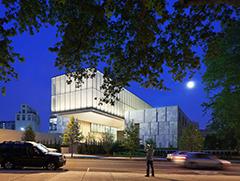
A review of the New Barnes Foundation Building in Philadelphia
The American Institute of Architects has bestowed on the new Barnes Foundation building its Honor Award for 2013 to Architects Tod Williams and Billie Tsien. I find this award unfortunate and another instance of the narrow vision of the architectural establishment, which too often values architectural glitz over rational analysis. The new Barnes Foundation building is a hollow behemoth of full of classy detailing, which turns the Barnes Foundation collection into the sideshow to the architecture.
This building is literally hollow. Sandwiched between the block that houses the art collection and the entry/stairway to the lower level/cloakroom/restaurant/restroom block is a vast central atrium labeled the Light Court, above which the Light Box, as Martin Fuller named in his gushing review “Victory” in the New York Review of Books of September 12, 2012, “serves as a wordless marquee that announces this singular presence and imparts a boldly contemporary quality” to the new Barnes. (See plan and section.)
The space below the Light Box is an empty rectangle 170 feet long, 45 feet wide, and 52 feet high. When I visited the new Barnes, a line of people stood along the Light Court’s north edge waiting to get into the picture galleries, an information desk lay at the south side, and the rest of the area was unpopulated. A few chairs and benches were positioned about the vast “internal plaza.” I gather this is the space that is used by the donors and politicians, who, according to the powerful film “The Art of the Steal” by Don Argott, removed the Barnes Foundation from its old home in Merion, Pennsylvania. They must give big parties.
I totally disagree with Martin Fuller’s review in which, referring to the Light Court after leaving the picture galleries, he says that “after the claustrophobic impact of Barnes jam-packed installations, you experience an astonishing whoosh of open space that comes as a liberating relief.” The Light Court is just a big empty room, and an example of “creeping gigantism in contemporary museum architecture,” a term Christopher Hawthorne used in his Architectural Record review of the new Barnes. At 7,650 square feet, the Light Court is a mere 8% of the 93,000 square feet of the new Barnes (pretty big for anteroom to the big show of the picture gallery, but not exordinary), but if you consider its volume of 397, 800 cubic feet, it is the museum’s big show.
The new Barnes does not qualify to be an “intimately scaled museum” like the Louisiana Museum of Modern Art outside Copenhagen, as Martin Fuller proposes. It’s a big space to which the nubbin of an imitation old Barnes is attached. And the Barnes collection is what this museum should be all about, an astounding collection of impressionist and post-impressionist paintings, African art, old ironwork, and Pennsylvania antiques. The Barnes collection is reduced to a cultural relic that attaches the reworked framework from which it was taken. I liken it to the preservation of the trading room from the old Chicago Exchange by Louis Sullivan and re-fashioned as a display. Barnes vision has been preserved, but perverted.
Beautifully detailed and exquisitely lit, the whole ensemble, from the exterior walls of pale Negev sandstone to silky surfaces of the Light Court is seductive, yet unsatisfying. The problem begins with the entry. In his critical review, Hawthorne states that he believes that despite other failings the new Barnes is “the thoughtful sense of procession that carries visitors…from the outside in and then from the museum’s airy common spaces almost inexorably towards the smaller scaled galleries.” My experience of entering and finding the galleries contradicts this view. Parking in the small parking lot behind the museum, the patron enters through a gap in a wall into formal garden and from there must look around for where to buy tickets and enter. The ticket booth is a small pavilion along the side street that requires deviation from the broad walk leading up to the building to purchase a ticket, then turn around and retrace steps past a long reflecting pool marked by an Ellsworth Kelly sculpture. (Why a Kelly piece to a museum that is mainly about late 19thcentury art?) At the end and across the reflecting pool is the entry, a large gap in the limestone wall. Penetrating the museum wall the visitor can’t stride too far forward because another wall blocks the path. The visitor must turn right and enter into another anteroom with on the left stairs that lead to a library, auditorium and shop below and on the right a coat check space, hallway to the restaurant , and restrooms Beyond the visitor sees the security guard/ticket taker at a far wall. Your ticket reviewed, the visitor turns again into the humongous Light Court. To the right is the information desk and at a distance across the court is the line of visitors waiting to enter the collection. This is not a procession, but a series of wandering steps used to control access. The barriers may be beautiful, they nonetheless speak more about crowd control than the majesty of entry to special place.
Entering the actual Barnes collection, the visitor is in series of rooms that recreate, as was stipulated by the judge who allowed the move from the old building to the new one, the arrangement of the paintings, the locks and iron work attached to the walls above the paintings, and the Pennsylvania antique furniture situated on the brownish ochre walls of Barnes original foundation building that is almost an exact replica. The lighting is good, apparently better than the original building, and doesn’t intrude upon the facsimile, but there are subtle differences with the old Barnes that reveal the reality of this new reincarnation. Paintings that once stood in the corners of the rooms or passageways between rooms are now isolated. They are outside the lines behind which a visitor must stand to view a work. Woe to whoever stands and tries to observe closely these paintings, as this will draw warnings by the guards to get within the viewing perimeter. This was not the case in the old Barnes, where the collector wanted the viewers to be able to study each picture. This small fact reveals what the new Barnes is all about. Observe, but not too long or too closely, because the visitor must keep moving. The tourist experience requires it; there is more to see in another attraction one short bus ride away. The Barnes Foundation has been subject to “Disneyfication,” as Christopher Hawthorne described the museum.
The new Barnes is a meant to be tourist attraction bringing in loot to the city. The politicians were bold enough to call this removal from Merion to the Benjamin Franklin Parkway’s museum row for what it is. The charitable trusts, which backed this move, were less forthcoming. Maybe this is why the building lurks behind a wall of trees along the Parkway concealing it true intent to be a tourist attraction. The true character of the new Barnes is revealed on a side street away from the bustle of the parkway where the Light Box vaults over and out of the flanking blocks like a big marquee. In his New Review of Books article, Martin Fuller correctly identified this feature. Here is the defining architectural image, and you don’t see it unless you cruise around the Barnes away from the parkway and its neo-classical museums. Here is the ready-for-publication picture that secretly and unintentionally describes the “Disneyfication” of the Barnes Collection. It is its new icon.
Hawthorne describes the building as soulless. I think he is right. Albert Barnes built a building in Merion designed by Architect Paul Cret that embodied what he wanted. He wanted a place for his collection to be studied and cherished by people who loved art. The old Barnes was, according to Hawthorne, an intimate structure with surrounding gardens that was a great place to contemplate art. It was a home for art. The place had character not unlike the irascible personality of its founder. I never saw it or visited it, but the pictures and descriptions remind me of the Mauritshuis in Amsterdam, a small palace that houses Dutch 17th Century masterpieces. (The Mauritshuis is now closed for renovation. Let’s hope its fate is better than that of the Barnes).
Barnes said his Foundation was educational facility. He did not have it open to the public except for a few days a week and then with restrictions. Matisse termed the Barnes Foundation the only sane place in America to see art. What happened with the Barnes, it removal from Merion is a very sad incident, which blemishes the new building by architects, who are otherwise known for their sensitive and outstanding work It was all done supposedly in the name of allowing more people to see the collection. Art tourism sits at the heart of this travesty and, as is said in Don Argot’s film “The Art of the Steal,” “It’s about who controls $25 billion in art; all the rest is bullshit.” The Barnes is just another pretty place to see great works for a few minutes and to spend your money. The soul is gone.
|