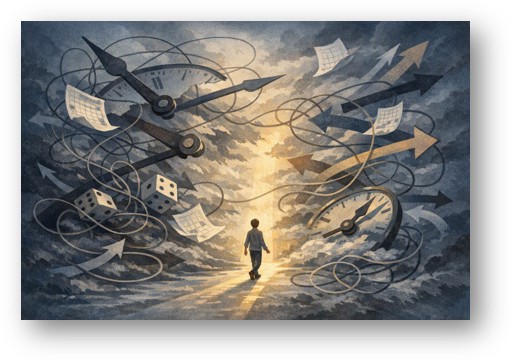
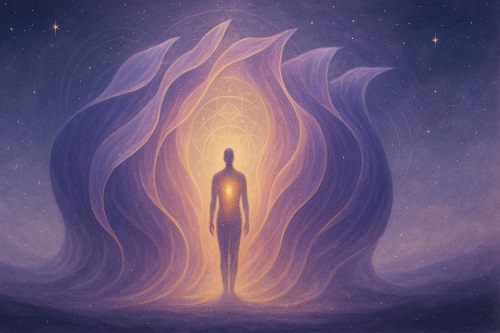
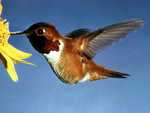
 Our fundamental belief about the nature of time helps determine how much of it we have to use.
TIME:
Our Most Previous Resource
by
William Cottringer
Hidden deeply in the pages of Rick Warren’s legacy, "The Purpose Driven Life," there are some powerful words that cleverly point the way to eternity—where time becomes everything we want it to be. These words profoundly describe three fundamental and interactive realities:
The best use of life is love.
The best expression of love is time.
The best time to love is now.
Several years ago, Joseph Clinton Pearce wrote an intriguing little book called "Exploring the Crack in the Cosmic Egg." He was pointing out a separate reality to help readers understand the paradox of time—understanding the simultaneous existence of the natural, tangible, real material world and the supernatural, intangible, ideal spiritual world. About the same time, the famous Berkley philosopher, Alan Watts, aptly reconciled the many aspects of these dualistic worlds with over 35 books.
In my own book, "You Can Have Your Cheese & Eat It Too," I attempted to go a little further with all these paradoxical ideas and translate them with my own metaphorical and practical spin. I think there are still some unspoken words in the pages of that book.
As I pass through the autumn of my life and get ready for the winter, I am experiencing a mighty transformation that I would like to humbly share. At 60, when all chronological indicators would say that I should not be in the best physical condition of my life—a funny reality is that I am. I have been running lately and getting totally lost in my runs, going further and further each time in a sort of dream world and then having to wake up and walk back for miles. Yard by yard life is hard; but inch by inch, life’s a cinch.
What does this all mean? It means that there are in fact two separate realities going on and that you have a choice to believe in whichever one that can do you the most good. Apply this intriguing notion to the concept of time, which just happens to be our most important resource. Nobody ever seems to have enough time, yet everyone has all there is.
Why do so many people have trouble managing their most precious resource—time? Maybe this is so because we focus too much on one time reality over the other. Whether you believe it or not, time can be either a constant, predictable mechanical sequence of the past, present and future or it can be very inconsistent, irregular and mysteriously simultaneous and psychological. We have all had the experience of time both flying and dragging by under different circumstances. And we all know what it is like to hurry up and wait.
This latter perception of time—not being artificially constrained by clocks and watches—is what probably leads to the comprehension of the eternal now moment, where time actually stops and you can get more done than you ever wanted to get done. You can often get twice as much done in half the time!
When you slow down and become more part of the now moment, an odd thing happens—time expands. But first you have to stop being held hostage by the more conventional, rational version of mechanical time, which isn’t an easy thing to do. Commonly held beliefs are hard to give up. It takes the wisdom to realize that what you believe is more a function of the viewpoint from where you are looking than what you “see.” You can always see more by changing belief viewpoints.
How do you make this important time transformation? You have to do it and not just think it. My suggestion is to confront the opposing choices you have of paying attention to your needs and those of others and gradually learn how to reconcile a selfish and a selfless life.
Re-read Rick Warren’s wise words in the beginning of this article and translate them into your own version. Sort through your priorities in life and consider exchanging some of the insignificant things your mind thinks you want that are usually tied to the traditional concept of mechanical time, for the more “eternal” things your soul knows you need—such as using your time to love others, without any limitations or an eye on your watch for the right time to pay attention to yourself.
Get lost in the now moment giving your love and time to others and you will have more time left over than you could ever use on yourself. The best use of your time is to learn what is right to do first in choosing between this or that so you have enough time to do both. This amazing insight is part of the choice you can make—as to which reality of time can do you the most good. That shouldn’t be a difficult choice. Don’t we all want more time?
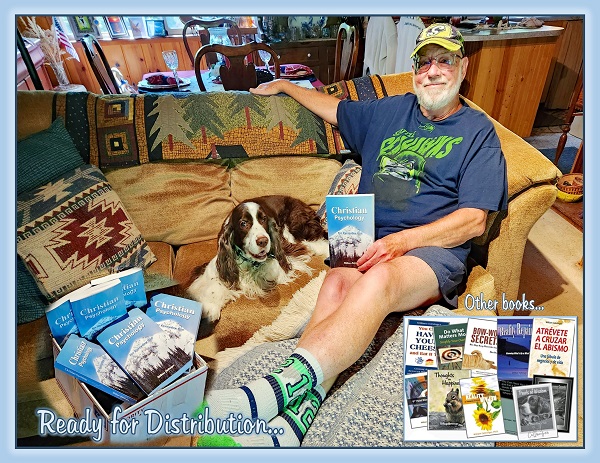
William Cottringer is busy expanding time by doing what matters most—loving others with what time he has. He is also author of You Can Have Your Cheese & Eat It Too, a self-help book that helps readers to reconcile the little cheese that their minds want and the big cheese that their souls need, so that they can have both.
|