Understanding Extreme Behavior
By
Bill Cottringer
“Human behavior flows from three main sources—desire, emotion, and knowledge.” ~Plato.
Is it my imagination or is extreme behavior becoming more commonplace these days? Is the incident rate of extreme behavior actually increasing or is the ubiquitous internet access and pervasive social media coverage giving an exaggerated boost to that perception? A fellow truth traveler friend of mine asked me why extreme behavior occurs. Here is my current understanding of the psychology of extreme behavior:
There are three main problems in understanding strange, extreme behavior, such as harmful violence and all-exclusive, destructive ideologies, with mean-spirited purpose:
1. The majority of all our behavior has unconscious motivations. Human mental evolution involves translating that unconscious stuff to conscious awareness. This is where the collective wisdom of the universe resides--in the unconscious part of the brain. It was probably planted there through genetics and activated by life experiences.
2. Behavior is driven by thoughts and beliefs, which are driven by the strength of our feelings about the truth and value of our thoughts and beliefs, which in turn produce certain behaviors. Trust in other people and beliefs, produces the neuro chemical oxytocin, which reinforces trustworthiness in our brains. To undo any behavior, we have to understand the fierce dynamics going on in between and within of our thoughts, feelings, beliefs, and behaviors and then change the new experiences encompassing these interactions, in order to change the interactions themselves, one by one, to get a better outcome.
3. We all have an internal thermometer report card that determines the pain or pleasure drive and outcome of our thoughts, feelings, beliefs, and behaviors. The more successful they cross the crossroad threshold of productive vs. destructive, the easier the behavior becomes, right or wrong, and modest or fierce, until it becomes a neural pathway habit. This process becomes very resistive to changing without the combination of drug therapy and intensive cognitive-emotive and behavioral therapy or some kind of life-defining or divine intervention.
Changing any behavior is a very complicated, difficult process. It has to start with a basic internal affirmation of wanting to change, then being able to change, and finally actually doing all the hard work that is required to change. Most people get lost somewhere in between because of other priorities during the very long-drawn-out process of undoing wrong choices that led to the problem, and making the right ones, one at a time.
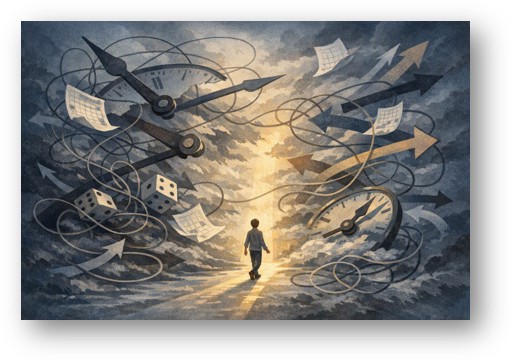
Quantum physics tells us that outcomes of the interactions between all things, including the variables of thoughts, feelings, beliefs, and behaviors, are very uncertain and only possibilities. It is all a self-learning algorithm that can't be accurately predicted. Heck, even the helpers are part of the outcome formula. Non-human mechanical "observers" were shown in controlled laboratories to affect the pattern outcomes of physics particle "shooters" against a wall. Once we become aware of any interaction, we become an integral part of it.
Our answers about the uncertainties of human behavior are coming slowly from physics. Understanding what a nanosecond really is helps understand the complexity of these algorithmic interactions. A nanosecond is the same as the number of seconds in 30 years. Can you even imagine a number that large? Than k heavens it is not infinitely divisible or we would really be lost in time.
The real problem here is that there are thousands of possibilities that can flavor the various thoughts (rational to irrational), feelings (strong to weak), beliefs (true to false), and behaviors (productive to destructive) in producing one of the many possible outcomes of the interactions. And the main choice in life remains the same: Which side of the equation do you want to play on and that is determined by genetics and the experiences we gain from all these interactions and what we think, feel, believe, and act in response.
The starting point in all change, requires a realization of what is and what isn't under our control to impact destiny (the large number of, but finite, choices that are available to us) so we can exercise free will responsibly to do more good than harm, with the actual choice we make in our reaction to where we are moved to on the chessboard by life and destiny, right now. In this sense destiny determines where you are now from all past interactions, and free will can only "control" the choices you make right now in your response to where you are right now. I hope this makes some sense to you because we are deep diving here.
Understanding that destiny and free will both coexist in reality is difficult to comprehend, but all the Yang-Yin opposites in life are just different sides to the same coin. Think of "destiny" as the six possible faces on a single die that can occur when cast, whereas "free will" is the one that actually shows up when you cast the die. However, each probability starts anew, not being tied to the past.
In gradually shedding all the tempting illusions of material reality, including certainty, time and space,, we are getting closer to a more accurate understanding of the reality of physics, which controls human behavior, including extreme behavior. And all that we don’t know or understand is gradually decreasing, so we can make more use of our brains on full throttle to figure out how to better deal with the problem of destructive and harmful extreme behavior. Someday soon artificial intelligence may identify a morality algorithm on good vs. evil that is universally satisfying. But for tight now morality is just a human invention to redistribute pleasure and pain more fairly, from a personal perspective of the perceiver.
“Engaging in extreme behavior such as violence or professing destructive ideologies is a desperate cry for help and relief from the harsh but inevitable reality of life’s uncertainties and ambiguities, which we all need to learn to embrace or die.” ~The author.
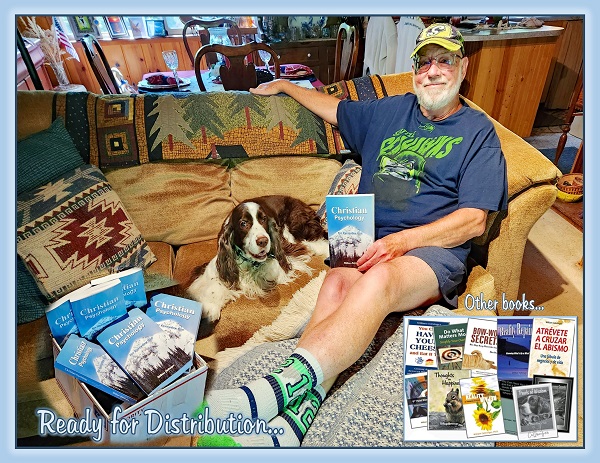
William Cottringer, Ph.D. is retired Executive Vice President of Puget Sound Security in Bellevue, WA, but still practices sport psychology, business success coaching, photography, and writing, living on the scenic Snoqualmie River and mountains of North Bend. He is also on the Board of Directors of the Because Organization, an intervention program in human trafficking. Bill is author of several business and self-development books, including, Re-Braining for 2000 (MJR Publishing); The Prosperity Zone (Authorlink Press); You Can Have Your Cheese & Eat It Too (Executive Excellence); The Bow-Wow Secrets (Wisdom Tree); Do What Matters Most and “P” Point Management (Atlantic Book Publishers); Reality Repair (Global Vision Press), Reality Repair Rx (Publish America); Critical Thinking (Authorsden); Thoughts on Happiness, Pearls of Wisdom: A Dog’s Tale (Covenant Books, Inc.). Coming soon: A Cliché a day will keep the Vet Away and Christian Psychology for Everyday Use (Covenant Books, Inc.). Bill can be reached for comments or questions at (206)-914-1863 or ckuretdoc.comcast.net.