Understanding Violence
By William Cottringer, Ph.D.
On February 23, 2024
Violence in an uncontrollable animal, which usually ends up attacking its own master. ~Renny Yagosesky.
There are two main problems standing in the way of understanding violence. One roadblock is that the violence trauma event is strictly an emotional one that can’t really be understood or corrected with rational thought. This is because these two mental processes use different languages to process information.
Also, the dynamics of such events involve a fierce reciprocal interaction between beliefs, thinking, feeling, and behaving, which are virtually impervious to untangling in a clear, meaningful way. And since the brain is hard wired for a rage response to occur in the face of danger or threats, each violence experience creates a neurocircuit that can only be re-written when a mitigating experience happens, which changes the beliefs, thoughts, and feelings. In other words, we can’t think, feel, or believe our way out of a situation we behaved into. The needed experience-orchestrating intervention skills only belong to the exceptional helpers.
The other problem in the way of understanding violence, is that intervention theories often give into the temptation of looking for common denominators to simplify the understanding and ideas for the healing process. When we get in the trenches to understanding violent events, we generally find that there are more differences than similarities in predispositions, thresholds, triggers, relevant psycho-social factors, and actual responses and outcomes. All the hard work in understanding one event, won’t necessarily be of any benefit to dealing with the next occurrence. There simply are no shortcuts in understanding the complex dynamics of violence trauma. One situation at a time is the reality, as inconvenient as that is.
Some of the ideas in this article came from three good friends and some from serious introspection of a psychologically trained and criminal justice experienced writer’s mind. One friend who, was an Air Force air policeman with me right after high school, did 30 years for attempted murder. The other friend was a college roommate who taught science for 5 decades and became a school violence expert. The third fellow writing colleague helps businesses learn how to use team intelligence to thrive to the triple line of prosperity, stakeholder satisfaction, and conscious capitalism. The introspection was retrospective reflection of 50 years of criminal justice work experiencing the problem of violence deep enough to be able to understand it well enough to write about it clearly enough.
Here is a summary of elements that make up the backstory, to be aware of in the journey to understand violence:
· Violence is the leading cause of death today.
· Several types of growing violence present the most challenges in understanding and trying to “cure.” These are school, workplace and other place mass shootings, police brutality, terrorism, human trafficking, and veteran’s suicide.
· Current neuroscience research helps us better understand the major influence of the biology of violence behind the attempted rational psycho-social explanations.
· The main function of the brain is learning to find rewarding situations and avoiding harmful ones. In this sense, homeostasis is the end-game goal of the brain, rather than seeking truth per se.
· Along these lines, the brain is hardwired for an automatic rage response to perceived danger and threats, from the early days of surviving life-threatening environmental events.
· Experiences with violence and trauma form neural circuits for learning aggression and rage responses quicker than normal.
· All danger and harmful situations surfacing today that the brain tries to avoid are buried in the three main conflicts that make our life’s stories—us vs. life, us vs. others, and us vs. ourselves.
· The brain develops thresholds for release of the rage response based on past learned experiences and future expectations.
· The main faucet for these thresholds is the accumulation of perceived and felt distress.
· A significant distress trigger is the resulting frustration from inability to meet basic needs like safety and security, belonging, self-esteem and love.
Major compounding psycho-social factors coming in to play include:
v An overwhelming sense of hopelessness and helplessness in not being where we want to be in solving one or more of the three main conflicts in life.
v Acute or chronic psychic or physical pain.
v Being over-controlled by other people or institutions like schools, government, churches, or the mass media.
v Substance abuse.
v Mental illness.
v Genetics.
v Intellectual disability.
v Unevolved moral conscience or over-active psychopathy or sociopathy.
v Mean disrespect or excruciating humiliation.
v Extremely unfavorable social conditions, including poverty and marginalization.
v Being trapped by a mean-spirited, harm-intending person or group with no apparent way out.
v Desperately trying to do right and being repeatedly and unfairly wronged.
v An overabundance of negative empathy and a severe shortage of positive empathy.
v Being a victim of a life of violence or trauma and not knowing any other way.
v A misguided belief that violence is justified or the only answer to solving a problem; giving yourself illicit permission to act irresponsibly.
So, this brings us to a promising problem-solving approach, which is the monumental challenge of learning how to outthink the brain. The ‘easier-said-than-done’ solution is the development of the critical capacities of emotional intelligence, mindfulness, empathy, morality, resilience, and communication. These important skills are briefly discussed below:
Emotional Intelligence
Here the goal becomes learning the value of effective self-management, reading others accurately, understanding others’ perspectives, and having intrinsic motivation as opposed to being motivated by external rewards. Without exercising consistent self-control, using the right approach to interacting with others, accepting the value of different perspectives, and doing things for their inherent reward, no long-term effective problem-solving can be accomplished.
Mindfulness
Using mindfulness in any problem-solving conflict involves downplaying past memories and future expectations in favor of becoming more aware of what is going on immediately, right here and now. Mindfulness is so important because it is the only method of piercing the time illusion to shift from the mechanical perception of time which manages us, to the fluid psychological version which allows us to manage it. Ironically, stepping outside time involves stepping into the eternal now moment, where artificial time constraints don’t get in the way.
Empathy
Empathy is the highest form of emotional intelligence and the best tool to facilitate change in ourselves and others. Simply defined, it is the most direct, authentic sense of inter-connection we have with other people and the rest of nature. It is also the only way to fully understand another person’s point of view. The problem with empathy is that it is a two-edged sword, meaning negative empathy can pave the path to aggression and violence, while positive empathy can raise the threshold for the rage response, thus inhibiting violence. At the end of an empathy day, the question becomes, why would you even want do harm to others when you are really doing it to yourself?
Morality
If there is such a thing as universal law of morality, it has to be within the principle of the brain’s main function, or to do good and avoid harm. The rage threshold can be raised in inhibiting violence when morality moves from being relative or personal, to a higher, authoritative guiding principle supporting the greater good. This has to be in sync with the learning how to outthink the brain, which at times, may be to just leave it alone to its own devices.
Resilience
Unsolved conflicts and problem-solving failures are an inevitable part of life, and they seem to have a habit of returning with more complexity and intensity when avoided or ignored. But these are the situations from which we can learn most, in discovering how to be more successful the next time. Resilience, or bouncing back up from a fall, can be learned from practice just like how the rage response forms faster neural circuits from trauma and violence experiences.
Communication
A major problem today is miscommunication, which sadly is much more prevalent than effective communication. Effective communication can only occur by developing a few essential skills: (a) practicing all the above general problem-solving skills (b) listening more and talking less (c) using assertiveness to minimize aggression or passivity (d) consciously creating a supportive tone of communication that minimizes defensiveness and opens up two-way communication. This can be done by conveying the empowering qualities of freedom, acceptance, tentativeness, sensitivity, and equality, instead of the demeaning ones of control, judgment, certainty, insensitivity, or superiority, which just work to shut down further communication before it even gets started.
Fortunately, there are a few rational-emotive mitigants available for raising the threshold of a violent response to the distress faucet and the various triggers. A few of these include communing with nature, meditating, praying, reading interesting articles or books, practicing passive hobbies, conversing with friends, seeking professional help, participating in a support groups, and listening to soothing music. Of course, one very effective way to correct problem behavior is to catch ourselves with our proverbial hands in the cookie jar.
For instance, it is a good start to become aware of when our past memories or future expectations are not relevant to a present situation. It is also helpful to know when we could and should control our impulses but don’t, or when we gain more control of our lives by better managing the responses and reactions, we make to the situations that life puts us in. Moreover, listening more and talking less can never be over-emphasized. Finally, true personal and professional development is facilitated most by questioning our own beliefs and perspectives, especially the ones we take for granted as being true without any verification.
Any intelligent fool can make things bigger, more complex, and more violent. It takes a touch of genius — and a lot of courage to move in the opposite direction. ~E.F. Schumacher.
Author's Bio:
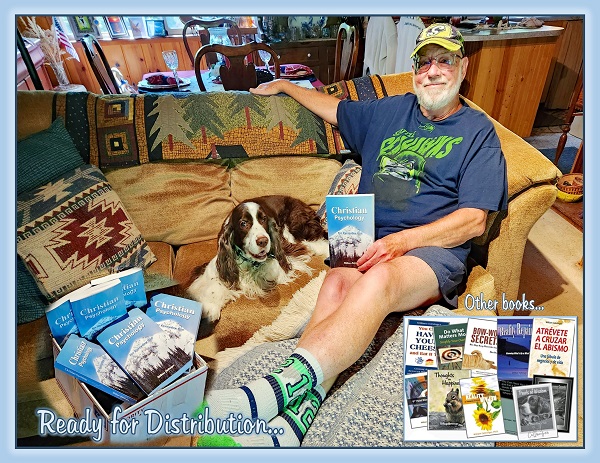
William Cottringer, Ph.D. is retired Executive Vice President of Puget Sound Security in Bellevue, WA, but still teaches criminal justice classes and practices business success coaching and sport psychology. He is also on the Board of Directors of the Because Organization, an intervention program in human trafficking, the King County Sheriff’s Community Advisory Board, and involved with volunteer work in several veteran’s groups and the horse therapy program at NWNHC Family Fund. Bill is author of several business and self-development books, including, Re-Braining for 2000 (MJR Publishing); The Prosperity Zone (Authorlink Press); You Can Have Your Cheese & Eat It Too (Executive Excellence); The Bow-Wow Secrets (Wisdom Tree); Do What Matters Most and “P” Point Management (Atlantic Book Publishers); Reality Repair (Global Vision Press), Reality Repair Rx (Publish America); Critical Thinking (Authorsden); Thoughts on Happiness, Pearls of Wisdom: A Dog’s Tale, and Christian Psychology (Covenant Books, Inc.). Coming soon: Reality Repair Rx + and Dog Logic. Bill can be reached for comments or questions at (206)-914-1863 or ckuretdoc.comcast.net.