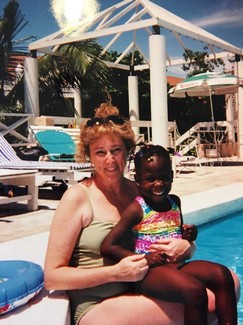
Our world is becoming too divisive, and it truly breaks my heart to turn on the television and hear all the negative vitriols that some people are spewing without thinking about how their words may hurt others. I have and will continue to make a concerted effort to hold on to the positives in life.
With that said, I am so very thankful for friends like Karen Ashmore, who gives me a reason to not give up on humanity. So Thanksgiving 2016, I am counting my blessings and I am very thankful for people like Karen who is doing a world of good.
Below is a Blogcritics interview I did with Karen in 2010, Karen has since passed the baton of leadership to Marie Marthe Saint Cyr in 2011. I am sure you too, will be hugely inspired by Karen! Happy Thanksgiving to all!
I met Karen Ashmore ten years ago at a fundraiser for Haiti, in Denver Colorado. I was immediately very impressed with her dedication to help the people of Haiti. I was even more intrigued after learning that she had adopted three Haitian children. It was through her that I first learned about the Lambi Fund of Haiti.
What made you decide to work for the Lambi Fund of Haiti?
I believe in social change and people helping themselves vs. charity. When my husband and I adopted our first daughter from an orphanage in Haiti, we saw the extreme poverty and wanted to do something. I researched organizations working in Haiti and Lambi Fund was head and shoulders above the rest. We started donating, then I became a consultant to Lambi Fund, then the board hired me as interim ED when the previous Executive Director resigned. I fell in love with the position and they ended up hiring me. Can you please tell the readers about your background? I have served on numerous boards (including Grantmakers without Borders), have over 25 years non-profit experience, and have raised over $20 million dollars for organizations in both US and Haiti .
I have a Bachelor’s degree in Journalism and will complete my masters degree in International Studies this year. My husband and I have raised six children, three of whom are from Haiti. How long have you been the executive director of Lambi Fund? Since 1994 .
I understand at one point you were kidnapped while in Haiti; that did not stop you from returning to Haiti. Can you tell the readers what happened and how you were able to get out of that potentially deadly situation.?
I was kidnapped along with 3 other women on Nat’l Route #1 in Haiti in 2005. Aristide had been deposed and there was a lot of political instability and kidnappings. We were kidnapped by 4 gunmen who came out of nowhere, and forced our male driver from the vehicle. Shouting and brandishing their weapons, two of them jumped in the front, one on each side of the woman sitting there. The other two shoved in back and one crammed in next to me, his gun cocked at my throat. The car accelerated wildly. The new driver ground the gears, banged us through potholes, veering dangerously. The men screamed at one another, gasping for breath and sweating. I though: ”I can’t die.
My adopted children have already lost their mother once!” The men shouted: ”Where is your money? What do you have?” They took our wedding rings, cameras, laptops, cash and credit cards. could see the face of the man beside me. . ”There must be more!” yelled the angry driver. ”Women are crafty!” They grabbed my breasts and ordered my colleague to pull up her skirt and groped her in search of hidden money. The driver swerved down another gravel road, fishtailing. They were shouting — arguing about where and how to execute us. One of them was going thru my wallet and found photos of my kids. He demanded to know who they were. “My children,” I replied. Soon the energy level started decreasing. Suddenly the driver slammed on brakes in the middle of nowhere and yelled “Sorti! Sorti!” -Get out, get out Startled, we opened the car door and I fell out. One of the men said “Run! Run for your lives!” We took off running and did not stop until we encountered a small church and banged on the gate for help. An old Haitian priest shuffled to the gate and let us in. We were frightened and as we told him what happened, he took us into the inner sanctum to hide.
We were eventually rescued by our staff in Haiti, who took us back to Port au Prince. We caught a flight home the next day. When your life is in danger, you want nothing else but to be with your family.
I am the only one that was kidnapped who has continued working with Lambi Fund and going back repeatedly to Haiti. In a way, I felt more committed because this is the type of thing that is experienced consistently by grassroots Haitians who are struggling for democracy and justice.
what major changes have you seen since becoming executive director?
Lambi Fund has grown tremendously since I started. Also more gender equity. I see more and more women in positions of leadership.
Please tell the readers how Lambi Fund began?
The Lambi Fund of Haiti was founded in 1994 by Haitians, Haitian-Americans, and North Americans. The Lambi Fund draws its name from the lambi (pronounced lahm-bee), the Haitian Creole word for conch shell, which was blown as a horn and used during the slave rebellion against the French colonialists in 1791, to alert the slaves to impending danger and the need to assemble.
The symbol of the lambi was chosen to represent the Haitian people’s hope, strength, resistance, and struggle for self-determination.
There is a lot of negative news about the funds donated for earthquake relief efforts not being dispersed properly, can you explain how Lambi Fund sprang to action after the earthquake?
One year later. Three hundred and sixty-five days since the ground shook and forever changed Haiti. I thought a lot about what I wanted to say about the earthquake and my Ayiti Cheri as we take this day to remember and honor the loved ones lost. Undoubtedly, countless news stories will air this week looking at Haiti’s journey this past year and how the rebuilding effort is progressing. To be certain, Haiti has had more than a tough go at things. The earthquake left Port-au-Prince and many cities in ruin, hurricanes flooded and damaged the south, cholera has mercilessly swept through the country leaving Haiti brimming with hardships, anxiety, and uncertainty, and Presidential elections held in November had chaotic outcomes.
The entire election swirled with rumors of rampant fraud and ballot-stuffing and most viewed the entire process as illegitimate. When results for the run-off election were announced in December, riots and violence broke out in the streets of Port-au-Prince. By most accounts, the rebuilding effort in Haiti seems stagnant. Tons and tons of rubble still litter Port-au-Prince’s streets, millions struggle to survive in tent cities, a comprehensive reconstruction plan still has not been agreed upon, and millions of dollars in aid money sits in banks. Despite these tough realities and the difficult road that Haiti must journey down, I would like for a moment to stop and offer a glimmer of hope. It seems that despite all this, life in Haiti goes on.
In 2010, the Lambi Fund of Haiti witnessed countless stories of heroism, peasant solidarity, recovery, and movements to envision, plan, and work to rebuild Haiti. While many may paint Haitians as helpless victims, nothing could be further from the truth. In reality, it is in the people where Haiti’s strength lies. Immediately following the earthquake, Lambi Fund staff and its local partners were very much in the midst of the disaster.
It took an agonizing six days to finally make contact with Lambi Fund staff in Haiti. Fearing the worst, Lambi Fund’s country director, Josette Perard, reported that the office just blocks from the presidential palace was damaged, yet miraculously all staff members were alive and healthy. Everyone though, had lost close friends and family. Lambi Fund staff quickly sprang to action and thanks to years of working with local grassroots organizations throughout Haiti, it seemed Lambi Fund was uniquely positioned to provide immediate and effective relief. Partnerships with local organizations that Lambi Fund had been developing for over 16 years served as an essential network during this time.
Lambi Fund convened regional committees of local grassroots leaders throughout the country to determine immediate and long-term needs. Over a half million earthquake survivors fled Port-au-Prince to stay with friends and family in rural Haiti. Household sizes doubled overnight and for Lambi Fund partners already struggling to survive on less than $2 a day, they did not have the means to provide relief. Based on these discussions, Lambi Fund was able to swiftly distribute emergency grants to 44 grassroots organizations to purchase life essentials like food, water, shelter and medical supplies.
In all, 8,000-9,000 people received emergency relief (1,080 families received grants and each family had an average of 8 people). Mr. Josephat, a member of a community organization in the Artibonite, recalled tearfully: “I had 21 people, strangers staying with me and my family. We did not think twice about welcoming them, but we had not yet figured out how they would be cared for or how they would be fed. When we heard about Lambi Fund’s program to help impacted families, I was so happy that I cried. I cried because I was touched and shocked that people who had been at the center of this disaster had the time to think about us. I was so proud to be a member of a strong organization, and I really deeply understood why being organized is the path to a better life. We would have been left to our own devices without Lambi Fund’s support.
The government never came and the NGOs which did drop by brought free food supplies and their methods of distribution stripped us of our dignity.” Google Ads Injected by Adsense Explosion 1.1.5 AdSense Plugin Explosion num: 2 Mr. Josephat’s sentiments were echoed throughout discussions with other partner organizations in Haiti. “My name is Ostazia. My husband and I have 10 children and we live in the North West. After the January 12, 2010 earthquake which destroyed Port-au-Prince, our household increased by 10 more people. This was extremely problematic as we did not have the means to care for them. It is thanks to my organization and the Lambi Fund that we got the relief we so desperately needed. THANK YOU VERY MUCH, THANK YOU!” Knowing that food security and restoring livelihoods for the thousands of survivors now living in rural communities would be essential, Lambi Fund’s second phase of relief focused on expanding crop production and the availability of locally produced food.
An emergency credit was provided to 1,254 farmers in 41 partner organizations to allow them to purchase more seeds, tools and supplies to increase crop outputs and feed more families. Based on reports from farmers, it is projected that about 10,000 persons benefitted from this program. By all accounts, communities generated bountiful harvests of peas, corn and vegetables for consumption and sale at local markets. In addition, Lambi Fund replenished community microcredit funds to help small business owners purchase more goods and restart their enterprises. Two women’s groups in Port-au-Prince who fight violence against women and provide support for women’s small businesses lost everything in the earthquake. Women and their families have been forced to live in squalid conditions in tent cities. Lambi Fund worked with these women to provide small grants to start small businesses and to send their children back to school.
Never before has Lambi Fund faced a disaster of such a daunting magnitude and it is thanks to you and your amazing support in this past year that Lambi Fund was able to mobilize and provide such urgent relief. For an extensive breakdown of Lambi Fund’s earthquake relief, I ask you to read the Earthquake Activities Update on our website www.lambifund.org . Haitian peasants are determined to be part of their country’s reconstruction and thanks to previous Lambi Fund organizational development and capacity building – they are organizationally strong and ready to serve as a collected front to implement change. In addition to continuing our support of sustainable economic and environmental activities, Lambi Fund has pledged to amplify the voices of the Haitian people and their determination to be included in this historic moment for nation building in Haiti.
In 2011, the Lambi Fund of Haiti is ready to implement the next phases of the Earthquake Recovery Plan: Increase micro-enterprises with additional community microcredit funds. Increase organic, locally-grown food and clean water with expanded sustainable agriculture, reforestation and water access projects. Increase livelihoods with expanded sustainable development projects, such as pig and goat breeding, grain mills and sugar cane mills. · Build latrines to prevent spread of disease and increase sanitation in rural areas, as a result of rapidly growing population. · Expand women’s program to address the special needs of women (more vulnerable to domestic violence and sexual assault in tent cities but several organized women’s groups are standing up for the rights of women and children). ·
Support Policy Advocacy program to express voice of the Haitian people in rebuilding Haiti. As foreign corporations and governments jockey for rebuilding contracts, the Haitian voice has been neglected. Haitians must be involved in all facets of rebuilding. People from rural communities are working together to increase sustainability in their communities and ongoing training in sustainable agriculture, animal husbandry, and increasing organizational capacity will be key to long- term success.
The Lambi Fund Earthquake Recovery Plan will continue in 2011 and beyond. Rebuilding Haiti is a long-term commitment for the Lambi Fund and we hope that you choose to take this journey with us.
Thank you Karen, for doing this interview!