George Washington’s Christmas list for his stepchildren in 1758 was ambitious: “A bird on Bellows, A Cuckoo, A turnabout parrot, A Grocers Shop, An Aviary, A Prussian Dragoon, A Man Smoakg, (a man smoking?) 6 Small Books for Children, 1 Fash. dress’d Baby & other toys.”
 Rather than the fervor leading up to December 25th that dies out almost as soon as the last gift is opened now, Christmas Day in colonial America began a season of festivities that lasted until January 6—thus the “Twelve days of Christmas.” Twelfth Day, January 6, was the perfect occasion for colonists to enjoy balls, parties, and other festivals.
Our emphasis on Christmas as a special holiday for children didn’t come about until the mid nineteenth century, brought to America by the more family-centered Dutch and Germans. Christmas in colonial America was predominantly an adult oriented holiday. The Southern colonies were the root of many celebrations (less Quakers/Puritans in the South and more Anglicans) and these included parties, hunts, feasts, and church services. Children were tucked away in bed or left behind, neither seen or heard. One sign of entering the adult world was the honor of attending your first holiday ball. Think how exciting that must have been for young ladies awhirl in taffeta and lace.
 Plantations and other colonial homes, even churches, were decorated with holly, laurel, garlands and sometimes lavender. My garden club used to decorate a colonial era home/museum and we were restricted to natural materials and native fruit like apples that might have been used in that day.
Mistletoe, an ancient tradition and the centerpiece of every colonial home, was hung in a prominent place. Romantic couples found their way under the green leaves and white berries just as they do now.
Light was of vital importance at this dark time of year.
Yule logs blazed and candles were lit, the wealthier having more to light. Isn't that always the way?
A key part of colonial Christmas celebrations were the large feasts. What foodstuffs were served and the amount set before the guests all depended on the provider’s income. The menu was similar to ours. Among the offerings at a colonial dinner might be ham, roast, turkey, fish or oysters, followed by mincemeat and other pies and desserts/treats like brandied peaches.
 Wines, brandy, rum punches, and other alcoholic beverages were consumed in abundance in well-to-do households. Slave owners gave out portions of liquor to their workers at Christmastime, partly as a holiday indulgence and partly to keep slaves at the home during their few days off work. Intoxicated workers were less likely to run away or make long trips to visit distant relations.
One of our most cherished traditions was unknown to colonists. The Christmas tree traveled to America from Germany in the nineteenth century. Christmas cards originated in London and didn’t gain popularity until the nineteenth century. Santa Claus is a combination of Saint Nicholas and Father Christmas from Dutch and English traditions. As Americans absorbed new people and cultures, the holiday traditions expanded. Today, Christmas is an ever-changing blend of the old and new.
 Our family makes these ‘Early American Ginger Cutouts’ from a colonial recipe I found in an old fashioned cookie cookbook published back in the 1950′s.
Sift together dry ingredients:
2 ¾ C. flour
½ tsp. baking soda
1 tsp. ginger
½ tsp. cinnamon
½ tsp. cloves
½ tsp. salt
Cream together:
1/2 cup butter
1/4 cup firmly packed dark brown sugar
¾ cup dark molasses (we use Blackstrap)
1 egg beaten
1 tsp. hot water
1 tsp. apple cider vinegar
Mix wet ingredients into the dry until well blended. Cover bowl and chill dough for several hours (or more). Roll on lightly floured surface and cut with cookie cutters. Place on cookie sheets and bake at 350 degrees for approximately minutes. We press sprinkles into the dough before baking but that’s a modern addition.
Enjoy this sweet spicy connection with our early American ancestors.
For more on my work and AN AMERICAN ROSE CHRISTMAS holiday
release (historical romance Christmas anthology by six Wild Rose Press authors) please visit: www.bethtrissel.com Or go to The Wild Rose Press where An American Rose Christmas is 30% off. Also available at Amazon, Barnes &Noble and other online booksellers. My story in the anthology is the first one and entitled A Warrior for Christmas.
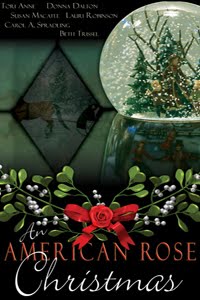
Blurb from A Warrior for Christmas: Reclaimed by his wealthy uncle, former Shawnee captive Corwin Whitfield finds life with his adopted people at an end and reluctantly enters the social world of 1764. His one aim is to run back to the colonial frontier at his first opportunity––until he meets Uncle Randolph’s ward, Dimity Scott.~
Excerpt:
December 1764, An estate outside Philadelphia
Blinking against wind-driven sleet, Corwin Whitfield followed the stout man through the front door of the massive stone house, far larger than he’d imagined. A dozen cabins or Indian lodges put together could fit inside and still leave ample room. With winter lashing at their heels, Uncle Randolph had pressed both man and beast hard to reach Whitfield Place before nightfall.
Icy pellets hit the door as his uncle shut the solid wooden barrier. Better than a skin flap, Corwin supposed. He was well accustomed to the wet and cold, but a fire would feel good. His gloved fingers were numb from riding over snowy roads all day, not to mention all the previous days. Puddles spread at his boots on the flagstone floor in the entryway.
 “Welcome home, Mister Whitfield.”
By the light of the small glass lamp on the stand inside the door, he saw a woman in an apron, severe skirts and gray shawl. The cap engulfed her pinched face. Inclining her head and curtsying, she said, “How was your journey, sir?”
“Wretched, Mistress Stokes.” Uncle Randolph waved a gloved hand at Corwin. “My nephew.” He swiped a paw at her. “My housekeeper,” he added by way of introduction. “Fifth cousin of my late wife’s, or some such connection.”

“Indeed.” Mistress Stokes curtsied to Corwin. “Welcome to Whitfield Place.”
He considered the etiquette drilled into him by his uncle and offered a brief nod. A bow didn’t seem required.
Uncle Randolph scowled. “Foul weather.”
She seemed unperturbed by his gruff manner. “Yes sir.”

“Bound to worsen. See to it the fires are built up.” Unbuttoning his brown caped coat, Uncle Randolph flung it onto the high-backed bench along one wall. He peeled off his gloves, tossing them and his tricorn onto the sodden heap.
Corwin did the same with his newly acquired garments. He couldn’t fault his uncle’s generosity, but the man had the temperament of an old he-bear.
Uncle Randolph ran thickened fingers over gray hair pulled back at his neck and tied with a black ribbon. “Where’s Miss Dimity keeping herself? Is she well?”
 Corwin detected a trace of anxiety in his tone.
The dour woman gave a nod. “Quite well, sir. She’s in the drawing room just after having her tea.”
“Good,” his uncle grunted. “Tell cook we’ll have our supper in there. Stew, pastries, and ale will serve. Don’t neglect the Madeira.”
Another curtsy and the housekeeper turned away to pad down a hall partly lit by sconces wrought of iron. His uncle frowned after her. “She’s a good body and keeps this place tidy but tends to be lax on the fires. We mustn’t risk Dimity taking ill. Delicate girl. Cold as a tomb in here.”

Corwin found Whitfield Place equally as welcoming as a grave. The chill was pervasive. A furlined wican would be warmer. He followed his uncle across the frigid entryway and through a wide double door. His relation paused just inside the spacious room and Corwin halted beside him.
“There she is,” Uncle Randolph said with the hint of a smile in his normally reluctant features. “My ward, Miss Dimity Scott. The little Quaker as I call her.”
Corwin thought it highly doubtful this staunch Anglican had taken in an actual Quaker. Looking past assorted tables, gilt-covered chairs and a gold couch, he spotted the feminine figure seated before the glowing hearth. A padded armchair the color of ripe berries hid much of her slender form.
His first impression was of fair curls, like corn silk, piled on her head beneath a circle of lace; his second, that the young woman bent over her embroidery seemed oblivious of all else.
One this unaware would never survive in the frontier. He’d been taught to move with the silence of a winged owl while observing all around him.
“Why does she not look up at our coming?”
“Ah, well, that’s a matter I’ve been meaning to discuss with you.”
The hesitancy in his uncle’s tone was unlike this man who knew his own mind and was swift to instruct others.
He squinted at Corwin with his good eye; the other perpetually squinted from an injury he’d received in a duel. “I trust you’ll not hold it against the poor girl as a sign of weakness, my boy. Warriors sometimes do and you’ve kept company with those savages far too long.”
It wasn’t like his uncle to ramble, and Corwin shifted impatiently upon hearing his adopted people disparaged again.
“What are you saying, Uncle?”
He rubbed his fingers over a chin grizzled with whiskers. “Dimity cannot hear us.”
“At all?”
“Not a sound, unfortunately. Though she is able to detect the vibrations of music. Odd, that.”
Like the beating of Indian drums. “Has she always been without hearing?”
****