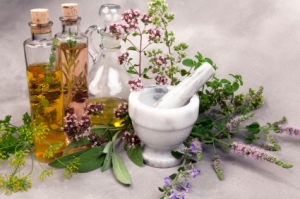
The Vinegar of the Four Thieves is a fascinating concoction, heavily embellished with legend, that supposedly warded off the bubonic plague.
I found this interesting snippet on a site that sells essential oils and herbs called Annie’s Remedy:
“Vinegar of the Four Thieves (Marseilles vinegar) There are many versions of this formula, which is often referenced in herbals dating from medieval times to the present. The French doctor Jean Valent including this one in his groundbreaking book on aromatherapy.
The story goes that this formula was revealed in the 17th century by four corpse-robbers caught red-handed during the time of the great plagues of Toulouse (1628-1631). Their disregard for the contagion thoroughly astonished the judges… The archives of the Parliament of Toulouse record that: “During the great plague, four robbers were convicted of going to the houses of plague-victims, strangling them in their beds and then looting their dwellings: for this they were condemned to be burned at the stake, and in order to have the sentence mitigated they revealed their secret preservative; after which they were hanged.”
***For the list of ingredients in the recipe and brewing instructions please visit the above link.
From a fascinating, far more in-depth article: Four Thieves Vinegar: Evolution of a Medieval medicine:

“The bubonic plague wreaked havoc in Europe off and on for about 600 years before peaking in the 1300s. Century after century, as late as the 1700s, outbreaks claimed up to half the population. The plague had a big influence on the life of William Shakespeare, having claimed the lives of some of his siblings as well as causing his theater to be shut down during several especially nasty outbreaks in London between 1593 and 1608.
It is well know that the bubonic plague is a bite-based infection. A lesser known fact is that there were many more victims than those bitten by fleas. It turns out that the bubonic plague was often the first step of a progressive series of illnesses. Two other types were pneumonia and septicemia. The resulting pneumonic plague was also very infectious and allowed person-to-person transmission.
This is the period of time responsible for the bizarre images of physicians wearing dark robes, wide-brimmed hats, and masks with long beaks. There was actually method to the madness. These beaks held dried herbs, spices and essential oils which the physician breathed. The robe was doused with a similar fragrant concoction. Scientific evidence today is building support for this seemingly outrageous behavior… many harmful microbes can’t survive in the presence of certain essential oils.
Meanwhile in France another interesting aromatic legend developed around a horrid sounding witch’s brew known as “Marseilles Vinegar” or “Four Thieves Vinegar.” A variety of recipes floated around. One recalled by Scientific American in 1910 included things like dried rosemary tops, dried sage flowers, fresh rue, camphor, “spirit,” garlic cloves and vinegar which was to be taken internally for 7 or 8 days “with occasional agitation.” It was said that this “medicated vinegar was invented by four thieves of Marseilles who successfully employed it as a prophylactic during a visitation of pestilence.”
And that, dear readers, may or may not account for the origins of this herbal concoction, but for more on this bizarre time period, herbal medicines, and disease prevention please refer to the above link.

I couldn’t make this stuff up if I tried. Strangely, or maybe not so strangely, the ultimate cure for the plague that killed masses of men, women, and children in England was the Great Fire of London. It cleaned up better than anything.
For a more in-depth look into that visit: The Great Plague and Fire of London