|
Gardening
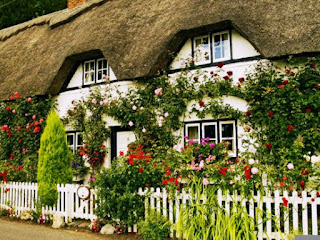
In midwinter my thoughts turn to gardening, of course. Ever wonder about the history behind these cherished plots of earth? Cottage gardens stretch back hundreds of years to the time when people used herbs for everything and grew most of their own food. These homey plots acquired their name from the country cottage around which they grew.
I love cottage gardens and strive to have my own. However, I live in a boxy white farm house, not a cottage, and our yard and gardens are rather sprawling for that overflowing, filled to the brim, in a compact sort of way look. Like mine, these small gardens are (and were) a mix of flowers, vegetables, and herbs. I strongly associate cottage gardens with the British Isles, because of our shared history and the influence of the Mother Country on the New World. But other countries have them too.
(Bee on catnip with our house in background)
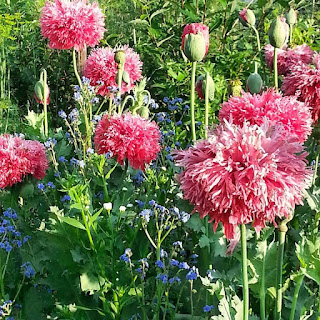
(Heirloom poppies)

"No two gardens are the same. No two days are the same in one garden." ~Hugh Johnson
People acquired the plants for their cottage gardens from friends and family in the form of ‘starts’ (root divisions) cuttings, and seeds. Very much as I do today, only I have the added benefit of seed catalogs. They are called passalong plants. Sometimes these gifts of plant starts to others have come back to me when my own died out. Thank heavens, I'm generous. If I gave any of you lupines, I would like some back now. :) I'm also a big fan of wildflowers.

(The front flower border in our garden)
Daughter Elise (my right arm in the garden) and I encourage beneficial insects to make their home among our plants. We are discovering which herbs and flowers, etc, are best for attracting pollinators, and we continually experiment with companion planting. It's as much a happy accident as intentional, but we grow a wide variety of flowers so that pollen sources are available throughout the growing season.
We've learned that heirloom, non hybrid flowers and vegetables are best for attracting butterflies, beneficial insects, and bees... As it turns out, these are the kind that make up traditional cottage gardens. Those new and improved varieties may look more attractive to us, but not to the pollinators. Butterflies give them a pass. Elise and I noted this with the 'Wave' petunias we got from a garden center. Not a single butterfly or bee paid any attention to those prolific blooms.
A few pics from our summer garden and our visitors.

(Painted Lady butterfly on Agastache flowers)
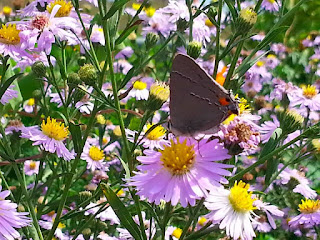
(Hairstreak butterfly on asters)
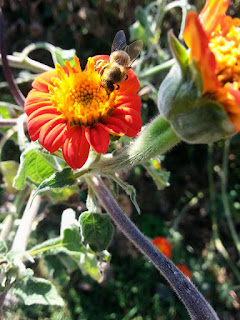
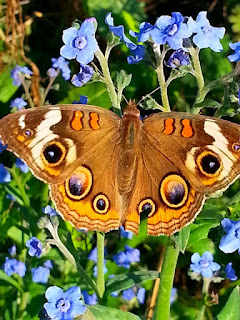
(Butterfly On Forget-Me-Nots)
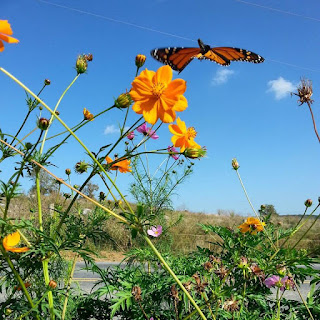
(Monarch visiting Bright Lights Cosmos)
Also, watch out for plants from garden centers that have been treated with systemic insecticides called neonicotinyl insecticides. You will unintentionally kill nectar seeking visitors with those flowers. For more on avoiding these killer flowers visit:
"It was such a pleasure to sink one's hands into the warm earth, to feel at one's fingertips the possibilities of the new season." ~Kate Morton, The Forgotten Garden
You can't go wrong with herbs.
|


This is a keeper!
m
The insidious insecticides in our garden center flowers might well be one of the things killing off our bee population.
I enjoy planting flowers from seeds. My husband and our oldest son built me a hothouse from old windows, and I so enjoy the growing of things in there. Right now the Christmas Cactus are in bloom there. I truly love nature, and gardens in general, although I'm getting to a point where I can't physically do all of the bending over and weed plucking that's involved in keeping up with my vegetables or flowers.
Thank you for the walk through your beautiful flower garden!
I have noticed that we have several, very beautiful garden center plants that don't attract pollinators at all. It is a shame because we really need all of those insects and birds to keep our environment continually evolving.
I'll never forget my brief stay on Victoria Island British Columbia in August. Cottage gardens there were aflame with color and seemed to decorate every household with their beauty. I would love, one day to get back there and see those gardens again.
Ron