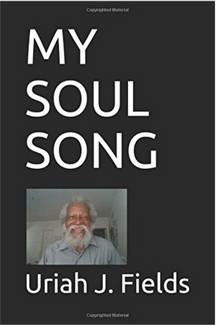
Fields was an outspoken, unconventional bootstrap leader, about Kng's age. He had worn a goatee since
his student days at Alabama State, which marked him as an outsider among the more image-conscious leaders.
(p.188). (From Parting the Waters: America in the King
years 1954-63" by Taylor Branch)
Taylor Branch's expression "more image-conscious leader." is underlined for emphasis. The focus however, is not on "more" but "less, "i.e., "less image-conscious," which this writer ascribes to himself as did Branch more than a half century ago. This he accepts as being one of his defining virtues..
Branch refers to the period when Uriah J. Fields was around his mid-twenties. This period spanned the 381-day Montgomery Bus Boycott and three years that preceded it, years when Fields was a college student, president of the student college council, a pastor and activist in Montgomery. This was also the period when Claudette Colvin was arrested for refusing to give her seat to a white bus rider. On May 6, 1955 Judge Eugene Carter found her guilty of violating Alabama's segregation laws and fined her ten dollars. Her pastor, Rev. H. H. Johnson and I were the only ministers present for her trial. Rev. Johnson was also my pastor and had a leading role in my ordination as a Baptist minister after I was called to pastor the Bell Street Baptist Church in Montgomery.
This was also the time that another writer, L. D. Reddick, in his book,"Crusader Without Violence: A Biography of Martin Luther King, Jr.," profiling Montgomery's leaders writes: "There was also the Rev. U. J. Fields, a shining comet that later somehow fell out of the obit. (p. 27). Referencing the trial that was held following the Grand Jury returning indictement against more than ninety MIA members under Alabama's anti-boycott law and Fields "Duces Tecum" summons "to bring and produce at the trial all minutes of meetings of the Montgomery Improvement Association" he writes, "The Rev. U. J. Fields, the secretary of the MIA, skirted the edge of contempt by his indirect evasive and at times impish answers to questions that the prosecution put to him." (p. 143).
On December 1, 1955 Rosa Parks was arrested for refusing to give her bus seat to a white man and on December 5, 1955, the first day of the Montgomery Bus Boycott and the day of Rosa Parks' trial, City Court Judge John B. Scott found her guilty of violating Alabama's segregation laws and fined her $10.00 and $4.00 court cost. This was the same day that African American leaders in Montgomery found the Montgomery Improvement Association (MIA)) for the purpose of providing organizational leadership to conduct the bus boycott. At the organizing meeting of the MIA Rev. Martin Luther King Jr., was elected president and Rev. Uriah J. Fields was elected recording secretary of the organization.
The aforementioned account of history provides the reader with some insight into the time and the person Uriah J. Fields who Branch writes this statement about, "...which marked him an outsider among the more "image-conscious leaders." This writer continues to consider his "less image-conscious" personality to be one of his cardinal virtues.
What follows is autobiographical and memoirish. It is about the perception I have of myself, although validated by many but misunderstood and unappreciated by others. Let me hasten to emphasize, however, that some people appreciated and encouraged me to be myself, nobody but myself, and expressed their desire to acquire the courage they recognized in me.
Come with me as I write about what some people perceived in me as idiosyncratic behavior and what I accept as normal behavior. No, I do not consider myself to be "a bird of the same flock" or any flock. I see myself as being unique. I have lived in conformity with this self-concept for more than a half century. I must confess, that at this juncture of my life I would not change anything. Frank Sinatra also speaks for me when he sings in "My Way" "...regrets I have had a few, but then again too few to mention." However, during my adult years there have been people, including some intimates, who more than suggested that I should change. Some people wanted me to cease and desist wearing a goatee or a beard during a time when it seemed that the only other person with a beard was Fidel Castro. I was even called, but not with affection, "Castro." I did not then or later heed their plea or relinquish my determination to be nobody but myself even though I am aware that to be nobody but yourself is the fight of a lifetime.
Of course, my unique behavior causes some people to see me as being weird, idiosyncratic or a deviant. Quite often, I sing while walking on my three or four mile early morning walk which I do four to six days a week, or when street walking, almost anywhere. I recall a few years ago, just three days before Christmas, while waiting at an airport to change airplanes a man having listened to me play my harmonica and singing and observing the positive responses people were extending to me, that included their applauses, gave me a $100.00 bill. Usually I do not accept money when playing my harmonica but I did on this occasion. I still have that $100.00 bill. While I play my harmonica and sing mostly for my own enjoyment, I delight in playing and singing for birds with the awareness that I am returning to them a favor. I also sing for other creatures such as squirrels and butterflies. I try to harmonize with their rhythms. These and other creatures have significantly impacted my life. Sometimes I hear a single bird singing with no other bird in sight. I stop and listen and learn how to be more spontaneous and express greater joy in my singning. It is this kind of behavior that Taylor Branch alludes to when he writes: " which marked him an outsider among the more image-conscious leaders." Or, as I put it, "less image-conscious." Suffice that I forgo citing other examples of my "less image-conscious behavior.
I have long since asked and answered this question to my satisfaction: "Has my "less image -conscious" way of being been personally advantageous and blessed other people?" The answer is affirmative which is evidenced in my having reaped a "less image-conscious" dividend. This way of being does not require me to be a role model but rather to be fully human. Ultimately I am responsibe only for myself and in the true sense to myself. All that jive talk we hear about being a role model is an illusion and counter-productive. A person should be encouraged to be himself/herself, not an imitation or duplicate of anyone else. Furthermore, it is easy for a would-be role model person to see himself as God or playing God having power that he does not possess. I have not had a role model person. The closest anyone ever came to be that person was my paternal grandfather who was born in slavery. Sixty-two years old when I was born, he lived until I was twenty years old. But he was not a role model. Indeed, i learned much from him.
Self-esteem, a sense of dignity and self-acceptance come from awareness and mindfulness of one's uniqueness and relationship with his Creator. "Stand inviolate of your uniqueness" is the key to personhood. Attempting to be like the greatest human being one may know can result only in being a mediocre person who falls short of his potential.
In the movie, "The Book of Eli, "Denzel Washington plays the role of Eli who is featured as a loner. He spends much of his time in silence. Eli reminds me of myself. I too am a loner or private person. But at times, I like to be with people and share my stories and talents with them and I have no problem in receiving from others. Am I an introvert or extrovert? Or, could it be that I am an ambivert. There is a wisdom of silence and a voice of silence. I sometimes refer to myself as a "Mutualtiy Warrior." In "The Mutuality Warrior's Song," I composed this is the response I make to the request of people who ask me to stay longer with them: " I share with them as best I can before moving on to be alone listening to life sing the song that says we are one. Yes, I can say, sweet is the journey on the Warrior's road and I wouldn't take anything for my journey."
The two things that can be said about my less image-conscious personality are: I am responsible and unpredictable. Of course, the latter can be disconcerting or disturbing for people who want to predict and hopefully prescribe another person's behavior. They may become uncomfortable when a person does not fit into a box. With these two qualities we can add the desire to be or behave appropriately. But whose appropriateness? must be a matter of discernment. Ultimately a person must consider for himself what is appropriate based on his responsible character and uniqueness.
Being less image-conscious allows me to be spontaneous much like other animals and creatures. This also means that I will go to nature more than I woud if I did not have this self-conception quality with the awareness that nature is my Source. As such I am benefited most when I embrace nature. Nature affords me with the greatest opportunity to be a self-actualizing person and to become reconciled with God and man.
Be aware and forewarned, if you observe me doing "my thing" in public that may appear to be off-beat, not what you expect of me, or a deviation from what you consider to be the norm, it is not because I am crazy, ignorant, unaware, irresponsible or unpatrotic. Without boasting or offering a defense I will take this opportunity to say that ounce for ounce and inch for inch of my full physical, mental and spiritual statures I will match my sanity, knoweldge, intelligence and wisdom with anyone who question my maturity or humanity. I will yoke with anyone. Wtih this invitation I am reminded of the invitation Adlai Stevenson extended more than a half century ago during his presidential election campaign when he said, "Now is the time for all eggheads to yoke together." It may be difficult for anyone to yoke with me or for me to yoke with anyone. It appears that yokes are for oxen, not human being who were created to soar with eagles and that means being alone most of the time.
This is the memoir of a "less image-conscious person who is alive...present and accounted for. I have a right to be here...to be myself, at this particular time and place.
Copyright 2010 by Uriah J. Fields