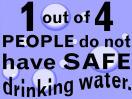
 Hmmmm? 1 out of 4. Not you, you say? What insures that you and I are NOT that ONE? Or the 100 out of 400 in a community? Or the 1,000 out of 4,000 in a rural town? Or the 10,000 out of 40,000, including the elderly and babies? Or a city with just under a half million people in it, and over 100,000 would be at risk? Even with bottled?
I volunteer in a hospital and people are there mostly for something they ingested (or shouldn't have) or for lack of the body being flushed with the right amount of water in the body. EXCELLENT water, not just good. Why?
Someone once coined a phrased "Good is the enemy of Best." How true . Water is not just some clear stuff that tastes like it left sand on your tongue. And mountain springs that blend with barley and hops turned sour don't count as water consumption at the "watering hole."
When it comes to city water and public fountains, anything can be floating in the water we give to ourselves, our kids, and our pets. And bottled water isn't much better. We teach people about a system that lets YOU regulate your own water safety and it's ranked number one in the world by the NSF (National Sanitation Foundation)
What convinced me was a nurse administrator who said, "You either HAVE a water filter, or you ARE a water filter." Just ask your liver and kidneys. There's is a thankless job that bites when things go wrong, i.e. stones, cancer, you name it, tap water is part of the problem
So for those who really care, what's cheaper? A state of the art system, or a hospital bill with medicines that you have to drink unfiltered hospital water to swallow when it was the water that puts you in the hospital in the FIRST place?
|













Safi
Carmen :-)
G