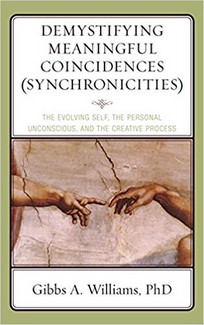
PREFACE: Meaningful Coincidence Book by Gibbs A Williams
Last edited: Wednesday, March 31, 2010
Posted: Wednesday, January 6, 2010
Introduction to G. Williams' book on coincidences.
Preface
Imagine you are attending a one trick magic show. As the performance ends you find yourself in a state of awe. “Now that you are dazzled,” says the magician, “I’ll either repeat the trick as often as you like, or I’ll show you how it’s done.” The choice is yours.
In recent years there has been an exploding interest in the topic of meaningful coincidences, often referred to as synchronicities (a term coined by Jung). Since the publication of Jung and Pauli’s seminal work on this topic: The Interpretation of Nature and the Psyche (1955),1 the Jungian perspective has had an almost complete monopoly with respect to the theoretical, interpretive, psychological, scientific, philosophical, occult, and spiritual implications concerning the nature and use of meaningful coincidences.
Synchronicities are associated with significant psychological change—transformation, transcendence, and an expansion of consciousness—occurring in sudden, unexpected, dramatically impactful ways.In this connection they involve the whole self both in terms of being and becoming. They are also associated with primary motivators including trust, hope, faith, intentionality, and persistence.
Jung and his followers emphasize the fact that most people initially experience meaningful coincidences in a state of awe, inducing a strong belief that they contain a coded message derived from some assumed mysterious ‘spiritual’ source transcending ordinary reality. These “messages” are believed to contain valuable information for the purpose of guiding individuals as they evolve spiritually during each person’s lifetime. Further, these messages are thought to be intuitively received—passively channeled—bypassing the conventional active process of generating meaningful cause and effect connections.
Whereas all synchronicities are different, at the same time they have a common structure. This structure consists of two halves: (a) a subjective inner reality event and an objective outer reality event A’ apparently uncaused but clearly connected by a felt sense of meaningfulness. It is this issue of rationally accounting for thenature of the nexus—that is the principle utilized to explain the nature of the connection between A and A’—that has—up to now—challenged and stumped investigators of these odd occurrences.
Central in his formulation about the nature of synchronicities is Jung’s elimination of conventional causality as an adequate explanatory principle. In so doing Jung is left with a two part “explanation” as to the process leading to the production of synchronistic events. This two part “explanation” is partly psychological and partly super or trans-natural. In so doing Jung challenges the primary assumption of conventional scientific causality, that is, that knowledge of external reality obeys knowable laws of cause and effect [psychic determinism]. Convinced that synchronistic events are rationally inexplicable, Jung (1955) provocatively concludes: “I doubt whether an exclusively psychological approach can do justice to the phenomena in question.”2 His challenging conclusion is a direct attack on Freud’s exclusively naturalistic theory of mind.
Jung’s anti rational conclusion is particularly striking in view of the fact that until their dramatic break in 1912 he was Freud’s heir apparent. Even more striking is the rarely discussed fact that their breakup had its beginnings in the context of a shared synchronicity in Freud’s study in 1909.3 Although initially deeply impressed by this mysterious event Freud later found a rational cause and effect explanation for that which Jung believed transcended reason. Alarmed by Jung’s immersion in the occult, Freud warned him not to get caught in the tide of “the black mud of occultism.”4 Jung, on the other hand, offended by Freud’s criticism, was convinced that the occult offered mankind a way to connect with transcendent spirituality, for him, a necessary task to experience a fulfilled life.
Adamantly convinced in their rightness of their respective positions, these two titans sparkeda theoretical (and personal) impasse. While Freud judged that Jung was losing his ability to think clearly, Jung judged Freud to be hyper rational. Note the explicit war of ideas between Jung—the advocate of faith versus Freud—the advocate of reason. Their de-facto war of ideas concerning the nature of synchronicities resurrected a philosophical dispute of long standing beginning with the arguments and counter arguments between Plato and Aristotle debating their differences as to the nature of reality and how we best attain and sustain true knowledge of it.
Their seemingly unbridgeable impasse led to a permanent rupture. The break with Freud also initiated a break down in Jung expressed as a “creative illness”5 resulting in the formulation of his original theory of “analytic therapy.” Central in the construction of his new theory was his lifelong preoccupation with the nature and use of meaningful coincidences.
Emerging from his illness, Jung was certain that he was on “the right path”—a path strewn with experiences of remarkable coincidences. Freud too was highly interested in these perplexing events but differed with Jung as to how to best account for them. Whereas Jung insisted that there must be a “spiritual” component transcending pure reason, Freud equally insisted that psychodynamic understanding alone—should ultimately provide a rational explanation. Counter attacking, Freud (1933) issued a simple but forceful, and, until now, unanswered question (undoubtedly directed towards Jung): “Is what the occultists tell us true or not?”6
Taking up Freud’s challenge, this book explores the nature of meaningful coincidences (synchronicities) and their practical use from an original, naturalistic, non supernatural, non Jungian perspective. My work is the outgrowth of forty years of research utilizing material derived from my thirty seven year journal and from the detailed session notes of some synchronicity prone patients in my psychoanalytic practice. My perspective gives these perplexing events—receiving relatively scant attention in the academic literature—fresh theoretical understanding and practical tools for decoding them for more effective self enhancement.
During this time I have gone through three distinct phases with respect to my experience of, reactions to, theories about, preoccupations with, and conclusions reached concerning synchronicities. Initially awed by what I refer to as my “Lazarus Rising” synchronicity I was unknowingly a de facto Jungian. If I had not changed so radically over my forty year study of this subject, remaining in the same state of “Jungian” consciousness as I was initially, I would never have written this book.
Before, and at the beginning of my psychoanalysis, I had a largely Jungian take on synchronicities, meaning I was preoccupied with thoughts, fantasies, and theories, concerning the possibility (wish?) that I was actually connected to a transcendent divinity receiving coded messages from an intelligent “spiritual source.” I was consumed with issues having to do with what I call at- one- ment consciousness. Thus I was preoccupied with concepts and experiences associated with merging, a desire for unity, unconditional acceptance, peace, love, avoidance of conflict, questing for perfection, and actively searching for absolute answers to ultimate questions.These questions included: Who am I and what do I really want, what is my life’s purpose and how do I access it. I compulsively looked to the outside for answers believing that this was the only location in which they might eventually be found. I actively sought out signs that divinity was real and concerned about my personal welfare.I entertained a partially conscious and partially unconscious wish to be saved.
Phase two coincided with the first few years of my psychoanalysis when I experienced a shift from an over reliance on passive intuition to active skepticism, a more Freudian approach in understanding myself. This shift occurred in the context of my developing an increasing capacity to think critically. Critical thinking enabled me to search for answers to my big questions by analyzing my psyche—returning to my developmental origins rather than seeking them via attempts to transcend my earthly experience reaching towards an assumed realm of absolute meaning. “. . . A significant attitudinal shift focused my search for the truth to realized knowledge gained from my personal struggles rather than passively waiting for revealed knowledge from some transcendent source of divinity characterized as “except ye see signs and wonders, ye will not believe.”7
I would characterize the sweep of my changing consciousness from one that was initially
“relatively reactive” to one which became “relatively reflective” as I made a slow but steady progression in growing a self-structure. In my attempts to objectify my own subjective experience, I found meaningful coincidences making seemingly important but mysterious contributions in my dedicated identity questing.
Bair (2003), quoting Jung, said: “synchronicity has been in existence since the beginning of
time, but it has no unifying origin, only appears sporadically, and does not progress
logically. In other words, nothing comes about because of any one thing; nor does one thing
lead directly to any other.”8 My investigation of these challenging phenomena demonstrates that there is in fact a remarkable experiential logic totally responsible for at least the kinds of synchronicities referred to in this book.
In this connection, finding myself unwilling to accept Jung’s dismissal of causality as “unthinkable” as an explanation of these events, I set out to study them scientifically. Aiding in this effort I was particularly impressed by Kuhn’s (1962) ground breaking monograph: “The Structure of Scientific Revolutions” who states: “Discovery commences with the awareness of anomalies, that is, with the recognition that nature has somehow violated the paradigm—induced expectations that govern normal science.”9 Observing that synchronicities fit Kuhn’s criteria to a tee, I have found it fruitful to classify a synchronicity as a scientific anomaly.
At this time I became interested in researching the psychodynamics of meaningful coincidences from a Freudian perspective. So, for example: I systematically began probing the primary assumptions and core organizing concepts associated with these odd occurrences hoping to find some hypothesized order associated with the production of these anomalous events. For example, while it is obvious that all synchronicities are different, it became clear that they all have a common structure. Further, as I had kept copious notes in my journal, I noted that when analyzed, synchronicities were seen to be embedded in specific situational and psychological contexts. In other words, knowing the contexts from which synchronicities spring, they could be studied scientifically—an impossible task according to Jung.
The third phase began near the end of my treatment which was associated with my discovery of the BritishSchool of Psychiatry namely, Guntrip and Winnicott.10These new concepts led to a major reorientation of my views about meaningful coincidences. Now, I thought of them as transitional experiences that signaled major markers in my attempts to gain (a) a solid identity, and (b) expanding consciousness. I became increasingly aware of the power of the creative possibilities of my own and others’ personal unconscious as a much more grounded guide than the vaguer symbolic guide of the collective unconscious stimulating archetypal images. I began to investigate the possibilities of two different logics (linear) and (durational) as a normal process in all humans; and, when viewed as overlapping (experiential logic) becoming fertile territory for the birth of these odd experiences. Since that time (4th phase), I have continued to explore and expand my ideas.
An immersion in the synchronicity literature indicates that the Jungian perspective raises more complicated questions than provides straight forward answers. Among these challenging questions are: if eliminating conventional causality as inadequate to explain the nature of meaningful coincidences is there an alternative conceptualization of causality that does adequately explain these occurrences? Are synchronicities created or discovered? What is the meaning of meaning? What is the relationship between causality and meaning? What is the meaning of spirituality?
With the self appointed task of researching these and other questions, armed with my increasing capacity to think critically, I began to look anew at the core organizing concepts associated with the Jungian understanding of synchronicities. Among these core concepts are conventional causality, meaning, meaning making, the transcendent function, a-causality, archetypal knowledge, the collective unconscious, and the likes.
Anticipating that the Freudians would deride his psychological/mystical/magical perspective, Jung formulated three anti-causal arguments. These are (1) The problem of rare and spontaneous events (an issue about method) (2) The Problem of Necessity and Relativity (an issue about meaning) and (3) A Problem of Simultaneity (an issue about time).11 My discovery of these seminal anti-casual arguments crystallized the focus of my research. Thus the core of my understanding of synchronicities is largely my refutation and the ensuing implications of these three anti-causal arguments.
As my own consciousness has changed (evolved?)so too has my perspective concerning my reactions to, explanations of, and conclusions about the nature and function of the core organizing concepts used by Jung to formulate his perspective of these perplexing events. In this connection, rather than attempting to offer a definitive explanation for how inner and outer events mysteriously conjoin resulting in a synchronicity, I focus exclusively on the psychology of the observer to adequately explain this process.
Utilizing a method I call contextual analysis, my personal synchronicities, and the synchronicities gathered in treatment sessions, are seen to be the exclusive outcome of a knowable complex psychodynamic process which is analyzable, thus scientifically explainable. In so doing, the nearly all prevailing Jungian part natural and part super natural interpretation of meaningful coincidences is demystified.
People, in general, are hungry for pertinent information that meaningfully connects with the complexity of their unique experience. My approach is a blue print for identifying, interpreting, and utilizing the coded information associated with synchronicities in ways that are both person specific and practically useful. It might aptly be said that this book is a map for aiding individuals to identify their life’s essential meanings, plus marking significant changes along their unique life’s journey.Additionally this perspective identifies an intimate connection with “spirituality” in the sense of making a felt connection with ones idiosyncratic creative process. This operational definition of spirituality is characterized by its being grounded and immanent rather than transcendent and mystical.
Because of the hunger for grounded good guidance this book may open up an appreciation for naturalistic creative possibilities equally as wondrous to human beings as are messages purportedly channeled from “the other side,” supposedly transmitted by angels, master teachers, and invisible archetypal influences.
An important implication of my work is that there is nothing mystical or divine about the origins of these anomalous events. While my analysis robs the “magic” associated with reacting to only the awe inspiring surface, it nevertheless affirms a wondrous appreciation for the creative capacities of each person to order his own internal and external chaos, potentially choosing to beam it in any direction he or she wishes.
I agree with Jung that these events are intimately connected to the unfolding of the self, but
the self he is referring to is assumed already preformed but forgotten at birth, whereas my conceptualization of the self is, agreeing with Jacobson, (1964) (and other self theorists)—initially an “undifferentiated matrix”13 that gradually evolves as the developing child learns to impose order on the random raw data of his or her internal and external reality. In this perspective, rather than viewing the “messages” associated with synchronicities as passively received (channeled) from some transcendent “spiritual” source of absolute meaning derived from the collective unconscious, I view them, instead, as self generated messages, the byproduct of a person’s idiosyncratic creative process whose origin is the personal unconscious, needing to be actively interpreted so to be able to fully utilize the rich information “hidden” in them.
A further result of my work is an expansion in understanding as to how human beings generate meaningful connections out of the seemingly random raw data of their individual and collective experiences whether synchronistic or not. In this connection,conventional scientific linear causality, relying exclusively on a play of ideas (linear logic), is expanded to include “messy” feelings, as well as the contribution made of such important but difficult to pin down mysterious “forces” including those of luck, chance, destiny, fate, karma, serendipity, and the likes. I call this hybrid logic—experiential (synthetic) logic.13
This book is for all those people who are fascinated in trying to rationally understand the nature of these strange experiences. If, they agree with my formulations, they will be helped to more fully appreciate the remarkable powers they have in jointly utilizing their conscious and personal unconscious for expanding their realistic powers of awareness. This expanded awareness is particularly useful in resolving fundamental problems with in-cohesive identities.
Thus these events may aptly be considered potentially rich material for an in—depth and in-breadth exploration of many patients’ core concerns, particularly those initially complaining of severe identity problems. It should be noted for those who have already attained a cohesive self these events are useful in accessing, freeing up, and directing their energies to goal oriented objectives. One does not need to be a psychoanalytic patient to greatly benefit from the findings of my work. However, being a patient does afford both the therapist and the patient a rich concentrated mine of compact experience with which to scientifically investigate the nature and use of meaningful coincidences.
This book will appeal to professionals (psychotherapists, counselors, scientists, artists), who may find the examination of the organizing concepts of: reality, knowing, meaning, process of meaning making, space, time, simultaneity, unconscious (personal and collective), consciousness, consciousness of consciousness, self, cohesive self, levels of psychological development, structural theory, cathexis, transitional space, transitional phenomena, logic and logics, overlapping logics, causality, a causality, principles ofquantum physics, and variants of causality and their interrelationships,—stimulating and thought provoking with respect to adding additional perspectives concerning the popular issue of a new paradigm for understanding the nature of ourselves and our relationship to the object world.
This book is also directed to those who find themselves mired in their psychological complexity having thus far failed in their attempts to find satisfying answers outside themselves. Thus, this book offers hope for those who yearn for change but lack the encouragement and psychological know how for doing so.
This work is divided into four main sections, following an introduction; part I looks at theoretical perspectives and consists of chapters 2–4; part II deals with theory construction (chapters 5–8); part III presents a new theory (chapter 9); and part IV looks at practical applications (chapter 10).
After providing in the preface a rational for writing yet another book on the nature and use of synchronicities, in chapter 1 I discuss the emotional power and intellectual challenge these perplexing phenomena present. In so doing I describe the phenomena, the associated awe response, and the implications of both, resulting in the efficacy of proposing an alternative naturalistic theory.
Chapter 2 details Jung’s personal and professional interest in meaningful coincidences. I describe a life-defining confrontation in Freud’s study in which Jung and Freud experienced a shared synchronicity, and recount Jung’s most significant coincidence, known as the Scarab synchronicity, along with some important implications of this event. I also explore Jung’s three anti-causal arguments to bolster his anti-rational account of synchronicities along with his provocative conclusion. Chapter 2 ends with an assertion that Jung’s understanding of the nature of synchronicities raises more questions than provides absolute answers.
In chapter 3 I summarize Jung’s three anti-causal arguments: (1) The problem of rare and spontaneous events; (2) the problem of necessity and relativity (meaning); and (3) the problem of simultaneity (time). Successfully refuting each of these anti causal arguments opens a pathway to constructing one or more naturalistic theories of synchronicities.
In chapter 4 I describe M. D. Faber’s naturalistic regressive synchronicity theories, identifying it as a good first attempt to demystify these perplexing anomalous events.
Chapters 5 through 8 detail my vicissitudes on the way to constructing my own naturalistic theory of synchronicities. Chapter 5 describes my initial fascination and curiosity about the phenomena and the challenges they present.
Chapter 6 describes my de facto Jungian position as I became immersed in studying various aspects of the esoteric occult.
Chapter 7 describes the influences of a marked shift towards a more Freudian perspective in my attempts to understand the nature and uses of synchronicities. In this connection I applied my new organizing concepts in understanding the nature of nineteen personal synchronicities I amassed over the course of eleven years noted in my journal.
In Chapter 8 I describe my growing conviction that my findings repeatedly confirm the validity of my new naturalistic progressive synchronicity theory.
In Chapter IX I offer a paper called: The Psychodynamics and Use of Meaningful Coincidents.
Chapter 10 is an application of my new synchronicity theory in understanding the nature and use of some synchronicity prone patients receiving psychotherapy in my private practice. Additionally I summarize my findings, list and discuss some relevant observations, suggest a guideline for others to decode their own and or their patient’s synchronicities, and discuss my conclusions.