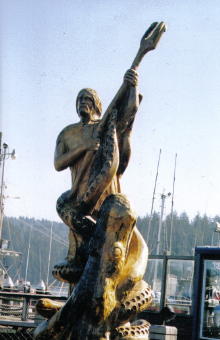
An excerpt from a book in progress on the folklore called Creatures in the Mist to be released in the Spring 2007.
Stories about mermen and mermaids can be traced back to ancient Babylonian mythology. Folklorist Horace Beck wrote “it is my belief that what we are dealing with when discussing…mermaids is really a fractured mythology—beliefs so old as possibly to reach back to Neolithic times, beliefs long since vanished into limbo, with only fragments remaining.” (1) Beck believes that the core myths of the mermaids have a northern European origin but I believe that they have a common origin that was “hard wired” in our minds as a species and not as geographical mythology. It would seem that a common religious and cultural tradition existed at one time in our ancient history; a tradition that still surfaces now and then in our mythology and folklore. Like the Faery, the legend of the mermaids may also come from this tradition.
The Native Americans had many legends of River Mermaids and the ancient Greeks had Eurynome, who was said to be the daughter of the God Oceanus. Eurynome was “a woman down to the buttocks and below that like a fish”. (2) Of Eurynome Brewster wrote she “was most probably a local river nymph with the body like a mermaid’s.” (3)
Mermaids, nymphs and water spirits may be survival tales of the sea Goddesses. Through time, the original stories became more and more elaborate and took on a flavor of their own from the people who passed the stories on. Folklorist Shahrukh Husain, in her book The Goddess, wrote, “the sea goddess survives in a debased form as water-sprites, sirens or mermaids. Probably the first mermaids were images of the fish-tailed Aphrodite—they are famously able to seduce men away from the land, and draw them down to their underwater kingdom. A reminder of their lost divinity lies in the tales of a mermaid….receiving the souls of drowned men.” (4)
Part of the fascination we have with Mermaids is their beauty and the danger associated with them. Legends of sailors capturing these creatures for a short time or living with them longer as husband and wife are interspersed with other stories with more dire results. Fiske noted “it has been a common superstition among sailors, that the appearance of a mermaid, with her hair comb and looking-glass, foretokens shipwreck, with the loss of all on board.” (5)
The Benin people of Nigeria also speak of mermaids. In Benin folklore the River Goddess Igbaghon ruled the underworld, which was below the water. She was waited upon by mermaids who informed her of trespassers who went to the river to wash or to fetch water—they never returned from their tasks. (6)
South African anthropologist Penny Bernard, who has studied water spirit lore and traditions in that part of the world, has found that many of the traits of the Native American river mermaids also exist in South African tribal beliefs. These water spirits are referred to as the “River People” and are believed to live in certain deep pools of water, especially below waterfalls. Bernard notes “some informants say they are fair skinned, with long dark hair, are naked and some have half-human, half-fish physical attributes (mermaid like).” (7) She also reports that these creatures only live in “living water”—that is water that is flowing in rivers, the ocean or waterfalls. Some, however, are also reported to reside in wells in Zimbabwe. Normally this tradition is only found in the more arid areas of Africa.
Water spirits cannot simply be dismissed as metaphors. The almost universal application of human-like characteristics and supra-natural powers, like those of the Faeries, demands a broader approach. At least through the 19th century the people of Christian Norway left offerings to water spirits every Christmas Day. The following account appeared in the December 17, 1859 issue of the British journal, Notes & Queries:
“…a fisherman wished on Christmas Day to give the Spirit of the Waters a cake; but when he came to the shore, lo! the waters were frozen over. Unwilling to leave his offering upon the ice, and so to give the Spirit the trouble of breaking the ice to obtain it, the fisherman took a pickaxe, and set to work to break a hole in the ice. In spite of all his labour he was only able to make a very small hole, not nearly large enough for him to put the cake through. Having laid the cake on the ice, while he thought what was best to be done, suddenly a very tiny little hand as white as snow was stretched through the hole, which seizing the cake and crumpling it up together, withdrew with it. Ever since that time the cakes have been so small that the Water Spirits have had no trouble with them.”
In the folklore of Tobago the mer-people are always male and live in the deep sea but they mate with “fairymaids” that live in the rivers and “secret mountain pools”. These fairymaids are described as beautiful with long lush hair and one foot shaped like a deer’s hoof. The fairymaid are said to live in caves behind waterfalls, near waterwheels and under bridges over deep rivers. The fairymaids of Tobogo appear to have many similar traits to the river mermaids of American Indian lore.
According to Beck, mermaids and Faeries may have a common origin. Mermaids “seem to be related to the Celtic faeries through their coloring, the name—Marie Morgane—and their underwater cities, love of music and ability to grant gifts.” (8)
Mysterious water creatures have been reported throughout the world’s folklore for hundreds and thousands of years. Like the Faery, these creatures also have almost universal characteristics and descriptions. California Miwok Indians called these creatures He-Há-Pe, or “River Mermaids” and described them as “beautiful fish-women [that] had long black hair and lived in deep pools and rivers”. (9) The Northern California Yana called these spirits hat-en-na or “water grizzlies” and described them as creatures with white and black spots. Other California tribes referred to these creatures as “Water Women” in their mythology. Called He-Há-Pe, these beautiful fish-women had long black hair and lived in deep pools and rivers. The “River Mermaids” reportedly pulled victims to their deaths in these deep waters. (10)
Cherokee mythology places this creature at the bottom of deep rivers where they await the chance to sneak out to find someone, preferably children, asleep. They then “shoot him with their invisible arrows and carry the dead body down under water to feast upon it.” (11) Like the elves, they leave a changeling, or “shade” in the individuals place, which acts like a human but withers and dies within seven days.
Nineteenth-century writer S. Baring-Gould reported several instances of supposed mer-people being caught. One such instance was the capture of a “Marmennill” or merman off the Icelandic island of Grimsey in the early 14th century, one also reportedly washed up on the beaches of Suffolk in 1187. (12) Baring-Gould notes other cases as well of mermen not only being seen but caught in 1305 and 1329 off Iceland, 1430 in Holland, 1531 in the Baltic, 1560 on an island west of Ceylon, and 1714 in the West Indies.
The 1560 incident, according to Baring-Gould, occurred near the island of Mandar. It was here that “some fishermen entrapped in their net seven mermen and mermaids, of which several Jesuits, and Father Henriques, and Bosquez, physician to the Viceroy of Goa, were witnesses. The physician examined them with a great deal of care, and dissected them. He asserts that the internal and external structure resembled that of human beings.” (13) Baring-Gould gives several other accounts of mer-folk being captured and examined by sailors and other people from Ceylon, Holland and the Shetland Islands.
According to Angelo Rappoport, “The sacred wells are a very favourite place with the fair children of the sea. Here, undisturbed by men, the green-haired beauties of the ocean lay aside their garb and revel in the clear moonlight.” (14) There are very few sacred wells at the ocean however, and Rappaport does not say how they journey to these places.
A South African anthropologist wrote of the African version of the mermaid referred to as “river people”:
“With regard to the appearance of the water spirits some informants say they are fair skinned, with long dark hair, are naked and some have half-human, half-fish physical attributes (mermaid like).” (15)
In Zulu lore mermaids would, at times, possess mediums and give them healing powers. They were also believed to come out of the waters at night, causing humans to avoid rivers and the ocean after nightfall.
Among both American Indian and African beliefs is that the River Mermaids and the River People must be treated with respect and fear—for both of these creatures would often lure unsuspecting individuals to their deaths or to live the remainder of their lives under water. This fear is universal among the world’s indigenous peoples. Among the Udmurt people of Estonia, water spirits would drown those humans who swam at the wrong time or swam without wearing a crucifix. (16)
The Pascagoula Indians of Louisiana not only respected the mermaid—they worshipped one. According to E. Randall Floyd, “legend has it that an entire…tribe—the Biloxi, also known as the Pascagoula—marched into a raging river at the command of a mermaid-like sea-goddess and drowned.” (17) This happened, according to legend, in the 1500’s. It was said that within a week after a white priest appeared to them, commanding them to “abandon their superstitions in an underwater goddess”, they disappeared in the waters of the Pascagoula River.
Some Native American lore states that a merman actually was responsible for their arrival on American shores. According to Rappoport, such a creature led the ancestors of modern Indians from Asia to America when he took pity on them one day when they were suffering from hunger. “Following the fish-man” Rappoport wrote, “they ultimately reached the American coast.” (18) The merman was described as having green hair and beard, a forked tail and a face shaped like a porpoise. This creature, according to Baring-Gould, appeared suddenly one day “in the season of opening buds”. “The people of our nation,” so says the legend, “were much terrified at seeing a strange creature, much resembling a man, riding upon the waves. …But if our people were frightened at seeing a man who could live in the water like a fish or a duck, how much more were they frightened when they saw that from his breast down he was actually a fish, or rather two fishes, for each of his legs was a whole and distinct fish.” (19)
Contemporary accounts of mermaid sightings read like daily news reports. Explorer Henry Hudson, on one of his attempts to open the Northwest Passage, wrote of one such event:
“This evening [June 15] one of our company, looking overboard, saw a mermaid, and, calling up some of the company to see her, one more of the crew came up, and by that time she was come close to the ship’s side, looking earnestly on the men. A little after a sea came and overturned her. From the navel upward, her back and breasts were like a woman’s, as they say that saw her; her body as big as one of us. Her skin very white, and long hair hanging down behind, of colour black. In her going down they saw her tail, which was like the tail of a porpoise, speckled like a mackerel.” (20)
A fearsome water creature called the Näkki is said to live in some of the rivers, springs and wells of Finland and, like the Water Monster and River Mermaids of North America and the Water Horse of Scotland, attempts to coax people, especially children, to their deaths. Described as a creature that looks like a man, naked with long hair and beard, he also may shape-change into an animal form—frequently a horse. Frequenting the shoreline of various bodies of water, the Näkki allows children to climb on his back and then plunge into the depths of the water to drown them. Other Finnish water creatures are the Vedenhaltia considered a “squatter of lakes, rivers or springs” and is mostly harmless unless you mock it. This creature also looks like a naked man with long dark hair. He is mostly seen sitting or standing in the water and either washing or combing its long hair. (21)
A water monster, described as a “giant leech”, is said by the Cherokee to have lived in a deep hole in Valley River, in North Carolina. Mooney records the story:
“Just above the junction (of the river) is a deep hole…and above it is a ledge of rock running across the stream, over which people used to go on a bridge. …One day some men going along the trail saw a great red object, full as large as a house, lying on the rock ledge in the middle of the stream below them. As they stood wondering what it could be they saw it unroll—and then they knew it was alive—and stretch itself out along the rock until it looked like a great leech with red and white stripes along its body. …at last (it) crawled down the rock and was out of sight in the deep water. The water began to boil and foam, and a great column of white spray was thrown high in the air and came down like a waterspout upon the very spot where the men had been standing, and would have swept them all into the water but that they say saw it in time and ran from the place.” (22) Legend says that many people lost their lives on this bridge and their bodies were later found with parts of their faces eaten off.
American Indian mythology is full of accounts of “enchanted lakes”, “water monsters” and “water gods”. Many of these myths are very similar to other stories around the world with comparable themes. “Water monsters” are part of Native American mythology from California to the Carolinas. Ethnologist James Mooney wrote of water monsters in Cherokee lore on the Tuckasegee River in Jackson County and in Madison County on the French Broad River, 6 miles above Warm Springs, and on the Little Tennessee River between Graham and Swain counties, all in North Carolina.
Among the Plains Indians a “water dragon” was said to rise up from a lake to destroy his enemy’s children while the parents were away. A skilled hunter killed the dragon by throwing red-hot stones into its mouth. This mythic theme of a battle between water and fire is common from the Dakotas to British Columbia.
The Water Monster was a feared supernatural creature said to eat both horse and rider if they got too close to the Water Monster’s lair. Likewise the Water Horse, a Faery being of Scotland and the Hebrides, would lay in wait in the form of a beautiful horse, sometimes even with saddle and bridle, for unsuspecting pedestrians. Should a weary traveler come across the magnificent animal and mount it to finish his journey it may be finished in a way not to his expectations. For once in the saddle, the beasts would run off and drag the hapless traveler to the depths of a lake or river where he would be devoured. The Water Horse was also known in Wales by the name glashtyn. It was described as “a goblin of the shape and appearance of a small horse or yearling foal in his rough, unkempt coat.” (23) The Water Horse was said to “beguile lonely travelers with his numberless tricks, one of which is to lure them to a stream, swamp, or water-hole. When he has succeeded he vanishes with a long outburst of mockery, half neigh, half human laughter.” (24)
According to Schoolcraft, the Faery of the Algonquin “comprise two classes, into which they are divided according as the location of their haunts is either on the land, or in the water. The favorite residence of their land fairies is the vicinity of promontories and water-falls, and in solemn groves. Besides furnishing a habitation for its appropriate class of fairies, the water is supposed to be the residence of an animal called nibau-auba, which has its counterpart, except as to sex, in the mermaid. The Indian word indicates a male.” (25)
As previously noted, American Indian legend is full of water-beings such as the Water Babies of the west. In Mexico, such creatures were called “Wachoqs” and were described as little people who lived in streams and lakes who had the ability to walk underwater.
More nature spirits than Faery, the Australian Aborigines have myths of water-spirits, also referred to as “Good Spirits”, who reside in streams and other water sources. Smith reports that these water spirits “dwell in the form of tiny bubbles that cling closely together in the limpid pools and make the surface look as white as snow.” (26)
NOTES
1. Beck, Horace. Folklore and the Sea. Mystic: Mystic Seaport Museum Incorporated 1973, 266
2. Brewster, Harry. The River Gods of Greece: Myths and Mountain Waters in the Hellenic World. London: I.B. Tauris & Co. Ltd. 1997, 97
3. Ibid.
4. Husain, Shahrukh. The Goddess. Alexandria: Time-Life Books 1997, 51
5. Fiske, John. Myths and Myth-Makers: Old Tales and Superstitions Interpreted by Comparative Mythology. Petersham, 1872
6. Osoba, Funmi. Benin Folklore: A Collection of Classic Folktales and Legends. London: Hadada Books 1993, 40
7. Bernard, Penny. “Mermaids, Snakes and the Spirits of the Water in Southern Africa: Implications for River Health”, lecture given in Shortcourse on the Role and Use of Aquatic Biomonitoring. Rhodes University, Grahamstown, South Africa, 2000.
8. Beck, Op cit., 265
9. Varner, Gary R. Sacred Wells: A Study in the History, Meaning, and Mythology of Holy Wells & Waters. Baltimore: Publish America 2002, 129
10. Merriam, C. Hart. editor, The Dawn of the World: Myths and Tales of the Miwok Indians of California, University of Nebraska Press, Lincoln 1993, pg. 228-230
11. Mooney, James, Myths of the Cherokee. New York: Dover Publications 1995, 349. A reprint of the 1900 publication “Nineteenth Annual Report of the Bureau of American Ethnology, 1897-98
12. Baring-Gould, S. Curious Myths of the Middle Ages. New York: John B. Alden, Publishers 1885, 205
13. Ibid, 227
14. Rappoport, Angelo. The Sea: Myths and Legends. London: Senate 1995, 184. A reprint of the 1928 edition published by Stanley Paul & Company, London. Originally titled Superstitions of Sailors.
15. Bernard, op cit., 7
16. Lintrop, Aado. “On the Udmurt Water Spirit and the Formation of the Concept ‘Holy” Among Permian Peoples” in Folklore, Vol. 26, April 2004, 9. Published by the Folk Belief & Media Group of the Estonian Literary Museum, Tartu.
17. Floyd, E. Randall. Great Southern Mysteries. Little Rock: August House Publishers 1989, 118
18. Rappoport, op cit., 165
19. Baring-Gould, op cit.,222
20. As quoted by Richard Carrington in “The Natural History of the Mermaid”, in Horizon, January, 1960, Vol. II, Number 3, 131
21. Varner, Gary R. Water of Life Water of Death: The Folklore and Mythology of Sacred Waters. Baltimore: Publish America 2004, 104
22. Mooney, op cit., 404-406.
23. Rhys, John. Celtic Folklore: Welsh and Manx. New York: Gordon Press 1974, 324. A reprint of the 1901 edition published in Oxford. Lewis Spence agrees with Rhys’ description of the water horse but also states that it “had the power of transforming its shape, and could appear as a young man or a boy, or even at times as an inanimate object.” (The Magic Arts in Celtic Britain, 94. Published by Dover Publications, Mineola, New York. A republication of the Rider & Company edition, n.d., London)
24. Ibid
25. Schoolcraft, Henry Rowe. History of the Indian Tribes of the United States: Their Present Condition and Prospects, and a Sketch of their Ancient Status. Philadelphia: J. B. Lippincott & Co. 1857, 662
26. Smith, William Ramsay. Aborigine Myths and Legends. London: Senate 1996, 112. A reprint of the 1930 edition, Myths & Legends of the Australian Aborigines published by George G. Harrap, London.
|


Bill