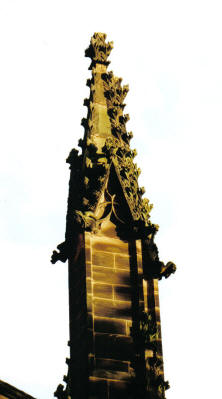
A second excerpt from the book now available, "Strangely Wrought Creatures of Life and Death" by Gary R. Varner.
Gargoyles and grotesques are found around the world. In many of California’s missions the friars created lavanderias, or open air laundry areas that were used not only for washing clothes but also for bathing. At California’s largest and richest mission, Mission San Luis Rey located today in northern San Diego County; water from the San Luis Rey River was diverted into channels and poured out of the mouths of “gargoyles” carved into walls. It is unknown if these grotesque images added to or minimized the Indian’s ritual use of water. Constructed in 1798 with the use of forced Indian labor, it is also unknown if the Franciscan friars or the Indians carved these gargoyles, but undoubtedly the concept was one brought to Old California from the Old World. It is interesting to note that the San Luis Rey gargoyles are very similar to those excavated at Mount Auxois, France that date to 160 AD.
Some have theorized that these images were placed on ecclesiastical structures to protect them, to act as magical “stop” signs to repel Satan and his minions, or as “spiritual scarecrows”. Others take the opposite view, stating that gargoyles were made as ugly as possible to actually represent evil. In this way, parishioners were made to feel safer once they entered the church—knowing that evil and danger lurked outside the sanctified walls of the church.
The stone masons had not used the image of the devil in religious sculpture until the middle of the tenth century. As the year 1000 approached, however, it suddenly became a worry of everyone that the world may come to an end with Christ’s return as foretold in the Bible. “In consequence of this state of fearful anticipation,” wrote Evans, “we find the devil and his acolytes making their appearance in the latter half of the tenth and the beginning of the eleventh century on the capitals and friezes, the doorways and pediments of churches, frequently as human monsters with jagged wings and forked tails, or that hideous abortion of an affrighted imagination, the dragon. The object of such creations was to exert a religious influence by inspiring terror.” (1)
Evans remarks may very well give us a good foundation as to why and how the gargoyles and grotesques were created—they were part of the churches campaign to ensure that the parishioners lived in utter terror of the End of Days. How better to enforce church attendance and docility than by providing a daily reminder of the horrors to come.
However, Evans goes on, as the millennium came and went without the end of the world the gargoyles and grotesques took on a different form. By the 15th century they became, as Evans says, “far more comical than terrible…They are devils who are fallen into dotage and visible decay, and with whom the artist can take all sorts of liberties, turning them into clowns and buffoons for the amusement of the populace.” (2)
Some of the most common attributes of both gargoyle and grotesque are horns and cloven hoofs. Many Green Man images in North America contain either the curved horns of the ram or the straight horns so often associated with Satan. These characteristics are part of a far older religious tradition, pre-dating Christianity by thousands of years. These horned gods were worshipped to ensure prosperity and fertility. Fertile fields, herds, as well as human fertility were fragile things that must continue to ensure the survival of the human species. Pan, Faunus, Cernunnos and other gods of fertility are perhaps the oldest of humankinds deities. The Christian church did all that it could do to either destroy the time honored traditions and rituals that focused on these gods or to assimilate them into the Christian iconography. Pan, Faunus and Cernunnos became images of the Devil and their forms were taken from pagan temples to decorate early Christian structures. Over time, their images became part of Christian symbolism but they retained their dual natures, representing the pagan way of life and belief as well as the Christian warning for demons and the consequences of sin.
The Church embraced these pagan images but only as a way to instruct the people that the old ways were evil and must be thrown off if salvation was to be obtained. In so doing, the Church ensured that the gargoyle and grotesque would survive and continue to exist in their dual nature.
NOTES
1. Evans, E.P. Animal Symbolism in Ecclesiastical Architecture. London: W. Heinemann 1896, 333-334.
2. Ibid., 334.

|



Ted