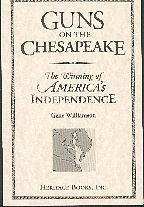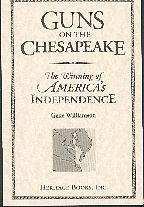
From the Introduction to GUNS ON THE CHESAPEAKE. The Revolutionary War was fought up and down the Atlantic seaboard of the newly declared United States. Thirteen states contributed to the making of a new nation. None more than the two situated on Chesapeake Bay.
The small Virginia port town lay exposed to the hostile warships patrolling the lower Chesapeake. The townspeople had sunk several small vessels in the channel of their shallow river to block an attack from the bay. On the morning of October 24, 1775, cannons signaled the approach of a heavily armed British schooner, a sloop, and three tenders carrying marines. Under orders from Lord Dunmore, Virginia's royal governor, the British commander threatened to burn the town. The threat was prologue to the first naval engagment of the Revolutionary War.
...Chesapeake warriors fought on the seas off the West Indies and as far away as the British Isles. They experienced early victory at Saratoga, served with George Washington's Continentals in defense of Boston, in the fight for Long Island and the battles at White Plains, Brandywine, Germantown, Trenton, Princeton, and Monmouth, the bayonet charge at the Cowpens and the siege at Savannah, the struggles at Hobkirk Hill and Eutaw Springs, the fall of Charleston and the battle that forced the British surrender at Yorktown. Bay families were honored by the spirit and valor of the Maryland Line, a famous regiment of Continental troops easily recognized by their blue jackets faced with red, and by the number of proud Virginia regiments, some in plain uniforms of green and black, others rigged out in blue coats cuffed and faced with yellow.
...No other part of America endured more hardship or suffering. The region was crisscrossed with rivers and streams and their uncountable tributaries. Most Marylanders and Virginians lived near these waterways, depending on them for their livelihoods and their chief mode of transportation. Richard Oswald underscored the commercial value of the Chesapeake area when he declared that the means of carrying on trade was "no where, in all America, so abundant as round the whole Coasts of that Bay, there not being perhaps a more plentiful district of Country upon Earth."
By the time the colonies announced their independence in 1776, Chesapeake Bay, "a colonial avenue of trade, had become an avenue of war," wrote Jean B. Lee.
That avenue led to a new nation.
GUNS ON THE CHESAPEAKE
Copyright 1998 by Gene Williamson
Published by Heritage Books Inc.
ESBN 0-7884-0962-X
|