As Monroe communities face rapid growth, the politics of local land use planning becomes critical to water quality protection. One of the most important things we can do is to elect decision-makers that spend tax payers money wisely, prevent unnecessary sprawl, increase stream bank buffers to 50 feet, ensure water quality and an adequate water supply.
Our water is more precious than oil and gold. Humankind cannot survive without clean water.
Monroe County is a huge watershed for the Ocmulgee River. Every creek, stream and river in the county flows into the Ocmulgee River and each has its own watershed.
Rocky Creek’s 6.9 square mile watershed supplied the City of Forsyth with water for 28 years until its water table dropped. The Russellville Water Treatment Plant on Tobesofkee Creek’s 12 square mile watershed has been Forsyth’s sole water source since 2001. (My previous watershed estimates were incorrect).
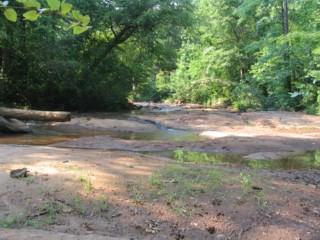
Bud, my husband, and I believe the drought, the elevation, the size and inadequate protection caused the lowering of Rocky Creek’s water table. The springs of Rocky Creek’s headwaters are low because there is little shade on the mostly pasture and open land and more homes tapped into the aquifer for well water.
As rooftops, roads, parking lots and driveways replace forest and vegetated areas creeks can no longer replenish themselves during a drought. Instead of slowly infiltrating the soil to recharge the groundwater, storm water runoff rushes downstream to flood low lying areas.
The water runoff bears fuel, oil, fertilizer and pesticides. The dirtier the source of the water, the more chance of poisoning at the tap. Bacteria, viruses and other parasites are removed. But chemical pollutants are removed at a much lower rate.
The ground water that makes up 91% of the rural drinking water is extremely important to the life and health of Monroe County’s citizens. Billions of dollars could be lost and the health of the people compromised if Monroe’s ground water remains unprotected.
As Monroe communities face rapid growth, the politics of local land use planning becomes critical to water quality protection. One of the most important things we can do is to elect decision-makers that spend tax payers money wisely, prevent unnecessary sprawl, increase stream bank buffers to 50 feet, ensure water quality and an adequate water supply.
Wise elected officials protect our watersheds. They respect and enforce the Clean Water Protection Act. Unfortunately, local politicians interfered with the enforcement of the Clean Water Act when they stopped the Environment Protection Agency (EPD) from fining a local developer $50,000 for causing sediment in the Little Towaliga River.
Wise elected officials would consult with the EPD and other experts on watersheds and permitting before spending 1.2 million of taxpayers money to refurbish the water treatment plant on a creek with major silt and water flow problems.
Since Rocky Creek no longer runs year round the 1.2 million needed to refurbish the water treatment plant could be better utilized on the Towaliga River’s large 67.7 square mile watershed. The city and county could also combine the water from Tobesofkee Creek and the Ocmulgee River. Both watersheds are much larger and flow year round.
Wise elected officials would stop promoting unnecessary sprawl, turning forest land, agriculture and greenspace into industrial, office and shopping centers where almost 100% of the water cannot infiltrate the soil and replenish the aquifers.
They would not clear trees for a new shopping center when the owner of the existing one is eager to sell.
Wise elected officials would care about a public-private partnership to save trees. Trees slow the flow of storm water, lower the total runoff volume and reduce the risk of catastrophic flooding. Trees retain the excess phosphates and nitrates, pollutants found in the runoff. Trees measure the health of a community. When we loose a tree we loose a climate regulator, an oxygen producer, an erosion and flood controller and a habitat and water shed protector. These services are free of charge, without them these functions must be provided by the government.
Citizens can join a number of watershed watch groups to work towards ensuring that Monroe County’s water is managed fairly and that there is enough clean water today and for future generations.
|